
Platform-Specific Content Guide: What Works
Format, length, and tone guidance for Instagram, LinkedIn, X, TikTok, and more, with examples of posts that actually performed.
Prefer posterly in Google Search?
Platform-Specific Content: What Works on Each Network
Recycling content across platforms doesn’t work. Why? Every platform has unique algorithms, audience habits, and formats that demand tailored posts. In 2026, creating content that fits each platform is key to boosting engagement and reach. Here’s what works:
- Instagram: Reels drive discovery (30-33% reach), while Carousels spark the highest engagement (6.9% rate). Stories excel at conversions, with 50% of users visiting a website after viewing.
- LinkedIn: Document Carousels dominate with a 21.77% engagement rate - 196% higher than videos. Native videos under 2 minutes are growing in reach and engagement.
- YouTube: Shorts attract new viewers with high views, while long-form content (7-15 minutes) builds loyalty and revenue.
Key takeaway: Tailor your content. For example, a LinkedIn post can become an Instagram Carousel or a YouTube Short. Tools like posterly simplify this process, saving time and ensuring posts are optimized for each platform.
Quick Comparison:
| Platform | Best Format for Engagement | Median Engagement Rate | Best Format for Reach | Organic Reach Rate |
|---|---|---|---|---|
| Carousels | 6.9% | Reels | 30-33% | |
| Document Carousels | 21.77% | Native Video | 5-8% | |
| YouTube | Shorts | 5.91% | Shorts | High |
The secret to success? Focus on platform-specific strategies and consistent posting to maximize engagement and reach.
::: @figure 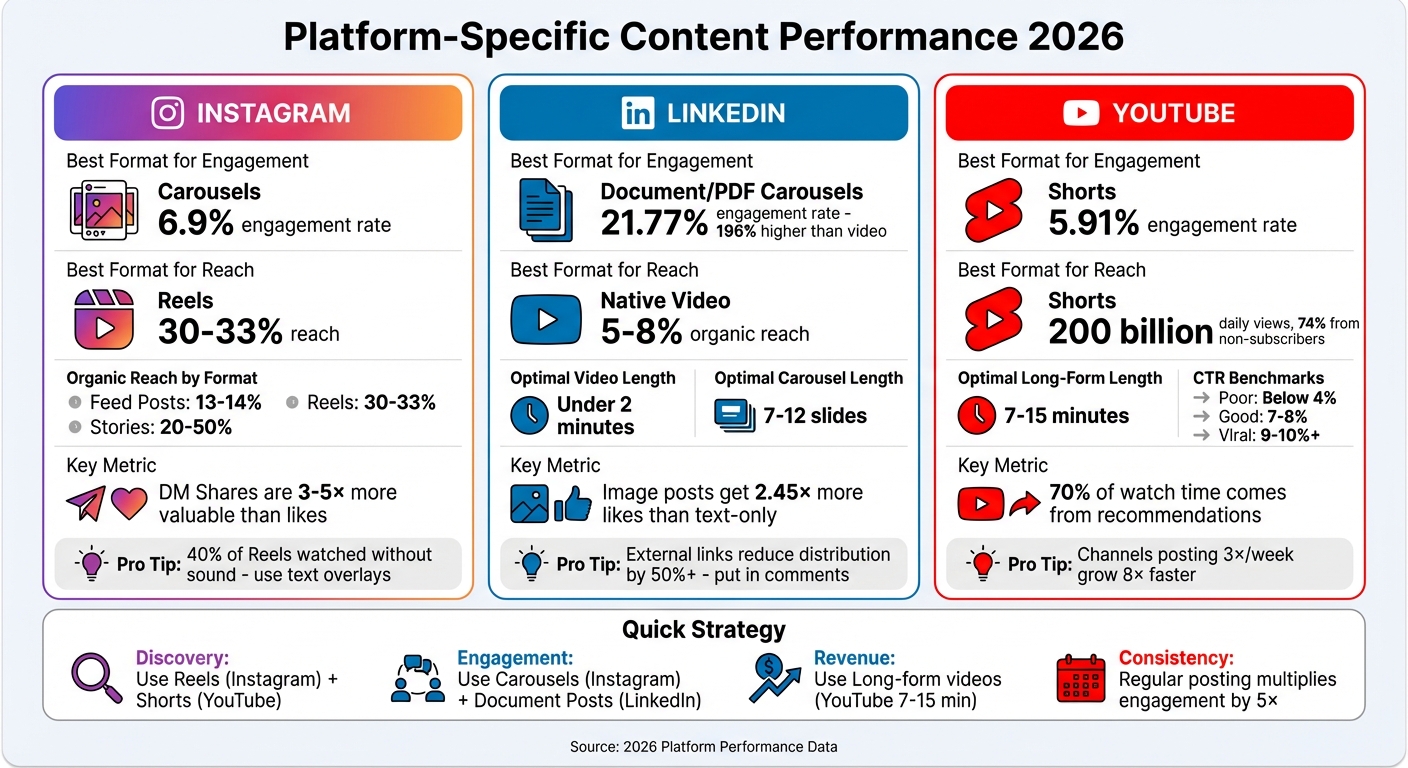 {Platform-Specific Content Performance: Instagram vs LinkedIn vs YouTube Comparison}
:::
{Platform-Specific Content Performance: Instagram vs LinkedIn vs YouTube Comparison}
:::
1. Instagram
Content Format Performance
Instagram’s content formats have distinct purposes: Reels boost discovery, Carousels spark engagement, and Stories drive conversions. Reels are the platform’s discovery powerhouse, reaching 30-33% of your audience - including non-followers - and are designed for viral reach. In fact, they can reach 2.25× more people than single-image posts [5][2]. However, their median engagement rate is 3.3%, which pales in comparison to Carousels, which hit a 6.9% engagement rate - nearly double the interaction for the same effort [5].
Carousels are particularly effective for educational or step-by-step content, as they generate the highest save rates and foster meaningful interactions [5][1]. Meanwhile, static feed posts have shifted in purpose. They now act as a credibility tool, ranking in Instagram’s search results when paired with keyword-rich captions and showcasing your brand’s portfolio [5]. Stories, sitting between Reels and Carousels, reach 20-50% of your followers and excel at conversions. Half of Instagram users visit a website to make a purchase after viewing a Story [5].
These benefits highlight how each format serves a unique role, but algorithm changes and engagement metrics also play a critical part in determining performance.
Engagement Metrics
Instagram’s algorithm continues to evolve, placing greater emphasis on DM Shares (Sends) and Sustained Watch Time, which now outweigh likes in determining reach [5][2]. Adam Mosseri, Head of Instagram, explained this shift:
"DM Shares (paper airplane icon) carry greater algorithmic weight than Likes. Content that gets shared gets distributed further. Full stop."
A single Send is now 3-5× more valuable than a like when it comes to reaching new audiences [6].
Comments have also become more nuanced. The algorithm now differentiates between simple emoji reactions and "high social relevance" comments - those containing five or more words [5]. Additionally, Instagram tracks user behavior like caption dwell time and comment depth. Longer pauses to read captions or thoughtful comments signal higher relevance, boosting your content’s visibility [5].
For Reels, grabbing attention immediately is crucial. Users decide whether to stay or swipe away within 1.5 seconds. This makes an engaging hook essential [5]. Since 40% of Reels are watched without sound, text overlays are no longer optional - they’re a must [5]. These factors underscore the importance of creating content tailored specifically for Instagram’s platform and audience habits.
Audience Reach
Different formats have varying reach potential: feed posts reach 13-14% of followers, Stories 20-50%, and Reels 30-33%. However, Carousels stand out by delivering 109% more engagement per person reached [2][5]. This shows that even with a smaller reach, Carousels can achieve exceptional engagement quality.
A smart way to maximise your content’s impact is through a repurposing workflow. Start with one main idea and adapt it across formats: create a Reel for discovery, a Carousel for depth and saves, and a Story sequence to interact with followers [5][1]. For Stories, keep sequences to 3-5 slides to maintain an 88% completion rate. Longer sequences (over seven slides) see completion rates drop to 60% [5]. Adding interactive stickers like polls or question boxes can further boost engagement. These interactions can increase your future Story ranking by 15-25% [5].
2. LinkedIn
Content Format Performance
On LinkedIn, certain content formats clearly lead the pack when it comes to engagement. Carousels, especially PDFs, dominate with a median engagement rate of 21.77% - that's 196% higher than videos and a staggering 585% higher than text-only posts [9]. These multi-slide documents encourage users to spend more time swiping through, which plays right into LinkedIn's algorithm that rewards longer dwell times [18, 19].
Native video is another rising star on the platform. By 2025, its usage is projected to grow by 69%, with reach increasing by 23% and engagement by 20% [10]. Short, vertical videos under two minutes are particularly effective, as they are now prioritised for discoverability [19, 21]. Meanwhile, text-plus-image posts continue to provide steady visibility and are great for personal branding. On the other hand, text-only posts have seen a decline - 18% less reach and 22% less engagement - as LinkedIn shifts towards prioritising visual content [10].
One thing to keep in mind: including external links directly in your post can slash your distribution by more than 50%. LinkedIn's algorithm favours "zero-click" posts that keep users on the platform. To avoid this penalty, place links in the first comment or in your profile bio instead [7]. Understanding these format trends is crucial for crafting posts that perform well on LinkedIn.
Engagement Metrics
LinkedIn's algorithm works a bit differently compared to platforms like Instagram. It prioritises two key factors: dwell time (how long users spend on a post) and engagement velocity (how quickly reactions appear after posting) [7]. This explains why carousels perform so well. To maximise their impact, aim for 7-12 slides with bold, easy-to-read text and an eye-catching first slide [18, 19].
Image posts also generate strong engagement, earning 2.45× more likes and 2.6× more comments than text-only posts. Multi-image posts are even better, often doubling the comment count compared to single-image posts [19, 22]. Polls, however, tend to underperform, with a median engagement rate of just 0.07% [8]. Switching out a poll for a text post on the same topic could deliver up to 7× better distribution [8].
For video content, grabbing attention early is critical. Focus on the first two seconds, keep videos between 30-120 seconds, and always include captions - 80% of LinkedIn users watch videos without sound [18, 21]. LinkedIn's emphasis on video content is clear, as Callie Schweitzer, Head of Premium Content & Community Strategy at LinkedIn, emphasised:
"Video, Video, Video, Video"
Audience Reach
LinkedIn's audience reach offers a competitive edge. Its organic reach stands at 5-8% of followers, outperforming platforms like Facebook (1.4-5.9%) and Instagram (3-7.6%) [11]. While LinkedIn's median engagement rate of 0.35-0.50% may seem modest compared to TikTok's 3.70% or YouTube Shorts' 5.91%, it still surpasses X (0.12%) and Facebook (0.15%) [11].
To maintain steady growth, a balanced content strategy is essential. The "5-3-2 rule" is a helpful guide: post five value-driven pieces (like tips or data), three curated posts with your insights, and two personal stories each week [10]. Interestingly, smaller accounts with 1,000-5,000 followers see the highest growth rates, ranging from 10% to 24.5% per month [11]. This makes LinkedIn a powerful tool for professionals looking to build their authority and grow their network.
3. YouTube
Content Format Performance
The way content performs on YouTube has evolved, with different formats catering to specific viewer needs. Videos lasting 7 to 15 minutes strike a balance between keeping viewers engaged and maximising monetisation through mid-roll ads [12]. Tutorials and educational videos often hold audiences for 15-30 minutes or more, provided they deliver genuine value [12]. In niches like tech and lifestyle, detailed 20-40 minute product reviews attract viewers who are ready to make purchasing decisions [12]. Meanwhile, story-driven vlogs are thriving, especially those over 20 minutes long, as viewers on connected TVs enjoy longer, binge-worthy content [12].
YouTube Shorts, on the other hand, are great for discovery, generating high view counts but less long-term loyalty compared to longer videos [12][13]. As creator Michael Gilmore explains:
"Shorts bring in the audience. Long-form earns their trust, loyalty, and your revenue."
The best approach combines both formats: use Shorts to draw in new viewers, then guide them to long-form content for deeper engagement. Channels using this strategy grow 41% faster [16][17].
A helpful planning tip is the 70/30 rule: dedicate 70% of your content calendar to well-researched pillar videos aimed at search-based growth, and use the remaining 30% for experimental or reactive content [14]. Channels that document their schedules see subscriber growth 40% faster over a year and publish three times more consistently than those without structured plans [14].
These distinctions highlight how content type and planning influence YouTube's algorithm.
Engagement Metrics
Once you’ve nailed the right formats, engagement becomes the key to success. YouTube’s algorithm prioritises videos that hold attention. Key metrics include retention and click-through rate (CTR). For retention, aim to keep at least 50% of viewers watching until the midpoint of your video [12]. The algorithm focuses on the shape of the retention curve, so maintaining consistent interest is more important than total watch time [16][17].
The first 30 seconds are critical - they set the tone and minimise early drop-offs, signalling quality to the algorithm [12]. For Shorts, you have even less time, with 1-3 seconds to hook viewers before they swipe away [17][18].
CTR benchmarks can reveal whether your content has viral potential. A CTR below 4% often limits distribution, while 7-8% is solid, and anything above 9-10% suggests your video could go viral [16]. Custom thumbnails are a must - 90% of top-performing videos use them, and adding expressive faces can increase CTR by 20-30% [16][17].
| Metric | Poor Performance | Good/Average | Exceptional/Viral |
|---|---|---|---|
| Click-Through Rate (CTR) | Below 4% | 7-8% | 9-10%+ |
| Retention (Videos >5m) | Below 30% | 40-50% | 50%+ |
| Shorts Watch-Through | Below 60% | 70-73% | 76%+ |
Audience Reach
YouTube’s recommendation system drives about 70% of total watch time, making it far more influential than search or subscriptions [16][17]. The platform uses five key recommendation channels to determine what content gets visibility [16][17].
Using a YouTube scheduler to time your uploads can also make a difference. The best times to post are Wednesday at 16:00 and weekdays between 15:00 and 17:00, while Sunday tends to underperform [15]. The platform’s largest demographic - users aged 25 to 44 - often watches during lunch breaks or late afternoons [15].
Connected TV viewing has reshaped the platform’s dynamics. Over 65% of ad revenue for many creators now comes from viewers on 127-cm screens, who prefer high-quality sessions of 30 minutes or longer [17][12]. Structuring videos like mini-episodes with natural ad breaks can help maximise revenue [12].
Meanwhile, YouTube Shorts attract 200 billion daily views, with 74% of those views coming from non-subscribers, making them a powerful tool for expanding reach [16][17].
Posting frequency also plays a role in growth. Channels uploading three times per week experience viewership growing 8× faster and subscriber counts growing 3× faster than those posting less than once a month [17]. However, consistency is more important than sheer volume - regular uploads build trust with both viewers and YouTube’s algorithm [14].
Schedule smarter with AI
AI captions, 18 platforms, plans from $7/mo
Platform-Specific Social Media Content Strategies Guide
::: @iframe https://www.youtube.com/embed/huTIIPIQmmg :::
Platform Comparison: Strengths and Weaknesses
This comparison highlights the key strengths and weaknesses of each platform, focusing on their ability to drive engagement and reach. Each platform has unique advantages, making them ideal for different content strategies.
| Platform | Best Format for Engagement | Median Engagement Rate | Best Format for Reach | Organic Reach Rate |
|---|---|---|---|---|
| Carousels | 6.9% [2] | Reels | 30-33% [5] | |
| Document (PDF) Carousels | 21.77% [2] | Native Video | 5-8% [11] | |
| YouTube | Shorts | 5.91% [11] | Shorts | High (growth lever) [11] |
These differences emphasise the importance of tailoring your content to each platform’s strengths. For instance, Instagram thrives on visually engaging formats like Carousels and Reels, while LinkedIn performs best with document-based posts and native videos. YouTube, on the other hand, offers significant growth opportunities through Shorts.
With tools like posterly, you can plan each platform variant in one calendar and customise the caption for each network. AI Studio supports image and video creation with Nano Banana and Veo, while the content creation guide covers practical ways to adapt one idea without publishing an identical post everywhere.
Consistency is also critical. Regular posting can multiply engagement by up to five times [9]. Posterly’s unified workflow makes it easier to schedule and adapt content without switching between separate publishing tools.
To maximise results:
- Use Reels and Shorts for discovery.
- Leverage Carousels for in-depth storytelling.
- Focus on long-form videos to drive revenue.
Each platform offers unique opportunities - success lies in matching your content to the format that works best.
Conclusion
Each platform demands a tailored approach. Instagram shines with visual storytelling through Reels and Carousels. LinkedIn favours professional insights shared via long-form text or document posts. Meanwhile, YouTube acts as a search engine, where evergreen tutorials can deliver ongoing engagement. A common mistake creators make is recycling identical content across platforms, which often leads to lacklustre results.
The solution? Create one strong piece of content and adapt it for each platform. For example, a YouTube tutorial can be transformed into a LinkedIn post with a professional tone or condensed into bite-sized visuals for Instagram.
This approach aligns with the advice of industry leaders:
"It's not about being everywhere. It's about being present in the right way, in the right places." - Frank Velasquez, Social Media Strategist [19]
Posterly simplifies this process with a unified composer that lets you draft content once and customise it for multiple platforms. Its integrated AI tools generate images with Nano Banana and videos with Veo, while smart scheduling removes the need to publish each version manually.
Posterly plans start at $7/month for five accounts and extend to $49/month for 100 accounts on the Agency plan, giving creators and teams one place to customise and schedule each platform version.
FAQs
::: faq
How do I adapt one idea for Instagram, LinkedIn, and YouTube without just reposting it?
To make one idea work across Instagram, LinkedIn, and YouTube, adjust it to match each platform’s unique features. On Instagram, go for eye-catching formats like carousels, reels, or stories to keep things visually appealing. For LinkedIn, lean into professional content by sharing concise text posts or swipeable PDFs that offer valuable insights. On YouTube, dive deeper with longer videos or tutorials that offer more detailed engagement. The key is to rework the main idea to suit each platform’s style, rather than simply reposting the same content everywhere. :::
::: faq
Which metrics matter most on each platform to improve reach?
Each social media platform has its own set of metrics that determine how far your content can go. Here's a quick breakdown of what to focus on:
-
Instagram: Keep an eye on engagement metrics like saves, shares, and Reels views. These actions show how much your audience connects with your content.
-
TikTok: Likes, comments, and shares are key here, especially when paired with trending audio. The more interactive your content, the better it performs.
-
LinkedIn: Professional networking thrives on comments, shares, and reactions. These show your content is resonating with the professional community.
-
X (formerly Twitter): Replies take the spotlight on this platform. Engaging in conversations can significantly improve your visibility.
-
YouTube: Prioritise watch time, likes, and comments. Longer watch times signal valuable content to the platform.
No matter the platform, one thing remains constant: consistent engagement with your audience is the secret to improving your reach. :::
::: faq
What posting cadence should I follow for consistent growth across platforms?
Consistency is the secret ingredient to growing your presence on social media. To keep your audience engaged, it’s important to post regularly while maintaining high-quality content. Here’s a quick guide:
- Instagram: Aim for 1-2 posts per day or at least 3 posts per week.
- LinkedIn: Focus on posting during weekdays for the best results.
- TikTok and X (Twitter): These platforms thrive with 1-4 posts daily.
Timing matters, too. Posting during peak hours - like weekday mornings or evenings - can significantly boost visibility and interaction. Regular, dependable updates not only keep your audience interested but also encourage stronger engagement over time. :::
Schedule smarter with AI
AI captions, 18 platforms, plans from $7/mo
Founder newsletter
Launch with Alex
Building companies from Dubai. Field notes from running more than one, and the decisions that paid off.
See more of posterly in Google
Add us as a preferred source. Google can show more of our articles in your Top Stories and a Preferred badge in AI Overviews.
Related Articles
Post Frequency Calculator
Work out how often to post on each platform with a free calculator, plus research-backed cadence benchmarks for Instagram, LinkedIn, TikTok and more.
Read moreAI Infographic Tools for SaaS Marketing
AI Infographic Tools for SaaS Marketing
Read moreHow to Create 30 Days of Social Media Content Using AI Images in posterly
Generate a full month of original social media images with posterly's AI image tool, write captions for each, and schedule it all in one session.
Read more10 Time-Saving Tips for Social Media Content Creators
Batched workflows, AI shortcuts, and templates creators use to ship more content with less effort. Practical wins, not productivity theatre.
Read more