
How AI Predicts Social Media Engagement
How AI Predicts Social Media Engagement

How AI Predicts Social Media Engagement
AI now predicts social media engagement with up to 80% accuracy, transforming how brands create and share content. By analysing past data, trends, and user behaviour, AI tools help marketers optimise posts before publishing. This shift has led to:
- 88% of marketers in 2026 using AI daily compared to 61% in 2023.
- Businesses reporting a 41% increase in revenue and 42% higher engagement.
- Improved targeting as platforms like Instagram prioritise "sends" over likes, and X penalises posts with excessive hashtags.
AI tracks advanced metrics like dwell time, video retention rates, and saves, categorising them into core, advanced, and visibility metrics to refine recommendations. Machine learning, natural language processing (NLP), and visual recognition power these predictions, helping creators test and improve content before posting.
Tools like Posterly integrate these AI-driven insights, offering features like optimal posting schedules, AI-generated captions, and performance analytics. By using AI, brands save time, reduce costs, and achieve measurable business growth.
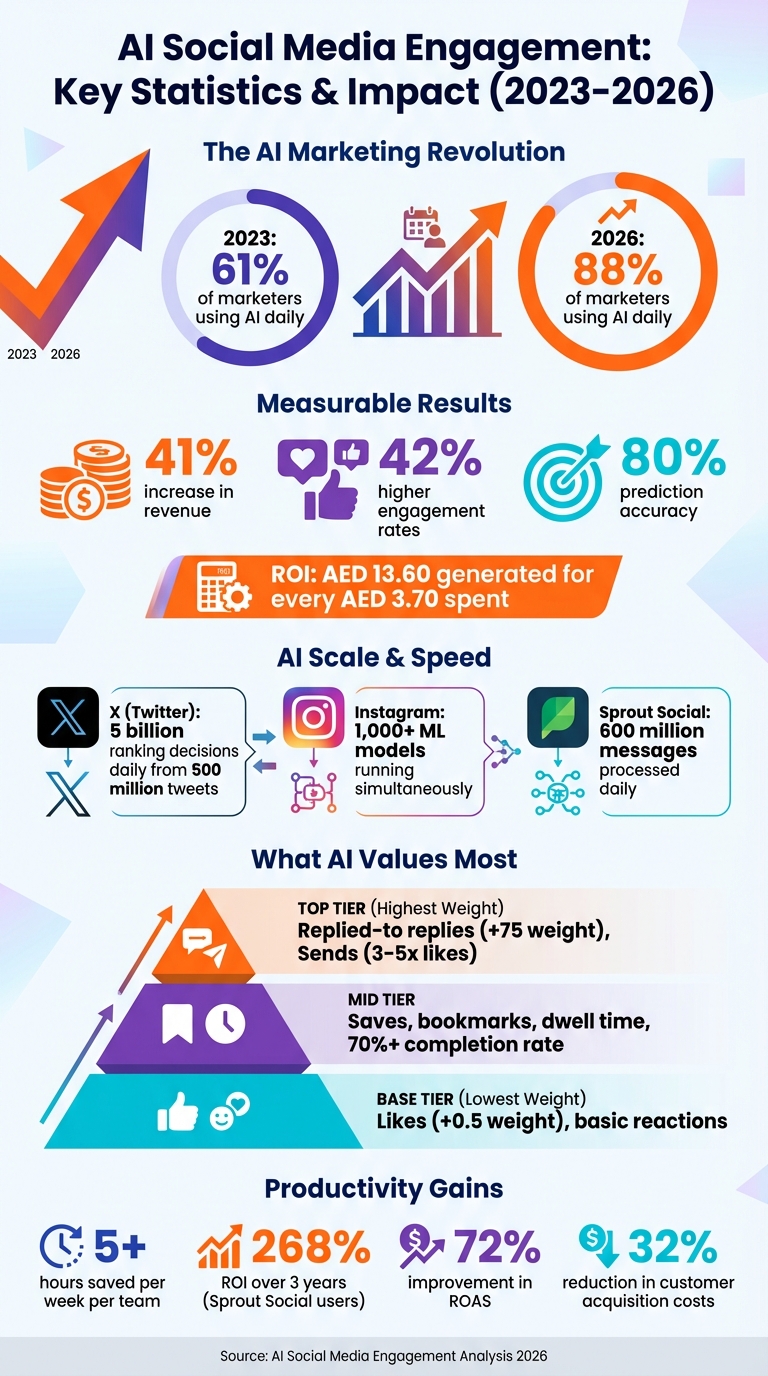
AI Social Media Engagement Statistics and ROI Impact 2023-2026
How Social Media Algorithms Actually Work (And How to Beat Them)
sbb-itb-f7b3a33
How AI Analyzes Engagement Data
AI has transformed how engagement data is analysed, moving far beyond basic metrics like likes and shares. It follows a three-step process to ensure precision and relevance. First comes Candidate Sourcing, which filters millions of posts down to a manageable few thousand. Then, Neural Network Ranking predicts how likely users are to engage with each piece of content. Finally, Heuristics and Filtering eliminates low-quality or redundant material. This entire process runs in real-time, enabling platforms like X to handle a staggering 5 billion ranking decisions daily, based on 500 million tweets.
Data Collection and Monitoring
AI tools gather engagement data using secure platform APIs that utilise OAuth 2.0 for authentication. Posterly, for instance, connects to over 10 social networks - including Instagram, Facebook, X, LinkedIn, and TikTok - allowing users to track performance metrics from one central dashboard. Metrics like dwell time (how long users pause on a post) and watch time (video retention rates) are closely monitored. Advanced systems like X's Grok process over 100 million pieces of content daily, pairing them with user interest profiles. Meanwhile, Instagram employs over 1,000 machine learning models simultaneously to enhance its recommendations.
Key Metrics AI Tracks
AI doesn’t just track basic reactions - it digs deeper into engagement patterns. For example, likes and retweets are considered surface-level indicators, while more meaningful actions carry greater weight. On X, a reply that gets a response from the original author is weighted at +75, making it 150 times more influential than a simple like, which is valued at just +0.5. Similarly, Instagram places more emphasis on "sends" (content shared via direct message), which are weighted 3–5 times higher than likes when determining whether to promote content to a broader audience. AI also employs natural language processing (NLP) to assess the sentiment and keywords in captions, while visual fingerprinting identifies whether content is original or reposted. These metrics are then categorised for more detailed analysis.
Categorising Metrics for Deeper Insights
AI breaks down engagement data into three main categories to better understand user behaviour:
- Core Metrics: These include likes, retweets, and reactions, which are quick, surface-level responses and carry the lowest algorithmic weight.
- Advanced Metrics: These go deeper, measuring elements like saves, bookmarks, dwell time, and the depth of conversations. For short-form videos, achieving a completion rate above 70% is often necessary for the algorithm to boost visibility.
- Visibility Metrics: These track how far content spreads beyond an account's followers, using measures like reach, impressions, and sends-per-reach ratios. For example, Instagram's visual fingerprinting system flags reposted content that shares over 70% similarity with existing posts, often reducing its reach by 60–80%.
| Metric Category | Examples | Algorithmic Impact |
|---|---|---|
| Core Metrics | Likes, retweets, reactions | Lowest weight |
| Advanced Metrics | Dwell time, watch-through rate, bookmarks, replies | High weight |
| Visibility Metrics | Sends-per-reach, likes-per-reach, impressions | Measures reach beyond current followers |
This categorisation allows AI to prioritise and amplify content that resonates most with users, while ensuring quality and originality remain central to its recommendations.
The Technology Behind AI Predictions
AI predictions are built on a complex blend of technologies that process millions of data points in real-time, enabling prediction accuracy rates of up to 80% as mentioned earlier. These systems integrate machine learning models, natural language processing (NLP), and visual recognition to anticipate audience reactions to content even before it’s published.
Machine Learning Models and Algorithms
Machine learning algorithms are at the heart of AI-powered engagement forecasts. Different types of models serve specific purposes:
- Regression models (e.g., Linear Regression, Random Forest) predict numerical outcomes like the number of likes or shares.
- Classification models (e.g., Decision Trees, Support Vector Machines) group content into engagement categories.
- Time series algorithms (e.g., ARIMA, Prophet) identify seasonal trends.
- Advanced neural networks (e.g., RNNs, LSTMs, Transformers) detect intricate relationships between text, behaviours, and engagement signals.
Before these models can operate, raw data undergoes preprocessing. This includes tasks like tokenising text, removing stop words, and simplifying words to their root forms through stemming and lemmatisation. Following this, feature engineering extracts key indicators such as hashtag counts, presence of media, and timing factors. A prime example of machine learning in action is Netflix’s recommendation system, which operates on similar principles and reportedly saves the company over AED 3.7 billion annually by reducing subscriber churn.
While these numeric predictions provide a strong foundation, NLP adds another layer of precision by interpreting the meaning and tone of content.
Natural Language Processing (NLP) and Sentiment Analysis
NLP plays a vital role in understanding text by analysing tone, sentiment, and intent. It can differentiate between emotions such as excitement, annoyance, or indifference. Sentiment analysis further categorises conversations into positive, negative, or neutral segments, offering real-time insights into brand reputation. Named Entity Recognition (NER) scans massive volumes of conversations to pinpoint mentions of specific brands, products, or locations. For instance, Sprout Social’s AI systems process an average of 600 million messages daily to uncover audience insights.
In 2025, the Atlanta Hawks used AI-driven insights to craft content that resonated with fans during All-Star Weekend. The results were impressive: a 170.1% increase in their Facebook audience and a 127.1% rise in video views over a three-month period.
"The role of AI in the social media industry isn't about making content; it's about shaping the experience so it feels made for each person."
– Chirag Bhardwaj, VP – Technology, Appinventiv
Beyond analysing text, NLP also powers features like smart inboxes that prioritise messages based on urgency or emotional tone. Platforms like X (formerly Twitter) use advanced NLP models to filter harmful content and misinformation automatically.
While text analysis is essential, visual content is just as critical for predicting engagement.
Image and Video Recognition
Deep learning models take visual analysis to the next level by examining the actual content of images and videos, rather than relying solely on captions or hashtags. For example, Instagram’s algorithm maps visual elements to user interest profiles, helping predict which audience segments will engage with specific content. These systems can even detect watermarks and metadata to deprioritise non-native content, which is crucial because users typically decide whether to engage with video content within 1.7 seconds.
"The algorithm now analyses image and video content beyond just hashtags and captions. What's actually in your visual content matters for discovery and recommendations."
– Adam Mosseri, Head of Instagram
Tools like Posterly's Nano Banana and Veo utilise these technologies to analyse and create visual content. Veo, for instance, helps generate user-generated content (UGC) videos, such as product reviews and tutorials, by predicting which formats will perform best before they’re even published. Instagram’s algorithm also considers a retention rate of 60%+ past the first 3 seconds as a key indicator for promoting Reels to broader audiences. This makes AI-driven visual optimisation a crucial factor in expanding reach and engagement.
Predicting Content Performance Before Publishing
AI now allows creators to predict how their content will perform before it even goes live. By testing different versions, identifying weak areas, and refining them, creators can publish with greater confidence. Let’s dive deeper into how historical data and engagement metrics drive these predictions.
Analysing Historical Data and Trends
AI relies on vast amounts of engagement data to predict content performance. By studying millions of posts across platforms, these tools identify patterns and elements that consistently lead to higher engagement. They examine everything from visuals and audio to structure and metadata. Using machine learning models - especially neural networks - AI evaluates how audiences have interacted with similar content in the past to forecast future responses.
Instead of just looking at "social graphs" (who follows who), AI focuses on "interest graphs", which track topics users have engaged with. This helps predict how relevant new content will be to specific audiences, even if they don’t follow the creator.
"The algorithm isn't your enemy. It's a distribution engine, and it's remarkably good at doing what it's designed to do - match content to interested audiences."
– Jamie Partridge, Founder & CEO, PostEverywhere
Some tools, like Pre, allow creators to test variations - such as different thumbnails or captions - against historical data. This process helps creators identify the most effective version before publishing. By uploading content for analysis, tweaking weak areas like titles or visuals, and validating improvements, creators can optimise their posts for better performance.
Key Factors That Influence Engagement
AI evaluates a wide range of variables to predict how content will perform. Here’s a breakdown of the main factors:
- Visual elements: These include scene composition, object detection, motion, facial expressions, and the readability of text overlays.
- Audio features: AI considers music genre, tempo, voice tone, speech clarity, and how well the audio syncs with visuals.
- Text and metadata: Factors like title sentiment, keyword usage, caption structure, hashtag relevance, and thumbnail appeal all play a role.
Beyond the content itself, behavioural signals are critical. Metrics like watch time, dwell time, and completion rates are key indicators of success. For short-form videos, completion rates above 70% are often needed to gain significant algorithmic visibility. Engagement signals such as saves, shares, and comments are also heavily weighted, with shares being especially important for extending reach.
Different platforms emphasise different metrics. For instance, TikTok values completion rates and the likelihood of rewatching, while LinkedIn focuses on dwell time and the quality of professional discussions. AI adjusts its predictions to account for these platform-specific priorities.
Prediction Accuracy Rates
AI’s predictive analytics are impressively accurate across multiple metrics. Here’s how it performs:
| Metric Predicted | Accuracy Rate | Business Impact |
|---|---|---|
| Click‐Through Rate (CTR) | 78–85% | Higher discovery and reach |
| Optimal Publishing Time | 82–88% | Maximum initial traction |
| Audience Retention | 72–80% | Better algorithm ranking |
| Engagement Rate | 70–78% | More shares and interactions |
| Viral Potential Score | 65–75% | Early viral identification |
Source: Vibbit
AI-driven scheduling can boost post reach by 40–60%. These systems aim for a Mean Absolute Error (MAE) of less than 10% when predicting audience retention curves, making their forecasts reliable enough to guide content strategies.
"AI video engagement prediction makes this possible, transforming content creation from guesswork into a data‐driven science."
– Vibbit
Platforms like Posterly use these predictive tools to help creators refine their content. Features like AI Scheduler and AI Caption Assist ensure posts are optimised before they go live. Posterly’s integration with tools like Nano Banana for image creation and Veo for video generation ensures that both visuals and engagement predictions work hand-in-hand.
Optimising Posting Schedules and Strategies with AI
AI doesn't just predict performance - it turns those insights into actionable posting schedules tailored to your audience. Instead of relying on generic platform averages, AI tools dive deep into your audience's behaviour, figuring out exactly when your followers are most active and ready to engage. Here's how AI-driven scheduling can help you stay ahead of the curve and adapt to changing trends.
Finding the Best Times to Post
AI pinpoints the best times to post by analysing your account's historical performance, rather than using broad industry standards. Machine learning tracks real-time audience activity to determine when your followers are most engaged. This personalised approach can boost engagement by as much as 50% to 150% compared to posting during off-peak hours.
The secret lies in understanding engagement velocity - the pace at which a post gains likes and comments, especially during the first 60 minutes. Interestingly, over 80% of engagement happens within this critical hour. AI also factors in platform-specific trends. For example:
- LinkedIn sees a 60% drop in engagement on weekends.
- TikTok thrives late at night, between 22:00 and 01:00.
- Instagram now experiences two peak periods: mornings (09:00–11:00) and evenings (19:00–21:00).
Here's a quick breakdown of peak engagement windows for popular platforms:
| Platform | Peak Windows (Local Time) | Best Days | User Behaviour |
|---|---|---|---|
| 09:00–11:00, 19:00–21:00 | Tue–Thu | Morning updates & evening entertainment | |
| TikTok | 22:00–01:00 | Tue–Thu | Late-night engagement spikes |
| 08:00–10:00, 12:00–13:00, 15:00–20:00 | Tue–Thu | Networking & midday breaks | |
| 09:00–12:00 | Mon–Thu | Morning routines & midday browsing | |
| X (Twitter) | 08:00–10:00, 12:00–13:00, 17:00–19:00 | Mon–Fri | Real-time updates & commuter scrolls |
| YouTube | 14:00–16:00, 20:00–23:00 | Thu–Sat | After-school/work viewing & weekend spikes |
"Your audience's attention follows a rhythm. When you post in sync with it, engagement takes off."
– Sarah Kett, Lifecycle Marketing Manager, Later
Tools like Posterly's AI Scheduler analyse these patterns to recommend the best posting windows for each platform. Even posting within an hour of the suggested time can increase engagement by 30% to 50%. The system also accounts for algorithm delays, suggesting posts 30–60 minutes before peak times to ensure content is indexed and distributed effectively.
Adapting to Emerging Trends
AI doesn't just find the best posting times - it keeps adjusting as your audience's habits evolve. These tools monitor performance, test new times, and refine recommendations based on shifting trends. Audience behaviour can change by 20% to 30% seasonally, making quarterly schedule reviews essential.
For example, LinkedIn's peak activity has shifted in recent years, with engagement now extending into the evening, from 15:00 to 20:00. AI also tailors strategies based on content type. Educational posts perform better in the morning (07:00–09:00), while entertainment content thrives during evening hours (19:00–23:00). Quick-consumption formats like Stories work well during commutes, while immersive content like Instagram Reels and long-form videos perform better at night.
"AI scheduling doesn't set it and forget it. It tries different times, measures results, and adjusts."
– Apaya
Posterly's AI Scheduler adapts to algorithm updates and seasonal shifts, ensuring your content stays in front of your audience when they're most likely to engage. This is especially valuable for brands managing multiple platforms, each with its own unique engagement patterns.
Customising Content for Target Audiences
AI goes beyond timing - it personalises schedules to match your audience's specific habits. By analysing micro-moments of high intent, AI identifies when your followers are actively browsing rather than passively scrolling. This level of personalisation ensures your content reaches the right people at the right time.
For accounts with global audiences, AI can even recommend posting the same content multiple times to target different regions. For instance, you might post at 09:00 EST for European followers and 20:00 EST for those in Asia. Posterly's AI Scheduler takes into account geographic data, like local time zones and regional habits, to refine its recommendations.
"The best time to post on Instagram is whenever you'll post consistently. Generic advice like 'Tuesday at 11:00' is based on averages that don't apply to your specific audience."
– Tim Eisenhauer, Writer, Apaya
Consistency is key. AI data shows that posting daily - even at a less-than-perfect time - can lead to better long-term growth than sporadic posting at "ideal" times. While the difference between "good" and "optimal" timing is only about 5% to 10%, consistent posting compounds algorithmic benefits over time. Posterly's dashboard simplifies this process, allowing you to manage multiple platforms while the AI handles the timing.
Measuring ROI and Business Impact of AI Predictions
AI predictions bridge the gap between social media engagement and tangible business growth. By turning engagement data into insights on revenue, conversions, and customer acquisition, social media evolves from being a "nice-to-have" to a genuine driver of growth. Here's how AI-powered predictions deliver measurable returns.
Linking Engagement to Business Goals
Posterly's unified dashboard simplifies tracking performance across platforms, connecting engagement metrics to business outcomes. Using predictive modelling, AI forecasts which content will drive conversions. For instance, predictive analytics can estimate click-through rates (CTR) with an accuracy of 78% to 85%, enabling brands to identify posts likely to bring traffic to their websites or landing pages.
The standout feature is attribution modelling. AI maps the customer journey from a social media interaction to a purchase, identifying the most effective posts, formats, and posting schedules. Companies using AI in marketing report a 41% average revenue increase, with AI tools generating AED 13.60 for every AED 3.70 spent. By connecting engagement metrics like velocity to actions such as email sign-ups or purchases, AI ensures resources are channelled into content that truly delivers.
Posterly enhances this process further by tracking cross-platform performance, including Google Business Profile. For local businesses, AI-optimised posts on Google Business Profile boost activity signals to search engines, improving local SEO rankings and visibility.
Demonstrating ROI with Predictive Analytics
Predictive analytics not only increase engagement and conversions but also reduce costs. AI-powered ad optimisation has been shown to improve return on ad spend (ROAS) by 72% while cutting customer acquisition costs (CAC) by 32%. Meta's Advantage+ Shopping Campaigns, which use automated AI targeting, deliver 30% better cost-per-acquisition (CPA) results compared to manual efforts.
Real-world examples illustrate these advantages. In 2025, Halara, a clothing brand, reduced CPA by 70% by using TikTok's Symphony Recommended Creatives to optimise social ad content. Similarly, NIB Health Insurance saved AED 80.8 million by adopting AI-driven digital assistants, slashing customer service costs by 60%. Bank of America's AI assistant, Erica, has handled over 2 billion interactions, resolving 98% of queries in just 44 seconds on average.
Sprout Social users reported a 268% ROI over three years by integrating predictive analytics and AI. AI-assisted posts consistently outperform human-only posts in engagement, with a median rate of 5.87% compared to 4.82%. On platforms like Threads and TikTok, the gap is even wider, with AI-assisted posts achieving engagement rates of 11.11% and 6.14%, respectively, compared to 5.56% and 4.17% for human-only posts. This higher engagement drives better algorithmic distribution, broader reach, and ultimately, higher conversions.
These results highlight how AI transforms social media management into a cornerstone of business success, delivering measurable and impactful outcomes.
Conclusion
AI has changed the way brands handle social media, shifting from guesswork to a science driven by data. As of 2026, 88% of marketers are using AI tools daily, making the move from manual processes to smart automation a must for staying ahead.
The numbers speak for themselves: AI-powered tools generate AED 13.60 for every AED 3.70 spent and increase revenue by 41%. On top of that, teams save over 5 hours each week by automating repetitive tasks, freeing up time for strategic thinking and creative projects.
Enter Posterly, a platform that brings AI-driven insights into a single, easy-to-use hub. It eliminates the hassle of managing multiple tools by offering features like AI-generated captions, 4K visuals through Nano Banana Pro, and UGC-style videos powered by Google Veo. Whether you're working on Instagram, TikTok, LinkedIn, or X, Posterly handles content creation and distribution seamlessly. Tools like Ship & Share turn technical updates into shareable marketing content, while the Google Business Profile Auditor ensures your local SEO efforts stay sharp.
This blend of accurate data and efficient workflows highlights how social media management has evolved. AI tools enhance creative efforts, allowing marketers to work faster without losing the human touch. Industry experts agree: AI helps social media managers streamline their processes without sacrificing creativity. With Posterly's pricing starting at just AED 25.70/month for the Starter plan, it's never been easier to optimise your workflow and achieve better results.
FAQs
What does “80% accuracy” mean in engagement prediction?
An "80% accuracy" in engagement prediction indicates that the AI successfully forecasts user interactions - such as likes, comments, shares, or saves - 80% of the time. This accuracy stems from analysing historical data and identifying trends, helping businesses fine-tune their social media strategies for better performance.
Which engagement metrics matter most now (likes vs sends vs saves)?
Engagement metrics that showcase how your audience interacts with your content are key. One of the most telling is the engagement rate, calculated by dividing likes, comments, shares, and saves by total impressions. Generally, an engagement rate above 3% indicates strong performance.
Interestingly, AI-driven insights reveal that saves and shares are becoming more influential. These actions suggest a deeper connection with the content, unlike likes, which can often feel more surface-level. This trend ties directly to organic growth strategies, as algorithms tend to favour content that sparks meaningful interactions.
How does AI choose the best time to post for my audience?
AI pinpoints the optimal times to post by examining your audience's activity patterns - things like likes, comments, and views - to determine when they're most engaged. Platforms such as Posterly rely on algorithms to study user behaviour, analyse the performance of previous posts, and keep an eye on platform-specific trends. This approach ensures your content goes live during peak engagement periods, boosting visibility and interaction while removing the need for trial and error.
Related Articles
Ultimate Guide to AI Social Media Scheduling
Ultimate Guide to AI Social Media Scheduling
Read moreAI Ethics in Social Media: What Creators Need to Know
AI Ethics in Social Media: What Creators Need to Know
Read moreHow to Build SaaS Drip Campaigns
How to Build SaaS Drip Campaigns
Read moreSocial Media Algorithms: Frequency Strategies Explained
Social Media Algorithms: Frequency Strategies Explained
Read more