
How To Train AI For Brand Voice
How To Train AI For Brand Voice
How To Train AI For Brand Voice
Your brand voice is how your business communicates - its personality in words. When consistent, it builds trust and recognition. But AI-generated content often lacks this distinctiveness, leading to generic, mismatched messaging. To fix this, you need to train AI tools to align with your brand's unique tone. Here's how:
- Define your brand voice: List personality traits (e.g., "authoritative yet approachable") and create rules for tone, vocabulary, and style.
- Prepare quality training data: Use 30–50 recent, high-performing content pieces that reflect your voice. Tag them with context like audience and platform.
- Build a brand voice guide: Include traits, approved phrases, tone rules, and examples of on-brand and off-brand content.
- Configure AI tools: Upload guidelines, provide high-quality samples, and use detailed prompts for better results.
- Test and refine AI output: Use a scorecard to evaluate tone, clarity, and accuracy. Regularly update guidelines based on feedback.
With clear guidelines and regular adjustments, your AI can deliver consistent, on-brand messaging across platforms like Instagram, LinkedIn, and email. This ensures your content feels authentic to your audience while saving time and effort.
::: @figure 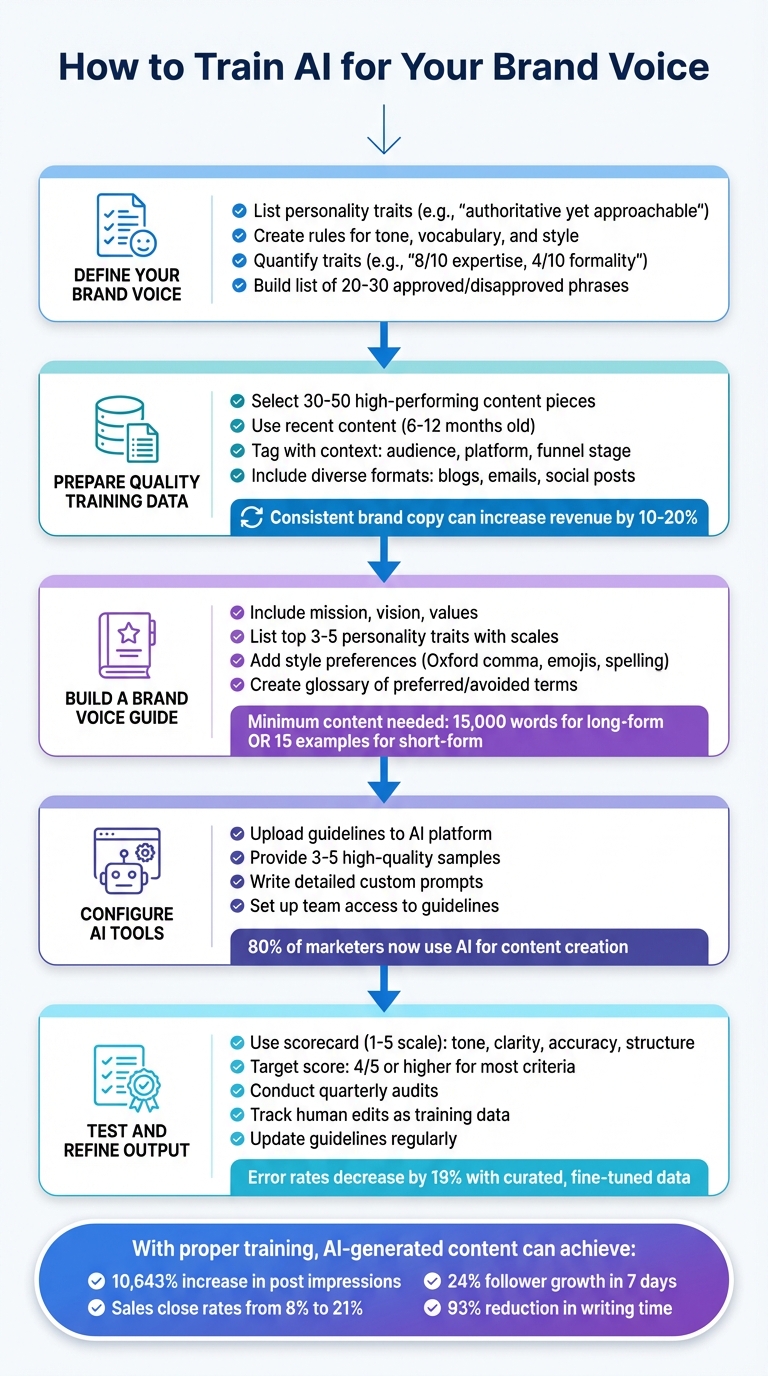 {5-Step Process to Train AI for Brand Voice Consistency}
:::
{5-Step Process to Train AI for Brand Voice Consistency}
:::
How To Train Chatgpt And Other AI Tools In Your Unique Brand Voice
::: @iframe https://www.youtube.com/embed/xOBC71WNpiM :::
sbb-itb-f7b3a33
How to Define Your Brand Voice
Defining your brand voice is essential when working with AI to ensure the content it generates aligns with your business identity. A clear, consistent brand voice helps AI produce content that truly reflects your unique tone and style. Without this groundwork, you're likely to end up with generic output that misses the mark.
List Your Brand's Personality Traits
Start by identifying your brand's core identity, which is rooted in its mission, vision, and values. These elements act as a compass for what your brand should and shouldn't communicate [6]. Instead of settling for vague descriptors like "friendly" or "professional", aim for more specific traits such as "authoritative but approachable" or "technical yet friendly" [1][4][5].
Take it a step further by quantifying these traits - for example, "8/10 expertise, 4/10 formality" - and consider your audience's demographics and style preferences [6]. This ensures clarity and consistency in your brand's tone.
Create a list of 20–30 approved and disapproved phrases. For instance, "Let's get started together" might align with your voice, while "Now or never" could feel too pushy [2]. Also, outline rules for using emojis, contractions, or industry-specific jargon [1][4][6].
Review Your Existing Content
To refine your brand voice, gather 3–5 examples of content that best represent your ideal style - your "greatest hits" [7]. These could include your "About Us" page, top-performing blog posts, standout ad campaigns, or even customer service transcripts that received positive feedback [5][8]. Study these samples for key patterns in sentence structure, tone, and vocabulary [2].
You can also use AI tools to audit your content. For instance, you might prompt: "Analyse the content at [URL] and identify five key brand voice attributes, including definitions, do's, and don'ts" [10]. This method allows you to spot trends across 10–20 pieces of content that might otherwise go unnoticed [2][7]. Additionally, comparing on-brand and off-brand examples provides clarity on what your brand voice is - and isn’t [8].
Build a Brand Voice Reference Guide
Once you've gathered all your insights, compile them into a detailed brand voice guide. This document should include your brand's mission, vision, and values [6][7]. List your top 3–5 personality traits, complete with numerical scales and clear definitions [8][6]. Add style preferences, such as whether you use the Oxford comma, how emojis should be handled, and whether British or American spelling is preferred.
Include a glossary of preferred terms and phrases, along with ones to avoid, based on your content review [8]. Use side-by-side examples to illustrate on-brand versus off-brand communication. For instance, show a social media post that aligns with your tone next to one that doesn’t. As Jayne Schultheis from Rellify points out:
"Successful AI training lies in providing the right data set and implementing systematic customization that teaches the AI to recognize and replicate your brand's unique voice." [7]
Store this guide in a living document, such as Notion or Google Docs, so it can evolve as your brand grows [8]. For effective AI training, you'll need at least 15,000 words of sample content for long-form projects or 15 examples for short-form formats like social media posts [3]. Assign 2–3 "brand guardians" - team members who deeply understand your audience - to regularly compare AI-generated content against your documented standards [2]. This guide will serve as the foundation for curating training data as you refine your AI strategy.
How to Prepare Training Data for AI
Once you've established your brand voice and created a reference guide, the next step is to assemble a carefully curated set of content that teaches your AI to replicate your brand's tone and style.
Select Content That Reflects Your Brand Voice
Start by choosing 30–50 high-performing pieces of content that truly represent your brand voice. It's not about sheer volume - quality is what counts here [12][13]. As Uba Alintah from Contently puts it:
"A few dozen pieces that perfectly capture your voice will teach an AI system better than thousands of mediocre examples mixed with outdated content." [12]
Focus on content with a proven track record. This could include standout blog posts, landing pages that convert well, or customer support emails that have received positive feedback. Stick to recent material - ideally created within the last 6–12 months - that aligns with your current brand identity. Avoid older content, especially if it's from before a rebrand. Aim for a diverse mix of formats, such as social media posts, white papers, and emails, to cover different communication styles. Including paired examples can help clarify the boundaries of your brand's tone.
Research indicates that consistent, well-curated brand copy can increase revenue by 10–20%, while poorly selected training data can lead to a 12% drop in revenue [13][8].
Once you've selected your content, it's time to tag it with context to guide the AI.
Add Context Tags to Your Content
Tagging your training samples with detailed metadata helps the AI understand how and when to adapt its tone. For each piece, include tags that specify details like the target audience, platform, funnel stage, and emotional intent. For instance, an Instagram post might be tagged as "short, emotional, emoji-friendly", while a LinkedIn article could be labeled "professional, calm, data-driven." This ensures your brand voice remains consistent but flexible enough to suit different formats and audiences.
Don't forget to include examples of edge cases, like crisis communications or responses to negative feedback. These scenarios teach the AI how to handle more challenging situations while staying true to your brand's identity.
Once tagging is complete, it's time to clean up your data.
Clean Up Your Training Data
Before uploading your content, remove anything that could confuse the AI or compromise its learning process. This includes boilerplate text, legal disclaimers, footers, call-to-actions, promo codes, and outdated dates.
As No Fluff advises:
"Treat voice as non-negotiable guardrails, not nice-to-have polish. Get that wrong and no amount of clever prompting will save you." [13]
Convert your cleaned content into machine-readable formats like JSONL or CSV. To keep your training data relevant, audit it every quarter and remove pieces that no longer align with your evolving brand standards. Studies show that error rates in AI models can decrease by 19% when using iteratively fine-tuned, curated data [13].
Finally, create a "mini-dictionary" of 20–30 preferred brand phrases and a list of terms or clichés to avoid. This ensures your AI consistently produces content that aligns with your brand's style and messaging.
How to Configure AI Tools for Your Brand Voice
With the right training data and a clear brand voice guide, you can fine-tune AI tools to deliver content that aligns with your unique style. This process transforms your AI from a generic assistant into a valuable team member that truly understands your brand.
Upload Your Brand Guidelines to AI Tools
Start by uploading your brand voice guidelines to your AI tool using its custom instructions feature. For instance, ChatGPT’s Custom Instructions allow you to define your business context and preferred response style for every interaction, saving you from repeating the same details repeatedly[4].
Other platforms like Jasper and Copy.ai let you build reusable brand profiles that automatically influence all content generated on the platform[6]. Tools such as BrazeAI take it a step further by letting you define personality traits, values, and even archetypes, such as “The Explorer,” directly within the system[14]. If you need advanced features, Pressmaster.ai offers "Voice Decoders" that analyse your existing content and create a voice fingerprint using over 30 linguistic traits[9]. With a 4.8/5 rating from more than 2,000 founders and agencies, this tool showcases how precise configuration can elevate content quality[9].
To help the AI better understand your style, upload 3–5 high-quality content samples. This allows the tool to pick up on subtle patterns in your vocabulary and structure through a technique called few-shot learning[7]. Once your guidelines are in place, the next step is crafting effective prompts to ensure consistent results.
Write Custom Prompts for Better Results
Even with brand guidelines in place, specific prompts are essential for guiding the AI’s output. The more detailed your instructions, the better the results. For example, instead of saying, "Write a social media post", provide a prompt like:
"Act as a world-class direct-response copywriter. Write an Instagram post for our new product launch. Target audience: UAE-based entrepreneurs aged 25–40. Tone: energetic and motivating. Use short sentences (under 12 words). Avoid clichés like 'game-changing' or 'revolutionary.'”[4][2].
Tailor sentence length to match your desired tone. For an energetic style, go with short, punchy sentences. For an authoritative voice, specify longer sentences with transition phrases like "therefore" or "as a result"[2][9]. Use your brand’s approved phrases and avoid terms flagged in your training data[8][2].
As Justin Blackman, a Brand Voice Strategist, explains:
"The biggest limitation of AI copywriting is that even if you can get it to write like you, it can't think like you. So it's on you to make sure it knows your perspective"[9].
Develop a library of modular prompt templates focusing on five areas: Audience, Purpose, Emotion, Proof, and Format[6]. This approach ensures consistency across your team while allowing flexibility for different content needs. Remember, the first draft is just that - a draft. If it feels too formal, adjust the prompt to say, "Make it more conversational." If it’s too casual, specify, "Use a more professional tone."
Once you’ve nailed down your prompts, it’s time to make these guidelines accessible to your entire team.
Set Up Team Access to Brand Guidelines
Centralise your brand voice guidelines in a shared location that your team can easily access. Platforms like Notion, Google Drive, or Airtable are excellent for storing assets such as your lexicon, examples of on-brand and off-brand content, and other key resources[8].
Configure your AI tools to apply brand guidelines at the workspace level. For instance, platforms like SEO.ai allow you to create "projects" with pre-set tone and style settings, ensuring everyone working on the project produces consistent content[7].
To maintain quality, appoint 2–3 "brand guardians" to review AI-generated content regularly. They can score tone and clarity on a 1–5 scale and update the shared guidelines based on these reviews[2]. Track all human edits to AI-generated content and use them to refine your prompts and training data. As Brian Shelton, a B2B Marketing Director, puts it:
"A detailed brand guideline isn't just documentation - it's the blueprint that determines whether your AI becomes a brand champion or a generic content machine"[8].
| Tool Type | Recommended Platforms | Team Access Feature |
|---|---|---|
| Shared Storage | Google Drive, Notion, Airtable | Centralised repository for guidelines and assets |
| AI Writing Platforms | Jasper, Copy.ai, Writesonic | Reusable brand profiles and style libraries |
| Communication AI | Braze, Grammarly Business | Workspace-level defaults |
| SEO/Content Tools | SEO.ai, Rellify | Project-specific tone definitions and custom AI agents |
For Posterly users, the platform’s unified dashboard makes it easy to integrate your brand voice guidelines into social media content workflows, ensuring every post stays true to your brand.
With 80% of marketers now using AI for content creation[6], ensuring proper team configuration is essential. Inconsistent guidelines can result in a 12% revenue loss for organisations, making this step not just helpful but vital to your success[8].
How to Test and Improve AI Output
Once you've set up your AI tools, the next step is making sure they deliver content that reflects your brand's voice. This requires consistent testing, refinement, and updates over time.
Check AI Output Against Your Brand Standards
One effective way to evaluate AI-generated content is by using a scorecard system. Rate each piece on a scale of 1 to 5 across four key areas: brand tone, clarity, accuracy/terminology, and message structure[2][9]. This creates a measurable way to track performance.
To improve quality, assign 2–3 experts to review the AI's output regularly[2][9]. These reviewers should avoid vague feedback and instead offer actionable suggestions. For instance, instead of saying "too formal", they might suggest: "Replace 'utilise' with 'use' and keep sentences under 12 words for a more dynamic tone."
For larger workloads, tools like Pressmaster.ai can help. With a 4.8/5 rating from over 2,000 users, this tool analyses linguistic traits and compares AI drafts to your best content, creating a "voice fingerprint" for alignment[9]. It also allows you to conduct batch QA analysis, letting you scan multiple blog intros at once to identify inconsistencies with your tone benchmarks[11].
Another key step is establishing a feedback loop. Start by providing the AI with 10–20 examples of your best content and asking it to replicate them. Track all human edits made to the AI's drafts - these edits act as training data for future improvements. As Lindsay Hope, an AI and Email Strategist, points out:
"AI copy performs best when it's tweaked with the human touch. You still have to tie any writing back to a human, and that's what I see people miss all the time"[9].
Brands that align AI with their voice effectively have seen impressive results, such as a 10,643% increase in post impressions and sales close rates jumping from 8% to 21%[15].
| Scorecard Criterion | Description | Target Score |
|---|---|---|
| Brand Tone | Does it reflect your core personality traits? | 4/5 or higher |
| Clarity | Is the message easy for your audience to understand? | 4/5 or higher |
| Accuracy | Are all facts, dates, and terms correct? | 5/5 |
| Structure | Does it follow your preferred sentence rhythm and length? | 4/5 or higher |
Use insights from the scorecard to refine your guidelines and improve future outputs.
Update Your Brand Voice Guidelines
Testing often reveals areas where your guidelines need adjustment. Since your brand voice evolves with your business, audience, and market trends, treat your guidelines as dynamic documents that require regular updates[8][11].
Conduct quarterly audits of your training data to remove outdated examples[8][11]. Content that worked six months ago may no longer align with your current tone or positioning. For instance, if you've shifted from a formal tone to a conversational one, the AI needs updated examples to reflect this change.
To prioritise relevance, use recency scoring to ensure the AI learns from your latest content. Automated alerts can trigger retraining cycles whenever guidelines are updated, preventing the AI from producing outdated material[8][11].
Be specific when updating your guidelines. For example, instead of saying "be more casual", provide clear instructions like: "Replace 'We are pleased to announce' with 'We're excited to share' and use contractions throughout." Include a "Say This, Not That" list with 20–30 preferred phrases and terms to avoid[2][9].
These steps help keep your AI aligned with your brand's evolving identity.
Track Consistency Across All Platforms
Once your outputs and guidelines are refined, ensure your voice remains consistent across all channels. This can be challenging when managing content for platforms like Instagram, LinkedIn, TikTok, and email.
Develop channel-specific profiles that outline "YES" and "NO" phrases and formatting rules for each platform[2]. For example, Instagram posts might use short, emotional sentences of around 12 words, while LinkedIn posts may require a more professional tone with sentences ranging from 15 to 25 words[2][8]. While the tone may shift slightly, the vocabulary and personality traits should remain consistent.
Use a unified dashboard to monitor engagement metrics across platforms[15][9]. This helps identify which tonal adjustments resonate most with different audiences. For example, Posterly offers a dashboard that integrates brand voice guidelines with social media workflows across 10+ platforms. It tracks consistency, measures performance, and ensures every post aligns with your brand.
Log recurring errors to spot stylistic drift[1]. If the AI repeatedly uses prohibited terms like "game-changing", it signals a need for adjustments in training data or prompts. Set clear Key Performance Indicators (KPIs) for AI content, such as tone accuracy, engagement rates, and brand alignment[1].
Brands that rigorously test and refine their AI-generated content have reported a 24% follower growth within seven days and a 93% reduction in writing time[15]. However, with 80% of marketers now using AI, the risk of "content homogenisation" is high[6]. The only way to stand out is through consistent testing, regular updates, and monitoring across all platforms.
As Riley Westbrook, Co-founder of Valor Coffee, wisely notes:
"The biggest mistake I see is when people expect AI to find their voice. It won't. You have to hand it your rhythm. If you do that, it's a solid tool"[9].
Conclusion
Shaping AI to reflect your brand's voice is a continuous journey that hinges on clear guidelines, quality training data, and regular fine-tuning. Start by outlining your brand’s personality traits and compiling them into a detailed style guide. This should include tone preferences, grammar rules, and a list of approved and prohibited terms.
Build a dataset of 30–50 top-performing content examples, prioritising quality over quantity. Ensure these examples are up-to-date and tagged with relevant context, such as target audience and communication channel. Use these principles to create precise configurations and testing protocols for your AI tools.
Set up your AI with carefully crafted prompts and system instructions that clearly define your brand’s persona and quality standards. Incorporate a human-in-the-loop feedback system, where designated brand experts review AI outputs, score them, and provide targeted corrections to refine the system over time.
Regular audits and updates will keep your guidelines aligned with your evolving business needs. By maintaining channel-specific profiles, you can ensure consistent messaging across different platforms. With 80% of marketers now leveraging AI for content creation [6], ongoing testing, updates, and human oversight are crucial to maintaining your brand’s voice. Tools like Posterly (https://poster.ly) simplify this process by helping your AI deliver consistent messaging across all channels.
"The deciding factor isn't the size of your dataset or sophistication of your model - it's the clarity of your guidelines and the expertise of your editors." - Uba Alintah, Contently [12]
FAQs
::: faq
How can I make sure AI-generated content reflects my brand's tone and style?
To make sure AI-generated content matches your brand's voice, start by developing a detailed brand-voice guide. This guide should outline your tone, preferred vocabulary, sentence style, and examples of both acceptable and unacceptable phrasing. Share this guide with the AI tool, along with sample content that mirrors your brand's style. Use specific prompts and ongoing feedback to fine-tune the results, and periodically update the guide to maintain alignment. Tools like Posterly’s AI-powered content creation solutions can simplify this process, helping you deliver consistent, audience-focused messaging tailored to the UAE market. :::
::: faq
What kind of content should I use to train AI for my brand's voice?
To ensure AI truly captures your brand’s voice, start by providing approved, on-brand materials. This includes your official style guide and tone-of-voice documents that highlight preferred language, personality traits, and any phrases to avoid. Pair these with a collection of approved content samples - like blog posts, social media captions, email newsletters, and ad copy - that reflect your brand’s tone and style.
Go a step further with structured guidelines. Define word choices, sentence lengths, and rhythm patterns to translate abstract ideas into clear, actionable instructions. Use metadata to tag content by platform (e.g., Instagram, LinkedIn), audience type, and tone, helping the AI learn how to adapt across different channels. Regular human feedback on AI-generated outputs is essential for fine-tuning its accuracy and keeping it aligned with your brand’s evolving needs.
If you’re working with Posterly, include finalised drafts that resonated with your UAE audience. Back these up with performance metrics such as likes, comments, and click-through rates. Make sure all figures follow UAE conventions - numbers like 1,250.75 AED, dates in the format 13/01/2026, and measurements in the metric system. Stick to British spelling (e.g., “colour”, “organise”) and steer clear of topics that might be culturally sensitive to ensure your content aligns with local norms. :::
::: faq
How often should I revise my brand voice guidelines for AI tools?
To keep your AI-generated content aligned with your brand's tone, it's essential to regularly review and refresh your brand voice guidelines. Ideally, set aside time each week to revisit these guidelines. This allows you to incorporate any shifts in your messaging or audience preferences. Frequent updates not only sharpen the AI's output but also ensure it stays in sync with your brand's evolving identity. :::
Related Articles
How to Create 30 Days of Social Media Content Using AI Images in posterly
A practical guide to generating a full month of original social media images with posterly's AI image tool, writing captions for each one, and scheduling everything in a single session.
Read moreHow to Find the Best Time to Post on Social Media Using posterly's AI Scheduler
Stop guessing when to post. This guide explains how posterly's AI Scheduler analyses your audience activity and automatically picks the best posting times so your content gets seen by more people.
Read moreHow to Manage Google Business Reviews on Autopilot With posterly
A step-by-step guide to responding to Google reviews with AI, automatically requesting new reviews from customers, auditing your profile for local SEO, and turning your best reviews into social media content.
Read moreHow to Manage Multiple Client Social Media Accounts With posterly Workspaces
A practical guide for agencies and teams on using posterly Workspaces to organise client accounts, assign roles, get content approved, and schedule posts across dozens of social profiles without things getting messy.
Read more