
Developer Docs vs. Marketing Content
Developer Docs vs. Marketing Content

Developer Docs vs. Marketing Content
When it comes to technical products, there’s a clear divide: developer documentation focuses on practical guidance for engineers, while marketing content aims to persuade business leaders about the product's value. Each serves a different audience and purpose, but blending the two can lead to confusion and mistrust.
Here’s the key difference:
- Developer Documentation: Provides clear, functional guides like API references, integration steps, and code samples to help developers implement a product quickly. Success is measured by reduced support tickets and faster "time to first value."
- Marketing Content: Targets decision-makers with case studies, blogs, and ROI-focused messaging to drive leads and adoption. Metrics include website traffic, click-through rates, and qualified leads.
Quick Comparison:
| Feature | Developer Documentation | Marketing Content |
|---|---|---|
| Audience | Developers, engineers | Business leaders, decision-makers |
| Goal | Technical validation, user success | Persuasion, lead generation |
| Content Style | Precise, functional, code-heavy | Engaging, benefit-driven, storytelling |
| Metrics | Time to success, fewer support tickets | Traffic, leads, conversions |
To succeed, keep these content types separate but aligned. Documentation should focus on usability, while marketing amplifies its visibility without compromising technical trust.
::: @figure 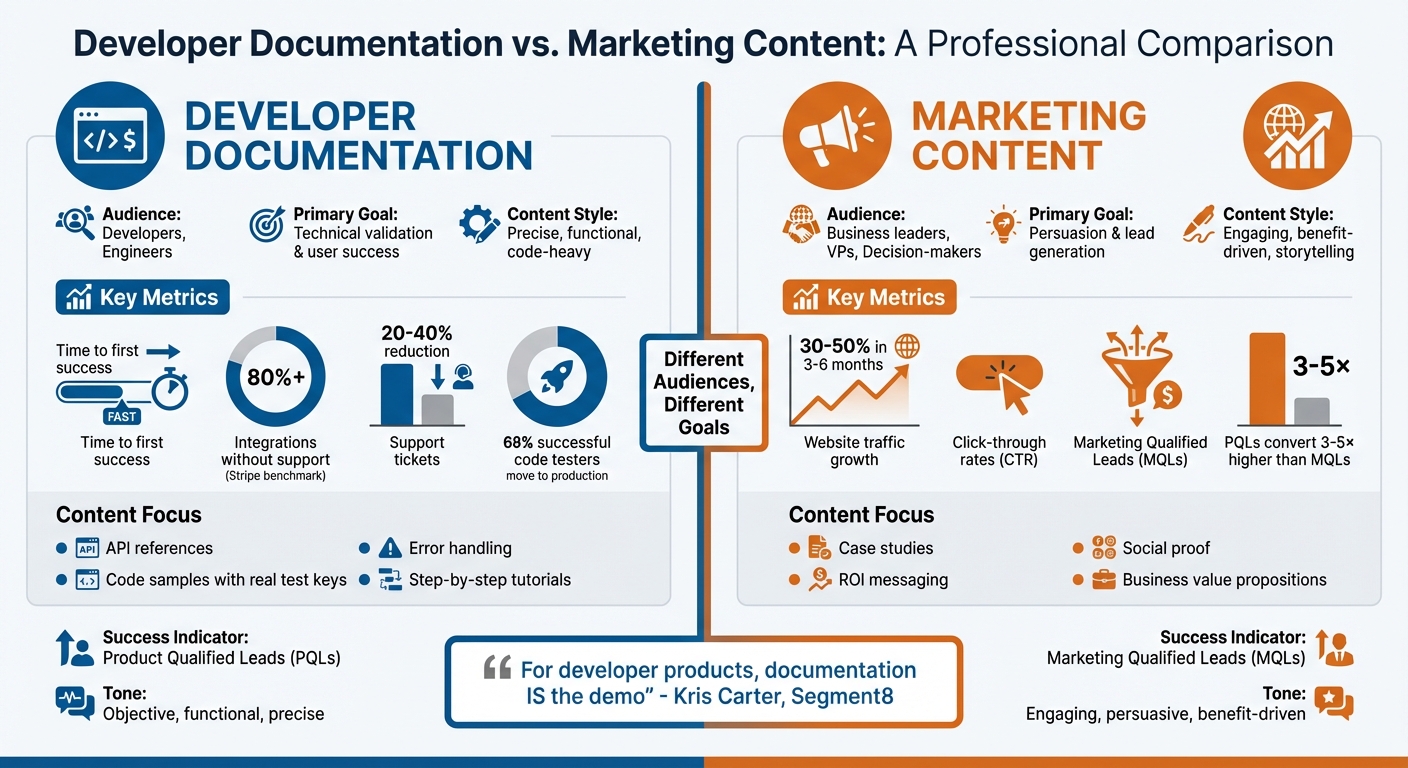 {Developer Documentation vs Marketing Content: Key Differences}
:::
{Developer Documentation vs Marketing Content: Key Differences}
:::
Docs as Marketing: Make Your API Irresistible
::: @iframe https://www.youtube.com/embed/7E-NEaXlspk :::
Primary Goals: Informing Developers vs. Engaging Customers
Developer documentation and marketing content are built with entirely different audiences and goals in mind. Documentation is there to guide developers through technical tasks - helping them integrate or use a product effectively. Marketing content, on the other hand, is all about convincing customers to adopt a product by showcasing its advantages, cost savings, and impact on business outcomes.
This fundamental difference influences everything - from the tone of the content to how success is measured. Developers, who are often the technical decision-makers, need straightforward API references and working code samples. Meanwhile, business leaders care more about metrics like ROI and case studies that prove the product's value [2]. As Kris Carter from Segment8 explains:
"For developer products, documentation IS the demo. Enterprise buyers see sales demos. Developers read docs" [3].
The sections below dive deeper into how these distinct goals shape content strategies and performance metrics.
Developer Docs: Clarity and Functionality
Developer documentation is all about precision and usability. Its purpose is to make technical integration as smooth and quick as possible. A key measure of success is the "time to first value" - how fast can a developer go from opening the documentation to completing a working integration?
Stripe is often held up as an example here. They aim for a metric where 80% or more of new integrations are completed without developers needing to contact support [3]. Any support request is seen as a failure in their documentation. Their approach works - 68% of developers who successfully run a code example in Stripe's docs end up integrating the product into production [3]. Additionally, well-crafted documentation can significantly reduce the number of support tickets. In fact, good technical docs can lead to a 20-40% drop in tickets for common issues [4].
In contrast, marketing content serves a completely different purpose.
Marketing Content: Persuasion and Engagement
Marketing content is designed to attract, engage, and persuade. It focuses on showcasing the product's benefits - how it saves time, increases revenue, or reduces risks. The tone is lively and benefit-focused, aimed at grabbing attention on platforms like social media, blogs, or email campaigns.
The metrics for success also reflect these goals. Marketing teams track website traffic, click-through rates (CTR), and Marketing Qualified Leads (MQLs) - potential customers who’ve shown interest by actions like downloading a whitepaper or signing up for a demo. For technical products, however, a more telling metric is Product Qualified Leads (PQLs) - users who reach a technical milestone, like successfully making an API call. These leads convert at rates 3-5 times higher than traditional MQLs [6]. This difference underscores why documentation often outperforms traditional marketing when targeting developers.
Comparison Table: Goals and Metrics
| Feature | Developer Documentation | Marketing Content |
|---|---|---|
| Primary Goal | Technical validation and user success | Persuasion and lead generation |
| Target Audience | Developers, Engineers (Evaluators) | VPs, Finance, Business Leaders (Approvers) |
| Content Focus | Accuracy, code samples, API references | Business value, ROI, social proof |
| Success Metrics | Time to first success, reduced support tickets | Traffic, CTR, MQLs, sales meetings |
| Tone | Objective, functional, precise | Engaging, persuasive, benefit-driven |
| Lead Type | Product Qualified Lead (PQL) | Marketing Qualified Lead (MQL) |
Content Structure and Style Differences
Developer documentation and marketing content are crafted for entirely different objectives. While developer documentation is designed for quick access and practical application - helping developers find an API endpoint, grab a code snippet, and move forward - marketing content is more about storytelling. It guides readers through a journey of identifying a problem, exploring a solution, and recognising the benefits, often ending with a clear call to action.
Developer Docs: Technical Depth and Precision
Developer documentation is all about functionality and accuracy. Think of it as a technical dictionary, where API endpoints, SDK methods, configuration options, and error codes are meticulously organised for instant access [3]. Tutorials and guides are structured by outcomes, typically featuring sections like project overview, prerequisites, estimated time, and step-by-step instructions [3].
Every code snippet in these docs is practical and ready to use, complete with real test API keys and error handling - no placeholder "TODO" notes here. This level of detail matters because when developers successfully execute these examples, they’re much more likely to adopt the product for production use [3].
The structure of developer documentation often follows a funnel-based approach. "Getting Started" guides cater to those evaluating the product, while more specific guides (sometimes called "Cookbooks") address mid-level challenges. Detailed API references are there for users deep into implementation [5]. High-quality documentation even links error codes to pages explaining both the issue and its resolution, turning errors into learning moments [3].
While developer docs focus on clarity and usability, marketing content takes a different route, aiming to connect with broader business goals.
Marketing Content: Engaging and SEO-Oriented
Unlike the structured, detail-oriented nature of developer docs, marketing content uses storytelling to engage and persuade. Headlines are crafted to grab attention and emphasise benefits, while the content flows seamlessly from identifying a problem to presenting a solution, often supported by social proof and ending with a strong call to action [4].
SEO plays a major role here. Marketing teams optimise content with strategic headings (H1–H3), compelling meta descriptions, and alt text that targets search queries like "OAuth2 token refresh example" [4]. The layout is designed to generate leads, featuring gated advanced guides, newsletter sign-ups, and clear call-to-action buttons for trials or demos [4].
To boost engagement, marketing content relies on visuals - hero images, testimonials, and videos - unlike developer docs, which prioritise functionality with features like copy-to-clipboard buttons, interactive API explorers, and architecture diagrams [3][4]. Interestingly, developers who use these interactive API tools within documentation are three times more likely to integrate the product [3].
Comparison Table: Structural Differences
| Feature | Developer Documentation | Marketing Content |
|---|---|---|
| Organisation | Functional (Reference vs. Guides) [3] | Narrative (Problem/Solution/Benefit) [3] |
| Core Elements | Code snippets, API endpoints, error codes [3] | Benefit-focused copy, CTAs, social proof [4] |
| SEO Focus | Long-tail, technical queries [4] | High-volume, awareness-based keywords [4] |
| Visual Elements | Copy-to-clipboard buttons, API explorers, diagrams [3][4] | Hero images, testimonials, video content [4] |
| Navigation | Version selectors, language tabs, deep search [3] | SEO-driven headers, internal linking [4] |
| Feedback Loop | Inline widgets, support tickets [4][5] | Conversion rates, lead quality, social shares [4] |
Recognising these differences allows you to use each content type effectively, ensuring they complement one another in a cohesive strategy.
Problems with Mixing Developer Docs and Marketing Content
Blending developer documentation with marketing content often undermines the purpose of both. Developer docs are meant to provide clarity and technical insights, while marketing content aims to persuade and showcase benefits. When these lines blur, confusion and mistrust can grow, making both formats less effective.
When Marketing Language Weakens Technical Documentation
Developers rely on documentation to make informed decisions, so when they encounter vague phrases like "unlimited scalability" or "zero-config" without solid technical backing, it raises red flags. These marketing buzzwords can obscure important details, leaving developers unsure about the product's actual capabilities or limitations [7][8].
What developers need are straightforward explanations of edge cases, performance constraints, and potential limitations - not a polished sales pitch. Omitting these realities to maintain a positive tone can lead to integration issues later on [7][9].
"If you can't explain your own product in plain language with concrete examples, relying instead on superlatives and buzzwords, you sound like you're hiding something." – EveryDeveloper [8]
Consider this: 54% of developers say the lack of quality documentation is the biggest barrier to using an API [5]. If the focus shifts from providing clarity to pushing a product, the documentation fails its primary purpose. As technical writer Deborah puts it, "In documentation, it is more important to get the user the information they need than to persuade them to buy. To compromise this weakens the value of docs to the user" [1].
Just as marketing language can erode trust in technical docs, overloading marketing content with technical jargon can make it less effective for its intended audience.
When Technical Details Reduce Marketing Effectiveness
On the flip side, marketing content loses its impact when it gets bogged down with overly technical language. While developers may want the nitty-gritty details, business decision-makers - like executives and finance directors - are more focused on outcomes and budgets [2]. Phrases like "RESTful API with OAuth 2.0" or "event-driven architecture using Kafka" might resonate with engineers, but they can leave business leaders puzzled about how the product solves their problems.
A great example of addressing this gap comes from Twilio. The company shifted its messaging from the developer-targeted "Ask your developer" to the more business-oriented "Reduce acquisition costs by 65%" [9]. This adjustment resonated with executives by focusing on measurable business value, not just technical features. The takeaway? Trying to cater to both audiences in one piece of content often results in neither being satisfied [8].
Engineering managers and VPs may care about technical credibility, but their main concerns often revolve around timelines and resource allocation. For example, knowing that implementation takes "2–4 weeks with one engineer" is far more actionable than a deep dive into technical specifications [2].
How to Keep Content Types Separate
The best way to avoid these pitfalls is to treat developer documentation and marketing content as distinct entities, each with its own goals. Documentation should prioritise user success, not act as a sales tool [1]. One practical step is to ban words like "easy", "scalable", and "high-velocity" in technical docs, replacing them with precise, data-backed descriptions [7].
"If I see 'Book a demo' or 'Talk to Sales,' I am out." – Yacine Hmito, Head of Technology, Fabriq [7]
For marketing, a dual-track approach works well. Headlines should highlight business value while offering developers a clear path to technical resources [2]. Separate content types - such as ROI calculators or use case pages for business leaders, and ungated quickstart guides or API references for developers - help ensure each audience gets what they need [2].
Another effective strategy is to adopt a "sales avoidance" mindset in technical content. This involves keeping developer relations and marketing teams somewhat independent to ensure technical content remains focused on utility, not conversion [9]. Additionally, bringing in external developers to review documentation can help weed out any promotional language that might undermine its credibility [9].
How Developer Docs and Marketing Content Work Together
Although developer documentation and marketing content serve different roles, they can complement each other when used wisely. This partnership not only validates a product's technical capabilities but also supports broader business goals. The trick lies in keeping their execution separate while aligning their distribution. Documentation should highlight technical value, while marketing ensures it reaches the right audience.
Using Developer Docs as Marketing Tools
For technical products, documentation often acts as the first impression. As Kris Carter, Founder of Segment8, aptly said:
"For developer products, documentation IS the demo" [3].
Developers prefer practical, working examples over polished sales pitches. This makes accurate and actionable documentation a powerful tool for driving conversions. For instance, Stripe shared during their 2023 Partner Summit that 68% of developers who successfully test a code example in their documentation go on to integrate the product into production [3]. Clear, executable code examples - complete with test API keys and realistic parameters - help developers achieve quick wins, boosting their confidence and commitment.
Documentation can also act as a steady source of leads. By optimising for specific, long-tail queries like "OAuth2 token refresh example", companies can attract highly qualified traffic. This approach can lead to 30–50% growth in organic traffic within 3 to 6 months [4], turning technical content into a reliable inbound funnel.
Interactive features in documentation take this a step further. Tools like "Try it" buttons or live sandboxes allow developers to test APIs directly, without needing to set up a local environment. This seamless experience makes developers 3× more likely to integrate the service [3]. By removing barriers to testing, companies make it easier for developers to evaluate their products.
Even changelogs can serve a dual purpose. Regular updates not only inform users about new features but also signal active development. Tools like Posterly's GitHub integration make it simple to convert code commits into shareable updates, allowing teams to highlight progress on marketing channels while keeping the technical content accurate.
With strong technical validation in place, the next step is to use marketing strategies to expand the documentation’s reach.
Promoting Developer Docs Through Marketing Channels
Once documentation establishes its technical credibility, marketing channels can amplify its visibility without compromising its integrity. The approach is simple: keep promotional language in the marketing materials and let the documentation focus on utility. As B2B marketer Ross Simmonds advises:
"Cut the fluff and don't try to sell your product or various features. Stick to what people want: code and direction" [10].
Platforms like GitHub, Reddit, and Discord are excellent for promoting technical content. These communities value practical, substance-driven posts, making them ideal for sharing guides, troubleshooting tips, or feature announcements. Email newsletters can also highlight new documentation sections or tutorials, encouraging repeat visits from existing users.
Product launches present another opportunity. When releasing new features, marketing teams can direct attention to updated API references or migration guides. This ensures developers have the resources they need right away, reducing support tickets. In fact, well-crafted technical content can cut support requests by 20–40% [4], while also encouraging faster feature adoption.
A great example of this approach is Vercel, which uses "Read the docs" as the primary call-to-action on their homepage [3]. This strategy recognises that developers trust technical documentation more than traditional marketing copy, turning the docs into a primary conversion tool.
The balance is critical. Marketing should highlight the documentation’s availability and benefits, while the documentation itself stays focused on delivering value. This separation helps maintain developer trust while ensuring the technical content reaches its intended audience.
Integration Table: Collaboration Strategies
Here’s a breakdown of how technical documentation and marketing can work together effectively:
| Strategy | Marketing Role | Documentation Role | Expected Outcome |
|---|---|---|---|
| SEO Optimisation | Research developer-focused keywords | Use structured content with schema | Increased organic traffic from technical users |
| Interactive Sandboxes | Highlight "Try it" features on key pages | Offer tested, executable code | 3× higher integration rate [3] |
| Changelog Promotion | Share updates via social media and newsletters | Provide detailed release notes | Faster adoption of new features |
| Gated Advanced Guides | Capture leads for enterprise-level features | Deliver in-depth technical content | More qualified leads |
| Error Message Links | Promote self-service support options | Link to searchable error references | Reduced support load, better user experience |
Conclusion
Developer documentation and marketing content play distinct yet complementary roles. Documentation provides developers with precise, actionable code that verifies product functionality. On the other hand, marketing content appeals to business leaders by emphasising return on investment, risk reduction, and strategic benefits. As Jeff Lawson, author of Ask Your Developer, aptly states:
"Developer documentation is the ultimate form of marketing" [5].
This distinction isn’t a barrier but an opportunity to create synergy when approached thoughtfully. Keeping the two separate while acknowledging their connection is essential. If marketing language infiltrates technical documentation, it can erode trust - developers prioritise practicality and need working code examples, not promotional messaging. Similarly, if technical jargon overtakes marketing materials, it makes the business case harder for decision-makers to understand. Each type of content must remain faithful to its audience and purpose.
Leading tech companies treat documentation as a key product feature. They invest in tools like automated testing for code snippets, optimise content for AI-driven search, and focus on metrics such as Time to First Success to ensure a smooth developer experience. Marketing then builds on this foundation by sharing documentation through channels like GitHub, using tools to turn commits into content, developer forums, and curated newsletters - without compromising its technical authenticity.
Striking the right balance is essential. Documentation answers the "how", offering the technical depth developers need to confidently implement solutions. Marketing addresses the "why", showcasing the value, cost efficiencies, and strategic benefits. When these two elements align, they create a seamless path for adoption through both technical precision and compelling communication.
FAQs
::: faq
How do developer documentation and marketing content work together to enhance product success?
Developer documentation and marketing content can join forces to fuel product growth by leveraging their distinct strengths.
Clear, thorough developer documentation enables technical users to understand, test, and integrate your product on their own. This independent learning process builds trust and creates a smooth onboarding experience, making documentation a powerful driver of product-led growth.
Meanwhile, marketing content extends the reach of developer docs by transforming them into engaging formats like campaigns, tutorials, or community-driven resources. For instance, a technical guide can be reshaped into an educational blog post or a series of social media updates, helping your product connect with a wider audience. Together, this combination ensures your product is not only easy to use but also visible and appealing to both technical users and decision-makers. :::
::: faq
Why should developer documentation avoid using marketing language?
Mixing promotional language with developer documentation can weaken its effectiveness and erode trust. Developers turn to documentation for precise, technical guidance - not sales pitches. When marketing terms creep in, the content can feel less dependable, as though it's prioritising promotion over problem-solving. This can lead to frustration or even alienation among users.
Additionally, excessive use of marketing jargon can obscure the technical clarity needed to resolve issues or understand the product thoroughly. To keep documentation credible and useful, it's crucial to focus on clear, practical, and developer-centric content that supports their needs without veering into promotional distractions. :::
::: faq
Why should developer documentation and marketing content be kept separate?
Developer documentation and marketing content are designed for completely different audiences and purposes, which is why keeping them separate is so important. Developer documentation caters to a technical audience, such as software developers, by providing precise, in-depth instructions. Its goal is to help users understand, integrate, and maintain software or APIs effectively.
On the other hand, marketing content targets potential customers. It uses engaging and benefit-focused language to spark interest and encourage conversions.
Blending these two types of content can create confusion. Developers may find promotional language distracting or irrelevant, while non-technical readers might feel lost in technical jargon. By keeping them distinct, you ensure that each piece of content speaks directly to its intended audience, improving clarity, usability, and the overall effectiveness of your communication. :::
Related Articles
How to Create 30 Days of Social Media Content Using AI Images in posterly
A practical guide to generating a full month of original social media images with posterly's AI image tool, writing captions for each one, and scheduling everything in a single session.
Read moreHow to Find the Best Time to Post on Social Media Using posterly's AI Scheduler
Stop guessing when to post. This guide explains how posterly's AI Scheduler analyses your audience activity and automatically picks the best posting times so your content gets seen by more people.
Read moreHow to Manage Google Business Reviews on Autopilot With posterly
A step-by-step guide to responding to Google reviews with AI, automatically requesting new reviews from customers, auditing your profile for local SEO, and turning your best reviews into social media content.
Read moreHow to Manage Multiple Client Social Media Accounts With posterly Workspaces
A practical guide for agencies and teams on using posterly Workspaces to organise client accounts, assign roles, get content approved, and schedule posts across dozens of social profiles without things getting messy.
Read more