
DM Automation vs Manual Messaging: When Each Wins
Pros, cons, and engagement data on automated DM bots vs hand-written replies, plus the line where automation hurts your brand.
Prefer posterly in Google Search?
DM Automation vs Manual Messaging: When Each Wins
DM automation and manual messaging each have strengths and weaknesses, making the right choice dependent on your goals. Automation, such as using an Instagram scheduler, excels in speed, cost-efficiency, and scalability, while manual messaging is better for personal, complex interactions. Here’s a quick breakdown:
- Automation: Handles thousands of messages 24/7, cuts costs (AED 3.67-18.35 per lead), and reduces response times to seconds. However, it struggles with emotional or complex queries and risks impersonal communication.
- Manual Messaging: Offers personal, empathetic replies and is ideal for high-value clients or nuanced issues. But it’s slower, costly (AED 36.70-91.75 per lead), and limited by human capacity.
Quick Comparison
| Aspect | DM Automation | Manual Messaging |
|---|---|---|
| Availability | 24/7 instant response | Limited to business hours |
| Personalisation | Context-aware, but lacks empathy | Highly tailored and empathetic |
| Scalability | Handles thousands of DMs | Limited to 20-30 messages per day |
| Cost per Lead | AED 3.67-18.35 | AED 36.70-91.75 |
| Response Speed | Seconds | Minutes to hours |
| Best Use Case | FAQs, lead qualification | VIP clients, complex issues |
For most businesses, a hybrid approach works best - using automation for repetitive tasks and manual messaging for high-priority interactions.
::: @figure 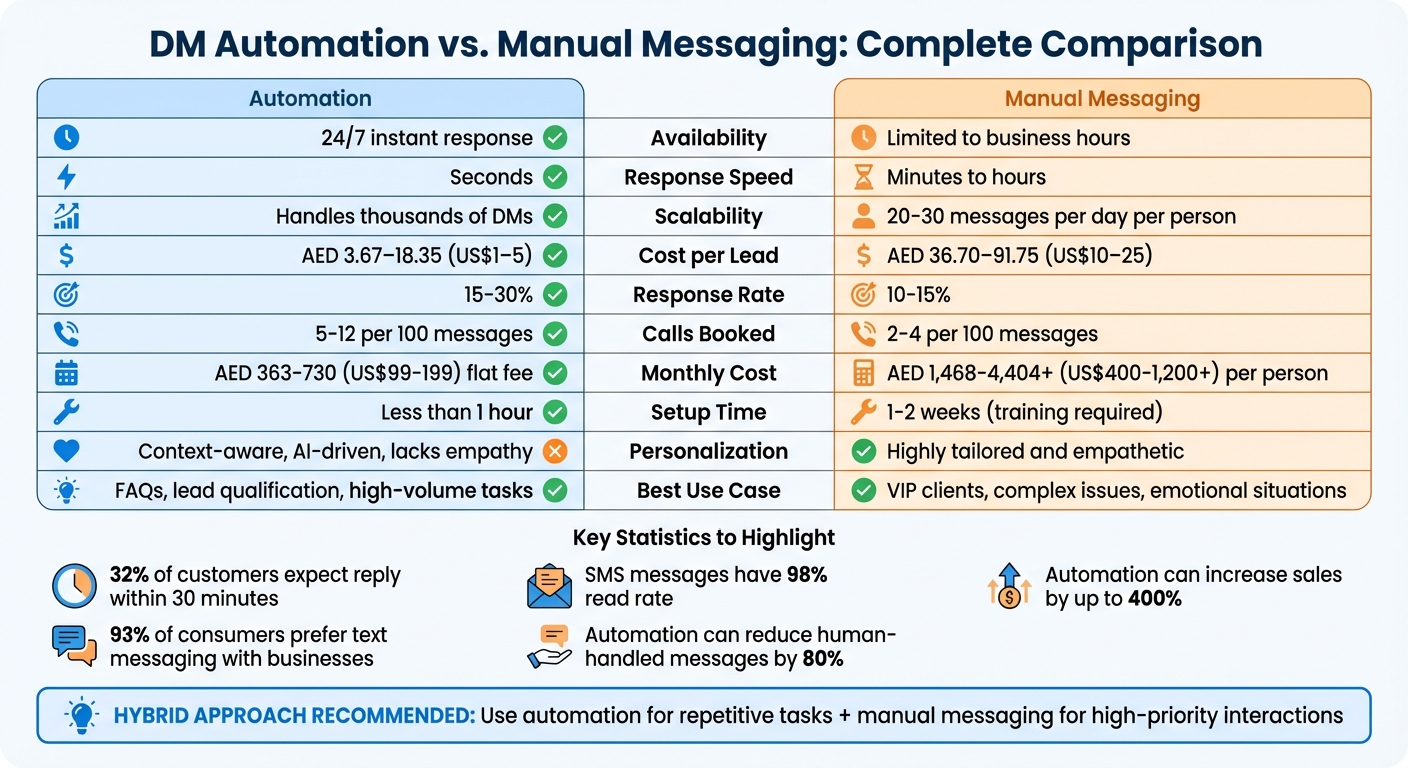 {DM Automation vs Manual Messaging: Complete Performance Comparison}
:::
{DM Automation vs Manual Messaging: Complete Performance Comparison}
:::
DM Automation: Benefits and Drawbacks
Benefits of DM Automation
Automated DMs offer round-the-clock engagement. Even at 03:00 on a Friday, your business can respond to queries - a crucial feature given that 32% of customers expect a reply within 30 minutes [5]. This constant availability ensures you never miss an opportunity, all without requiring late-night shifts.
Another advantage is scalability. A single AI-powered system can handle thousands of conversations across multiple accounts, something that would otherwise demand a massive human workforce [7]. Consider this: automated messaging typically achieves response rates of 15-30%, compared to 10-15% for manual outreach. It also books 5-12 calls per 100 messages, far outperforming manual efforts, which average just 2-4 calls. And the cost? Automated systems generate qualified leads for as little as AED 3.67-18.35 (US$1-5), compared to AED 36.70-91.75 (US$10-25) when relying on manual teams [7].
Automation is also great for handling routine queries, such as inquiries about business hours, pricing, or product availability. It can collect emails, qualify leads, and redirect prospects to the right team - all while maintaining a consistent brand voice [6][7][2]. This frees up human teams to focus on more complex or high-value interactions.
However, automation isn't without its challenges.
Drawbacks of DM Automation
The biggest issue with automation is its struggle to handle nuanced situations. AI often falters when faced with multi-part questions, emotional complaints, or issues that require a personal touch [5]. For example, a frustrated customer dealing with a delayed order might find a scripted response more aggravating than helpful. And if the system is poorly configured, it can even result in endless loops of irrelevant replies [3].
Platform rules also create hurdles. Take Meta, for instance, which enforces a strict 24-hour messaging window for Facebook and Instagram. Without explicit opt-ins, you can't send automated messages beyond this timeframe [3][4]. Additionally, automated "cold" DMs sent to non-followers often end up in the Message Requests folder, reducing their visibility [9]. High volumes of repetitive messages can also lead to shadowbans, rate limits, or even account suspensions [5][8].
There's also the risk of damaging your brand's image. Messages that come across as robotic or impersonal can alienate your audience. Users might opt out, report your account as spam, or simply ignore future communications [8][10].
As Aman from xAutoDM explains, "Automated messages sent incorrectly can come off as too much. When they feel a communication message is impersonal or doesn't relate to them at all, customers' perception of the brand can be damaged" [8].
These drawbacks highlight the importance of balancing automation with thoughtful implementation.
DM Automation: Side-by-Side Comparison
| Metric | Automation Pros | Automation Cons |
|---|---|---|
| Response Time | Instant, 24/7 availability | May feel rushed for complex issues |
| Personalisation | Uses dynamic tags for basic relevance | Lacks true empathy and situational awareness |
| Scalability | Effortlessly handles high-volume outreach | High volume increases risk of platform penalties |
| Error Risk | Eliminates human typos and missed messages | Risk of bot loops or irrelevant responses |
| Cost Efficiency | AED 366-732/month flat fee (US$99-199) | Requires initial setup and ongoing optimisation |
Manual Messaging: Benefits and Drawbacks
Benefits of Manual Messaging
Manual messaging shines in areas where automation often falls short: creating genuine human connections. When customers interact with someone who truly understands their needs, trust builds naturally. This sense of authenticity plays a key role in fostering loyalty and encouraging meaningful actions - something scripted responses can't replicate [11].
This approach is particularly effective for handling complex or nuanced issues. Manual messaging allows for deep personalisation by adjusting tone, asking specific questions, and tailoring responses to fit unique contexts. For example, a high-value client might receive a more carefully crafted message than a casual reply to a long-time follower [13]. This level of attention helps businesses better understand their audience's motivations and needs, directly contributing to stronger loyalty and higher conversion rates [6][11][12].
The statistics back this up: 93% of consumers prefer communicating with businesses via text messaging, and SMS messages boast an impressive 98% read rate, with most being read within five minutes [14]. When done manually, these interactions feel personal - like chatting with a friend. Adding elements like emojis, videos, or photos can make these exchanges even more engaging and relatable [14].
However, these advantages come with notable challenges.
Drawbacks of Manual Messaging
Despite its strengths, manual messaging has clear limitations - chief among them is scalability. Humans have finite capacity, with many experiencing burnout after sending just 20-30 messages per day [7]. Managing direct messages manually is time-consuming, requiring 1-2 hours daily for prospecting and an additional 2+ hours for sending messages and follow-ups. This adds up to 15-20 hours per week [7].
This time commitment also translates into higher costs. The cost per qualified lead for manual messaging ranges from AED 36.70-91.75 (US$10-25), compared to the more economical AED 3.67-18.35 (US$1-5) for automated methods [7]. Scaling manual efforts often means hiring additional staff or Virtual Assistants, which can cost AED 1,468-4,404+ (US$400-1,200+) per month per person [7]. As your audience grows, these expenses increase proportionally.
Manual messaging also struggles with speed and consistency. Responses are limited by human availability, making it difficult to meet the expectations of the 32% of customers who want a reply within 30 minutes [5]. Additionally, manual messaging typically achieves a response rate of 10-15%, booking only 2-4 calls per 100 messages - a lower performance compared to optimised automation [7]. Teams may also face challenges with maintaining a consistent tone across different staff members and lack the systematic data tracking that automated systems provide [7].
As Santiago Garcia Solimei, Global Head of Social Media & Brands PR at Meliá Hotels International, observed: "When we started to report on how many people wanted to book hotel rooms through social media, we realised we hadn't capitalised on the business potential coming through direct and public messaging" [6].
Manual Messaging: Side-by-Side Comparison
| Metric | Manual Messaging Pros | Manual Messaging Cons |
|---|---|---|
| Speed | Thoughtful, nuanced replies | Slow; limited by human typing speed and availability |
| Personalisation | High empathy and contextual flexibility | Inconsistent tone during high-volume periods |
| Scalability | Ideal for VIP clients and complex situations | Very low; requires additional staff to grow |
| Efficiency | Best for closing high-value, relationship-driven deals | High cost per lead (AED 36.70-91.75) and labour hours |
| Availability | Can adapt to unique situations in real-time | Restricted to business hours |
5 Best Instagram DM Automation Tools in 2026 (Ultimate Comparison)
::: @iframe https://www.youtube.com/embed/Ynd9-X1XMOM :::
Schedule smarter with AI
AI captions, 18 platforms, plans from $7/mo
DM Automation vs. Manual Messaging: What Sets Them Apart
The main difference boils down to speed versus depth. Automation responds in seconds, while manual messaging can take minutes, hours, or even days [2]. This matters because 32% of social media users expect a reply within 30 minutes, and 42% expect one within an hour [5]. This speed advantage is just the start of how these two approaches differ.
Availability is another major distinction. Automated systems are active 24/7, engaging with customers no matter the time. On the other hand, manual messaging depends on human schedules, with off-hour inquiries often pushed to the next working day [2]. This constant availability makes automation ideal for time-sensitive interactions.
Then there’s scalability. Automation can handle thousands of conversations simultaneously without breaking a sweat. Compare that to human teams, who typically manage 20-30 messages daily before hitting their limit [7]. Even better, AI chatbots can cut down the number of messages needing human input by 80%, which boosts team productivity by 25% [6].
That said, personalisation is where manual messaging shines. Humans can adapt their tone, read between the lines, and address complicated objections. Automation, however, offers consistency. It ensures follow-ups are never missed, keeps the brand voice uniform, and uses AI to tailor responses based on context [6].
Automation vs. Manual Messaging: Direct Comparison
| Aspect | DM Automation | Manual Messaging |
|---|---|---|
| Availability | 24/7 instant response | Limited to business hours and staff availability |
| Personalisation | AI-driven, context-aware; uses data tokens | Highly nuanced; empathetic and tailored responses |
| Volume Handling | Handles thousands of DMs effortlessly | Limited to 20-30 messages per day per person |
| Response Speed | Instant (seconds) | Minutes to hours (or longer) |
| Cost per Lead | AED 3.67-18.35 (US$1-5) | AED 36.70-91.75 (US$10-25) |
| Response Rate | 15-30% | 10-15% |
| Calls Booked | 5-12 per 100 messages | 2-4 per 100 messages |
| Setup Time | Less than 1 hour | 1-2 weeks (training required) |
| Monthly Cost | AED 363-730 (US$99-199) flat fee | AED 1,468-4,404+ (US$400-1,200+) per person |
| Compliance | Requires Meta-verified tools; adheres to a 24-hour window | Naturally compliant; lower risk of "bot" flags |
Choosing the Right Approach: Automation, Manual, or Both
The method you choose should align with the situation. Automation shines in managing repetitive, high-volume tasks like answering common questions about store hours, shipping updates, or pricing. It’s also perfect for 24/7 lead qualification. When dealing with large-scale enquiries, automation ensures no one waits longer than a few seconds for a response.
On the other hand, manual messaging is essential for situations that demand empathy and nuanced judgement. VIP customers, complex sales discussions, and delicate matters - like refund requests or product quality concerns - are best handled by a human. When emotions run high or a tailored solution is required, bots simply won’t cut it.
A hybrid approach brings the best of both worlds. Start with automation to greet users, ask a couple of qualifying questions, and direct enquiries to the right team. Then, set up triggers for human intervention when terms like "urgent", "problem", or "refund" appear. For example, in January 2026, Alexxmarketing’s automated comment-to-DM workflow generated 500 leads and secured three high-ticket clients in just one week [4]. This method blends the efficiency of automation with the personal touch needed for more intricate scenarios.
"Automated DMs aren't meant to completely replace human customer service. Instead, they enhance it by automating the repetitive stuff, so your team can focus on where they'll have the biggest impact."
For a seamless integration of both methods, tools like posterly make it easy. With a unified dashboard covering over 10 platforms, posterly lets you monitor automated processes while stepping in for high-priority leads. Its AI-assisted dashboard (Pro plan: AED 55/month for 12 accounts; Power: AED 92/month for 30 accounts) streamlines routine tasks while keeping manual support ready for high-value interactions.
Conclusion
Consider using DM automation for tasks like answering FAQs, qualifying leads, and ensuring 24/7 responsiveness. On the other hand, reserve manual messaging for situations that demand empathy, personalised attention, and a human touch.
The numbers back this approach: automation can cut down the volume of messages handled by humans by 80% [6] and even increase sales by up to 400% [15]. Still, human input is irreplaceable when it comes to handling complex discussions or emotionally sensitive matters.
As Suraj Kiran, Co-Founder at LinktoDM, puts it:
"The goal is not total automation, but intelligent augmentation of your communication strategy."
- Suraj Kiran, Co-Founder at LinktoDM [1]
For creators and teams in the UAE juggling multiple platforms, posterly offers a practical solution. Its unified dashboard helps you oversee automated workflows across Instagram, TikTok, LinkedIn, and more - while leaving room for manual input when required. Starting at just AED 26/month (Starter plan for 5 accounts) and scaling to AED 92/month (Power plan for 30 accounts), it enables you to streamline repetitive tasks while maintaining the personal touch that builds lasting customer loyalty.
FAQs
::: faq
How does combining automation and personal messaging enhance customer engagement?
Using a mix of automation and personal messaging can dramatically improve how businesses connect with their customers. Automation speeds up responses to routine questions, cutting wait times from hours to just seconds. On the other hand, personal messaging lets human agents step in for more complex or sensitive issues, striking a balance between efficiency and a human touch.
This approach allows businesses to build trust and loyalty by combining speed with personalised care. Customers enjoy quick solutions while still feeling appreciated through meaningful human interaction, fostering stronger connections and creating better experiences overall. :::
::: faq
What are the potential downsides of relying too much on DM automation?
Relying too much on DM automation can create several problems. For starters, it often leads to impersonal messages that lack warmth and personality. When people receive messages that feel robotic or overly generic, it can frustrate them and damage your brand's image. Nobody likes feeling like just another number in a system.
Another issue is that platforms like Instagram and X (formerly Twitter) have strict rules against anything that looks like spam. If you lean too heavily on automation, you risk triggering penalties, such as account restrictions or even permanent bans. Staying within the guidelines of these platforms is a must to avoid such setbacks.
Finally, excessive automation can hurt your ability to foster genuine engagement - the kind that builds trust and meaningful relationships. Striking the right balance between automation and personal, manual interactions is essential to keep your communication authentic and impactful. :::
::: faq
When is it better to use manual messaging instead of automation?
Manual messaging shines in scenarios where personalised communication is crucial for building trust and fostering strong relationships. Take, for instance, interactions with high-value clients or addressing unique customer concerns - manual messaging allows you to craft tailored responses that demonstrate a genuine understanding of individual needs.
This method is also perfect for real-time, spontaneous exchanges, such as handling urgent inquiries or engaging in dynamic conversations. In situations that are sensitive or complex, manual messaging brings a sense of empathy and nuance, offering a level of care that automated systems often struggle to match.
While automation is excellent for boosting efficiency and handling large-scale tasks, manual messaging stands out when authenticity, personalisation, and immediacy are essential to achieving meaningful communication. :::
Schedule smarter with AI
AI captions, 18 platforms, plans from $7/mo
Founder newsletter
Launch with Alex
Building companies from Dubai. Field notes from running more than one, and the decisions that paid off.
See more of posterly in Google
Add us as a preferred source. Google can show more of our articles in your Top Stories and a Preferred badge in AI Overviews.
Related Articles
AI Social Media Monitoring: Real-Time Tools That Work
How AI-powered monitoring catches mentions, sentiment shifts, and viral risks in real time, tools, setup, and what to actually watch for.
Read morePlatform-Specific Content Guide: What Works
Format, length, and tone guidance for Instagram, LinkedIn, X, TikTok, and more, with examples of posts that actually performed.
Read moreAI Infographic Tools for SaaS Marketing
AI Infographic Tools for SaaS Marketing
Read more10 Time-Saving Tips for Social Media Content Creators
Batched workflows, AI shortcuts, and templates creators use to ship more content with less effort. Practical wins, not productivity theatre.
Read more