
Pinterest Content Discovery: 7 Key Ranking Factors
Pinterest Content Discovery: 7 Key Ranking Factors
Pinterest Content Discovery: 7 Key Ranking Factors
Pinterest is a visual search engine that thrives on quality content and user engagement. With UAE users among the most active globally, understanding how Pinterest ranks content can help you stand out. Here are the seven key factors that influence your success on the platform:
- Pin Quality: Use vertical images (1000x1500 px) with clear, bold text overlays. High-resolution visuals and proper formatting are essential for better visibility.
- Keyword Usage: Keywords in titles, descriptions, and board names help your content get discovered. Align your keywords with the content on your linked page for better rankings.
- Domain Trust: Verifying your website and using Rich Pins improves credibility and increases your content's reach.
- Profile Strength: Organize niche-specific boards, maintain an active posting schedule, and ensure your profile reflects your expertise.
- Engagement Signals: Saves, clicks, and long clicks (35+ seconds on your site) indicate valuable content. Early engagement boosts visibility.
- Content Freshness: New Pins (under 7 days old) receive a temporary ranking boost. Regular posting (5–15 Pins daily) keeps your account active and reliable.
- Regional Relevance: UAE-specific content, including Arabic-language Pins and local trends like Ramadan, performs well due to location-based personalization.
These factors work together to optimize your content for Pinterest’s algorithm, helping you reach the right audience and improve engagement. Focus on quality visuals, strategic keywords, and consistent posting to maximize your impact.
::: @figure 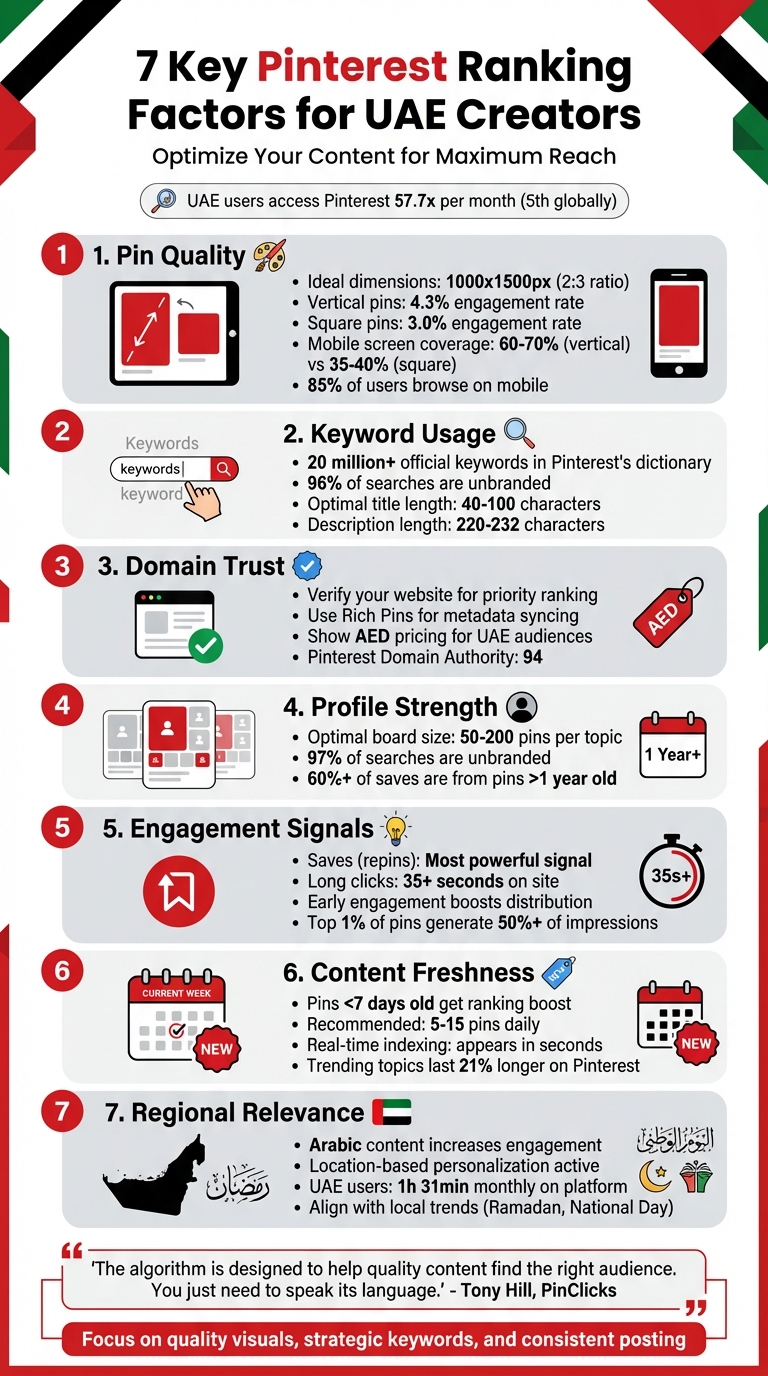 {Pinterest Ranking Factors: 7 Key Elements for UAE Creators}
:::
{Pinterest Ranking Factors: 7 Key Elements for UAE Creators}
:::
Understanding the Pinterest Algorithm
::: @iframe https://www.youtube.com/embed/DJsv6N5_cy0 :::
How Pinterest Content Discovery Works
Pinterest’s content discovery is powered by a machine learning system with three interconnected components. First, there’s the User Graph, which groups individual preferences into clusters like "home décor" or "fitness", capturing the diversity of user interests. Then comes the Matching System, which pairs the right Pins with the right audiences. This system uses a multi-stage ranking process to filter and match Pins to users who are most likely to engage with them.
When you search on Pinterest, your query goes through a three-stage funnel: retrieval, pre-ranking, and full ranking. This process narrows billions of Pins down to the most relevant ones. During pre-ranking, the system evaluates factors like keyword matches and image quality. The full ranking stage then applies the "Pinnability" algorithm, which predicts user engagement by analysing historical data and real-time behaviour [2]. For the home feed, Pinterest uses a tool called Pixie, which identifies related content based on your recent interactions [1][2].
Pinterest’s algorithm relies on three key metrics: relevance, quality, and trust. Relevance is determined through its "Interest Taxonomy", an internal dictionary with over 20 million keywords used to categorise content [2]. Quality is measured through engagement metrics, such as the number of "Saves" and "long clicks" (when a user spends 35 seconds or more on your website) [1][2]. Finally, Trust is tied to Domain Quality, which considers whether your website is verified, claimed, and consistently produces content that users save [4][6].
"The algorithm isn't working against you… it's actually designed to help quality content find the right audience. You just need to speak its language." – Tony Hill, PinClicks [1]
For creators in the UAE, Pinterest tailors its results using geographic data, language preferences, and local trends [2][5]. This means content optimised for Arabic-speaking audiences or tied to regional events - like Ramadan or National Day - has a better chance of reaching the right users in the Emirates. Pinterest’s indexing system, Manas Realtime, ensures that new Pins appear in search results within seconds of being published, especially when you schedule Pinterest pins to align with peak activity [2]. To maximise visibility, it’s crucial to align your content with local interests and cultural moments.
Pin Quality and Visual Performance
When it comes to Pinterest, visuals are everything. The platform's algorithm prioritises content quality, and that means your Pins need to look sharp and be optimised for performance. For starters, the ideal Pin format is a vertical layout with dimensions of 1000×1500 px and an aspect ratio of 2:3. Why? This format takes up a significant chunk of mobile screen real estate - about 60–70% - while square Pins only manage 35–40%. Considering that 85% of Pinterest users browse on mobile devices, this difference can make or break your Pin's visibility and engagement [13].
Why Visual Clarity Matters
Pinterest's algorithm uses computer vision to analyse your images. It looks for objects, colours, and styles to determine relevance [13]. If your image is blurry, it’s likely to be penalised in distribution. To avoid this, ensure your visuals are crisp and professional. Also, keep text readable: use bold, sans-serif fonts with a minimum size of 24pt for body text and 60–80pt for headlines. Make sure critical elements stay within the central 80% of the image to prevent them from being cut off on smaller screens [13].
File Size and Load Times
File size is another critical factor. While Pinterest allows files up to 20MB, it’s best to keep them under 5MB to ensure faster load times and avoid algorithm penalties [13]. Compression tools can help you reduce file size without sacrificing quality - aim for a range between 2–5MB. Additionally, bright, high-contrast colours tend to perform better. Interestingly, 87 of the top 100 dominant colours in viral Pins were shades of white, near-white, or light grey [7].
Key Differences Between High-Quality and Low-Quality Pins
| Feature | High-Quality Pin | Low-Quality Pin |
|---|---|---|
| Aspect Ratio | 2:3 (Vertical) | Horizontal or Square (Reduced reach) |
| Dimensions | 1000 x 1500 px | Under 600 px width (Pixelated/Penalised) |
| File Size | Under 5 MB (Fast loading) | Over 20 MB (Slow loading, may be rejected) |
| Text Overlay | 60–80pt headlines; high contrast | Small fonts (< 24pt); low contrast (Unreadable) |
| Engagement | 4.3% average engagement rate | 1.9%–3.0% engagement rate |
| Distribution | Full home feed & search visibility | Cropped, distorted, or buried by the algorithm |
Engagement and Branding Tips
Vertical Pins consistently outperform other formats, achieving an average engagement rate of 4.3%, compared to just 3.0% for square Pins [13]. In fact, the top 1% of Pins generate more than half of all impressions and clicks on Pinterest [7]. To boost brand recognition and build trust, consider adding a subtle logo or watermark to your Pins. This small touch can make a big difference in reinforcing your brand identity [13].
Keyword Relevance and Pinterest SEO
While stunning visuals grab attention, keywords are the backbone of your Pin's discoverability. Pinterest isn't just a platform for pretty pictures - it's a search engine. Its algorithm uses keywords to categorise and recommend content. What sets Pinterest apart is its internal dictionary of over 20 million official "interest keywords" (referred to as "annotations"), which helps match your Pins to the right audience [2]. This system ensures that the keywords in your Pin align with the content you're linking to, creating a seamless user experience.
The algorithm evaluates something called "topic cohesion." This means it checks how well the keywords in your Pin title and description align with the content on your linked landing page. When the keywords and content match well, your Pin ranks higher. But if there's a disconnect - like a Pin titled "Vegetarian Slow Cooker Recipes" linking to a blog post about general meal prep - the algorithm may hide your Pin from search results [2]. So, while eye-catching visuals draw people in, accurate and strategic keyword placement ensures they can find your content in the first place.
Keyword placement is key. The algorithm prioritises keywords at the beginning of Pin titles, so placing your primary term upfront is critical [3]. Board names also play a significant role in determining your Pin's "neighbourhood" within Pinterest's Content Graph. For example, instead of using a generic board name like "Food", opt for something more specific and keyword-rich, such as "Vegetarian Slow Cooker Recipes" [2].
Here's a quick breakdown of how different text elements on Pinterest contribute to rankings and how to optimise them:
| Pin Text Element | Ranking Role | Best Practice |
|---|---|---|
| Pin Title | A major search signal that impacts click-through rates (CTR). | Keep it between 40–100 characters and start with your primary keywords [7]. |
| Pin Description | Adds semantic context to the Content Graph. | Write 220–232 characters using natural language and secondary keywords [15]. |
| Board Name | Determines topical relevance and the "neighbourhood" of your Pin. | Use specific, niche keywords like "Modern Farmhouse Décor" [2]. |
| Board Description | Boosts board relevance and your profile authority. | Include 1–2 keyword-rich sentences that clearly explain the board's niche [16]. |
| Alt Text | Improves visual recognition and accessibility. | Provide a literal description of the image while incorporating target keywords [7]. |
Interestingly, 96% of searches on Pinterest are unbranded [15]. This means users are looking for ideas, inspiration, and solutions - not specific brands. To tap into this, leverage Pinterest's autocomplete feature and the Pinterest Trends tool to uncover high-volume search terms. Then, naturally incorporate these keywords into your titles, descriptions, and board names [18]. By doing so, you align your content with what users are actively searching for, amplifying your reach.
Domain Quality and Profile Strength
Pinterest assesses the trustworthiness of your linked website through something called "Domain Quality." Essentially, this is a ranking factor that reflects how reliable your site appears to the platform. The more users engage with your content, the stronger your domain’s authority becomes[4].
Start by verifying your website. Verification through a Pinterest Business account is a critical first step. It signals trust, and verified accounts enjoy a clear advantage: Pins from verified owners are prioritised over re-pins[19]. Sarah Israel from Hootsuite puts it simply:
"Domain quality ranks the perceived quality of your website based on the popularity of the pins linked to it"[21].
Rich Pins add another layer of credibility. These Pins automatically pull metadata like pricing and availability directly from your website[20]. This real-time syncing ensures your Pins always display accurate information, which reinforces your site’s reliability. For businesses in the UAE, using Product Rich Pins with AED pricing and local stock data is especially important[5]. Showing prices in AED, rather than USD, highlights that your content is tailored for UAE shoppers - a key ranking factor[2].
Consistency is just as important as verification. Regular activity keeps your domain quality strong. Pinterest rewards fresh content, with Pins less than seven days old receiving a notable ranking boost[1]. To make the most of this, align your content with local trends and ensure it stays relevant to UAE audiences.
| Feature | Impact on Domain Quality | UAE Implementation Strategy |
|---|---|---|
| Website Claiming | Adds a verification badge; prioritises owner-created Pins | Use a .ae domain or regional subfolder to emphasise local relevance |
| Rich Pins | Syncs metadata (e.g. price, stock); improves presentation | Use AED pricing to cater to local shoppers |
| Verified Merchant Programme | Boosts trust and shopping visibility | Register via Pinterest Business Hub after integrating your catalogue |
| Consistent Activity | Keeps domain signal active; boosts reliability | Post at least one fresh Pin daily to leverage the freshness boost |
User Engagement and Freshness Signals
After ensuring your content is high-quality and optimised for SEO, the next step is to focus on user engagement and how fresh your Pins are. These two factors play a big role in boosting your ranking on Pinterest.
Pinterest evaluates three main engagement signals to decide which Pins deserve more visibility: saves (repins), clicks, and comments. Among these, saves are the most influential. As stated by Pinterest for Creators:
"The strongest metric to measure how people are engaging with a Pin - and how an idea is resonating with people - is saves" [22].
When users save your Pin, it signals that your content is worth revisiting later. This tells Pinterest’s algorithm to distribute your Pin to a broader audience. Understanding how these engagement types differ allows you to fine-tune your strategy for better results.
Engagement Types Matter
It’s important to distinguish between Pin clicks (enlarging the image) and outbound clicks (visits to your linked site). A key metric here is the "Long Click", where users stay on your linked site for 35 seconds or more - this is a strong indicator of meaningful engagement [1][2]. Comments also play a role, as they show users are invested enough to start a conversation [5][22].
Early Engagement is Key
When a Pin gets early interactions, Pinterest’s Pinnability system recognises it as high-quality content and boosts its distribution [2][3]. Timing your posts is crucial - posting during peak activity hours for UAE audiences increases the chances of getting those early saves and clicks. Thanks to Pinterest's real-time indexing, new Pins can show up in search results within seconds, making the first hour after publishing especially important [2]. Posting consistently during these peak times ensures you maximise this critical engagement window.
Why Consistency Matters
Regular posting is not just a good habit - it’s essential. Tony Hill, Founder of PinClicks, emphasises this point:
"Pins that are less than 7 days old get a ranking boost, which is why consistent posting is so important" [2].
The freshness boost resets with every new Pin, which is why a steady posting schedule outperforms sporadic activity. Maintaining a regular rhythm ensures you take full advantage of the freshness window and sustain your momentum.
Here’s a quick comparison of the benefits of consistent posting versus irregular activity:
| Feature | Regular Pinning Schedule | Irregular Posting |
|---|---|---|
| Algorithm Signal | Shows reliability and active creator status [3][2] | Indicates lower engagement [4][23] |
| Freshness Boost | Fully utilises the <7-day ranking boost for new Pins [1][2] | Misses out on freshness windows, leading to traffic drops [5] |
| Audience Growth | Builds a following and increases reach over time [5] | Struggles to maintain momentum or community interest [22] |
| Distribution | Content is consistently shown in the "Smart Feed" [17] | Relies on older Pins resurfacing occasionally [5] |
1. Pin Quality and Visual Clarity
The visual appeal of your Pins is the cornerstone of success on Pinterest. The platform’s algorithm uses advanced computer vision to analyse every image you upload - examining objects, colours, and styles to decide where your Pin appears in search results [1]. If your image is blurry, poorly lit, or distorted, the algorithm struggles to categorise it properly, which means your Pin won’t reach its intended audience [5].
The 2:3 aspect ratio (1,000 x 1,500 pixels) is the gold standard for high-performing Pins [5][7]. Why? Because 85% of Pinterest users browse on mobile devices [4]. Vertical images naturally take up more screen space, making them more eye-catching and harder to scroll past.
Sharp visuals and resolution are non-negotiable. Pinterest explicitly recommends "solid lighting, great framing, high-resolution assets, and stylised effects" as markers of quality [5]. Interestingly, 89% of the most viral Pins are standard Image Pins - not videos or carousels [7]. High-contrast visuals paired with lighter backgrounds can make your Pins stand out in Pinterest’s busy feeds.
Text overlays need a thoughtful approach. Since most users are on mobile, opt for large, sans-serif fonts to keep your text readable [4][7]. Place the text in the top or bottom third of the image to maintain the visual focus on the primary subject [7]. Don’t forget to name your image files with relevant keywords and include descriptive alt text - this helps Pinterest’s algorithm understand your content better [14].
For the best results, upload images in PNG format with sRGB colour profiles. Pinterest converts files to 8-bit RGB JPEGs, which can reduce image clarity [24]. And here’s a pro tip: over 60% of Saves on Pinterest are for Pins that are more than a year old [7]. So, investing in high-quality visuals not only boosts immediate performance but also ensures your content remains relevant over time.
2. Keyword Relevance and Pinterest SEO
Pinterest operates as a visual search engine, with 96% of its searches being unbranded [15]. Users often look for ideas like "minimalist kitchen remodel" or "15-minute vegan breakfast recipes" [15], making the use of relevant keywords essential for content visibility.
While visuals are crucial, your keyword strategy is just as important. Pinterest relies on over 20 million official annotations to categorise Pins [1][2]. When you upload a Pin, the platform evaluates a "topic cohesion score", which compares the keywords in your Pin's title and description with the text on your linked landing page [1][2]. If everything aligns, your Pin is more likely to gain traction. On the other hand, mismatched keywords can hurt its visibility.
To get the most out of your keywords, place your main keyword within the first 50–60 characters of your Pin title, as this is where it has the greatest impact [3][18]. In your description, include secondary or long-tail keywords like "small apartment Scandinavian living room ideas" and aim for a length of 220–232 characters [15][7]. Save your Pins to specific, searchable boards - titles like "Healthy Meal Prep" are far more effective than vague ones [18][2].
Pinterest's autocomplete feature and Trends tool can help you find popular keywords and track their performance over time [18][8]. For seasonal content, keep in mind that users often search 45 to 90 days in advance. For example, plan your Ramadan or back-to-school Pins well ahead of time [8]. This thoughtful keyword integration ensures your Pins perform at their best.
Finally, avoid overloading your descriptions with keywords. They should flow naturally while still being strategic. Use 3–5 relevant hashtags and add keyword-rich alt text to make your content more discoverable [18][7].
3. Domain Quality and Website Trust
Pinterest doesn’t just focus on individual Pins - it takes a broader view by evaluating the credibility of your entire website. This is where Domain Quality comes into play, a Pinterest-specific metric that assesses how users interact with your site’s content [19]. Unlike Google’s Domain Authority, Pinterest’s approach directly impacts how quickly your Pins show up in search results and home feeds. A key factor here is the consistency between your Pins and their landing pages - any mismatch can hurt your credibility.
Pinterest also uses a "Topic Cohesion" score to gauge how well a Pin matches its landing page [2]. To avoid penalties, ensure that your Pin’s topic aligns seamlessly with the page it links to. This means paying attention to elements like your webpage’s title, meta description, headings, and even the visual similarity of images.
Building trust goes beyond technical fixes - it’s about sustained engagement. With 85% of Pinterest users accessing the platform on mobile devices [4], having a mobile-friendly website is critical. Installing the Pinterest Tag can provide the algorithm with valuable insights about visitor behaviour and traffic quality [9]. Additionally, adding a "Save" button to your website’s images can encourage organic pinning, signalling to Pinterest that your domain is a trusted source of content [5].
Consistency is the golden rule here. As Paul Yokota from Tailwind explains:
"Pins from the same site rise faster as people engage with them. Your job: a steady cadence of fresh Pins to keep that domain signal warm" [15].
4. Profile and Board Strength
Your Pinterest profile plays a key role in showcasing your expertise on the platform. Pinterest evaluates something called "Pinner Quality", which measures how often you pin, how much engagement your content gets, and how actively you interact with other users[4]. This score impacts how quickly your Pins show up in search results and home feeds.
To strengthen your profile's authority, verifying your website is a smart move. By verifying your site using an HTML tag or DNS record, you can ensure all Pins from your site are attributed to your profile. Plus, it gives you access to Pinterest Analytics, which provides insights into your performance.
Organising your boards effectively sends a clear signal to Pinterest's algorithm, grouping your Pins into specific content clusters. Pinterest’s Pixie algorithm uses these clusters to organise related content into "neighbourhoods." For instance, a board titled "Modern Farmhouse Living Rooms" will likely perform better than a general "Home Décor" board because it delivers a focused message about its content. As Tony Hill from PinClicks points out:
"Pinterest favours boards that are focused on single, specific topics rather than diverse collections."[1]
For the best results, aim for boards that contain 50–200 Pins focused on a single topic. This approach sends strong signals to Pinterest’s recommendation system[2]. Additionally, well-structured boards work hand-in-hand with your SEO strategy, helping to reinforce your niche.
Consistent keyword usage across your profile is another way to boost discoverability. A strong profile includes an SEO-friendly bio (up to 500 characters), a username that aligns with your niche, and board titles enriched with primary keywords to establish topical authority[26]. It’s worth noting that 97% of Pinterest searches are unbranded, meaning users are generally looking for ideas rather than specific companies[26]. If you have boards that stray too far from your core niche, consider making them secret or deleting them to maintain your profile's focus[1].
Interestingly, over 60% of "Saves" on Pinterest come from Pins that are more than a year old[7]. With Pinterest’s Domain Authority of 94, optimised boards also have a strong chance of ranking in external Google search results[26]. A great example of this is Kara Jamison, founder of Blooming Joy Flower Co. In August 2025, she reorganised her Pinterest boards to focus on niche-specific educational content like "zinnia care" and "seed starting." By creating SEO-rich board descriptions and pinning consistently, she grew her monthly reach by 23,000 impressions, reaching a total of 63,000 impressions and receiving about 1,000 saves in just 30 days[27].
5. User Engagement Signals
While eye-catching visuals and solid SEO help your content get noticed, engagement signals are what keep a Pin performing well over time. Pinterest evaluates these interactions using a ranking system called "Pinnability", which predicts how likely users are to engage with a Pin. Pins with higher scores are rewarded with better placement in search results and home feeds[2][3]. This scoring system highlights how different types of engagement can boost your Pin's visibility.
Saves (Repins) are the most powerful signal, showing that users find your content valuable enough to save for future reference[1][2]. Long Clicks - when users spend 35 seconds or more on your linked page - are next in line, indicating your content delivers on its promise[1][2]. While clicks and image expansions don't carry as much weight, they still contribute positively to your Pin's overall performance.
"The algorithm prioritises pins that inspire people to save them or spend meaningful time on the linked website." - Tony Hill, Founder[2]
Your Pinner Quality score also plays a role in boosting visibility. This score reflects factors like how often you pin, how much engagement you generate, and how active you are in the Pinterest community[4][6]. Simple actions like replying to comments or interacting with user submissions can help improve this score, further amplifying your reach.
Another critical point: early engagement is key. High interaction rates within the first few hours signal the algorithm to share your Pin with a broader audience[3][7]. By understanding these engagement signals, you can better align your Pinterest strategy with user behaviour and maximise your content's reach.
6. Content Freshness and Posting Consistency
When it comes to boosting your Pinterest performance, keeping your content fresh and maintaining a consistent posting schedule are key. Pinterest actively prioritises fresh content to ensure search results remain dynamic and engaging, rather than being dominated by older pins. With its real-time indexing system, "Manas Realtime", new pins can appear in search results almost instantly. Additionally, the "Pixie" recommendation engine gives priority to pins that are less than 7 days old when suggesting content to users [1][2].
"Pins that are less than 7 days old get a ranking boost, which is why consistent posting is so important." – Tony Hill, Founder, PinClicks [2]
This ranking boost highlights the value of a steady posting routine. Instead of posting sporadically, maintaining a predictable schedule is more effective. Pinterest recommends posting 5–25 fresh pins daily. For newer accounts, starting with 3–5 pins per week is a good target, while more experienced creators can aim for 1–3 pins each day [7][28]. By posting consistently, you signal to Pinterest’s algorithm that your account is a dependable source of fresh ideas, which can positively impact your Pinner Quality score [3][4].
A great way to maximise your efforts is by creating multiple unique designs for the same URL. Changing up the visuals, headlines, or colour schemes for each pin counts as fresh content, even if they link to the same blog post or page [1][7]. To avoid triggering spam filters, space out these designs by 2–3 days [28]. Tools like Posterly can simplify this process by allowing you to batch-create and schedule pins, ensuring a steady flow of fresh content without the need for daily manual uploads.
It’s also important to avoid recycling identical images or duplicating content, as this can activate spam filters and potentially result in a temporary account block [5][28]. Instead, consider setting aside time to batch-create 10–15 unique pin designs using templates. By scheduling them strategically, you can take full advantage of Pinterest’s 7-day freshness boost while maintaining a natural and consistent posting rhythm [28].
7. Visual and Regional Relevance for UAE Audiences
Pinterest users in the UAE are some of the most engaged globally, accessing the platform an impressive 57.7 times per month - ranking 5th worldwide [11]. On average, they spend about 1 hour and 31 minutes monthly on Pinterest [11]. To maximise your reach, it’s essential to craft visuals that connect with local preferences and cultural nuances.
Given this high engagement, the quality and precision of your visuals can make or break your success. For UAE audiences, vertical images (1000 x 1500 px, with a 2:3 ratio) are ideal for mobile viewing while also boosting SEO signals [10][25]. Incorporate bold text overlays in either Arabic or English to provide immediate context. Pinterest’s image recognition technology analyses both visuals and text overlays, meaning your design choices directly influence how your Pins are categorised and discovered [10].
However, localisation involves more than just translation. Arabic content resonates strongly with local users, increasing engagement [12]. For Arabic Pins, use large, clear fonts that support right-to-left (RTL) formatting [12]. Additionally, ensure your keywords reflect regional interests. For example, phrases like "Dubai interior design" or "traditional Emirati recipes" help align with Pinterest’s algorithm, which prioritises geographically relevant content to match regional search intent [2][3]. By weaving in UAE-specific language and cultural elements, you not only improve search visibility but also foster a deeper connection with your audience.
"Arabic-speaking users are going to trust websites that adopt their language and satisfy their cultural preferences." – Centric Tech [12]
To further refine your strategy, align your content with local trends and seasonal events. Pinterest’s Trends tool can help you identify popular topics specific to the UAE, allowing you to time your content around culturally significant moments [5][29]. Interestingly, trending topics on Pinterest tend to stay relevant 21% longer than on other platforms, giving your regionally tailored visuals a longer-lasting impact [10].
Summary of the 7 Key Ranking Factors
Here's a quick recap of the most important ranking factors to help UAE creators make the most of Pinterest.
Pinterest's algorithm rewards vertical images (2:3 ratio, 1,000 x 1,500 px) with clear, bold text overlays. These overlays assist Pinterest's image recognition system in categorising your content effectively [6][8][10].
Domain quality plays a key role too. Verifying your website and enabling Rich Pins not only boosts your credibility but also gives you access to valuable analytics [6][8][10]. Meanwhile, keywords are crucial for discovery. Using them strategically in pin titles, descriptions, board names, and alt-text ensures your content aligns with Pinterest’s extensive internal dictionary of over 20 million annotations [1][2]. Creating niche boards like "Dubai Interior Design" instead of broad ones like "Home Décor" further sharpens your content's relevance [1][8].
Engagement signals - such as saves and long clicks - carry significant weight [1][10]. Pinterest also prioritises fresh pins. Posting consistently (5–15 pins daily) outperforms uploading in bulk [8][10][15]. Since 82% to 85% of Pinterest traffic comes from mobile devices, it’s essential to optimise your visuals for small screens by using bold and easy-to-read text [10]. Plus, with 96% of Pinterest searches being unbranded, newer accounts have a real chance to gain traction by regularly sharing relevant content [15].
For creators in the UAE, regional relevance is especially important. Local engagement metrics show that audiences in the region are highly active [11]. Content tailored to local trends, cultural preferences, and seasonal events benefits from Pinterest's location-based personalisation [2][8]. To capitalise on this, start pinning seasonal content early to catch users in the planning phase [8][15].
Lastly, keep in mind that trending topics tend to last 21% longer on Pinterest, giving you more time to optimise your content [10]. By focusing on these seven factors - pin quality, keyword usage, domain trust, profile strength, engagement signals, content freshness, and regional relevance - you can build a strong presence that resonates with UAE audiences and delivers consistent results over time.
Conclusion
Getting a handle on Pinterest's ranking system can turn random efforts into a well-planned strategy. With billions of searches happening daily and over 100 billion pins saved on the platform [2], tools like "Pixie" and "PinnerSage" help you work with the algorithm, not against it.
"The algorithm isn't working against you… it's actually designed to help quality content find the right audience. You just need to speak its language." - Tony Hill [1]
When you understand how the algorithm works, you can craft strategies that are both effective and tailored to your audience. For example, geographic relevance ensures that search results are customised by country, region, and even city [2]. By combining visually appealing pins, smart keyword usage, and a focus on regional relevance, you can make your content more discoverable. Add to that the benefits of consistent daily posting, which takes advantage of Pinterest's real-time indexing to boost visibility [2].
Of course, keeping up with these best practices manually can be tough. That’s where tools like Posterly come in. This platform simplifies content scheduling for over 10 platforms, helping you stay consistent. With features like AI-assisted content creation and smart scheduling, you can maintain the "Pinner Quality" signal that shows the algorithm you’re a reliable source.
FAQs
::: faq
What are the best ways to increase engagement on my Pins in the UAE?
To increase engagement on your Pins in the UAE, focus on crafting visually striking, culturally relevant content that truly connects with your audience. Use crisp, high-resolution images that incorporate themes like desert-inspired tones, modest fashion, or Ramadan-friendly designs. Including Arabic keywords alongside English (en-AE) ensures you reach local users while maintaining broader appeal.
Make your Pins easier to find by placing keywords thoughtfully in titles, descriptions, and board names. To spark interaction, add calls-to-action, pose questions, or link to content that keeps viewers engaged. Posting new Pins regularly during peak UAE times - typically between 20:00 and 22:00 GST - and saving them to well-curated, niche-specific boards can also improve performance.
Don't forget to keep an eye on your results through Pinterest Analytics. Track metrics like saves and clicks, then fine-tune your approach to get the best engagement and achieve your goals. :::
::: faq
How can I effectively use keywords to improve content discovery on Pinterest?
Keywords on Pinterest are like clues that help the platform figure out what your content is about and how to rank it. To get the most out of your efforts, focus on using natural, relevant keywords in your Pin titles, descriptions, and board names. These keywords should reflect how people typically search for ideas, steering clear of overly brand-specific jargon.
Here are some tips to make the most of keywords:
- Do your research: Use Pinterest-specific tools like Pinterest Trends to uncover popular, evergreen, or seasonal keywords. Long-tail keywords, such as "modern minimalist living-room décor 2026", work especially well to tap into users' planning mindset.
- Leverage Pinterest’s official terms: Incorporate Pinterest's interest vocabulary seamlessly into your content. For example, include your main keyword within the first 30 characters of your Pin title, add 2–3 related phrases in the description, and use relevant terms for your board names.
- Keep it relevant: Make sure your keywords align with the content on your landing page. This not only ensures consistency but also builds trust and improves your content’s performance.
Staying consistent is essential. Update your Pins regularly, track how your keywords are performing, and tweak them to match seasonal trends or emerging topics. Tools like Posterly can make this easier by allowing you to schedule Pins, integrate researched keywords, and optimise your content with AI-driven suggestions - all from one platform. :::
::: faq
How does Pinterest rank content based on regional relevance?
Pinterest’s algorithm customises content distribution by factoring in a user’s location, language, local seasons, and regional preferences. This approach helps users find pins that resonate with their specific geographic and cultural setting.
For instance, users in the UAE might come across content reflecting local holidays, traditions, or seasonal trends, offering a more tailored and engaging Pinterest experience. :::
Related Articles
How to Create 30 Days of Social Media Content Using AI Images in posterly
A practical guide to generating a full month of original social media images with posterly's AI image tool, writing captions for each one, and scheduling everything in a single session.
Read moreHow to Find the Best Time to Post on Social Media Using posterly's AI Scheduler
Stop guessing when to post. This guide explains how posterly's AI Scheduler analyses your audience activity and automatically picks the best posting times so your content gets seen by more people.
Read moreHow to Manage Google Business Reviews on Autopilot With posterly
A step-by-step guide to responding to Google reviews with AI, automatically requesting new reviews from customers, auditing your profile for local SEO, and turning your best reviews into social media content.
Read moreHow to Manage Multiple Client Social Media Accounts With posterly Workspaces
A practical guide for agencies and teams on using posterly Workspaces to organise client accounts, assign roles, get content approved, and schedule posts across dozens of social profiles without things getting messy.
Read more