
Efficient Content Calendars with AI Tools
Efficient Content Calendars with AI Tools
Efficient Content Calendars with AI Tools
Efficiently managing social media content can be challenging, especially when juggling multiple platforms and maintaining consistency. AI tools simplify this process by automating content creation, scheduling, and performance tracking. Here's what you need to know:
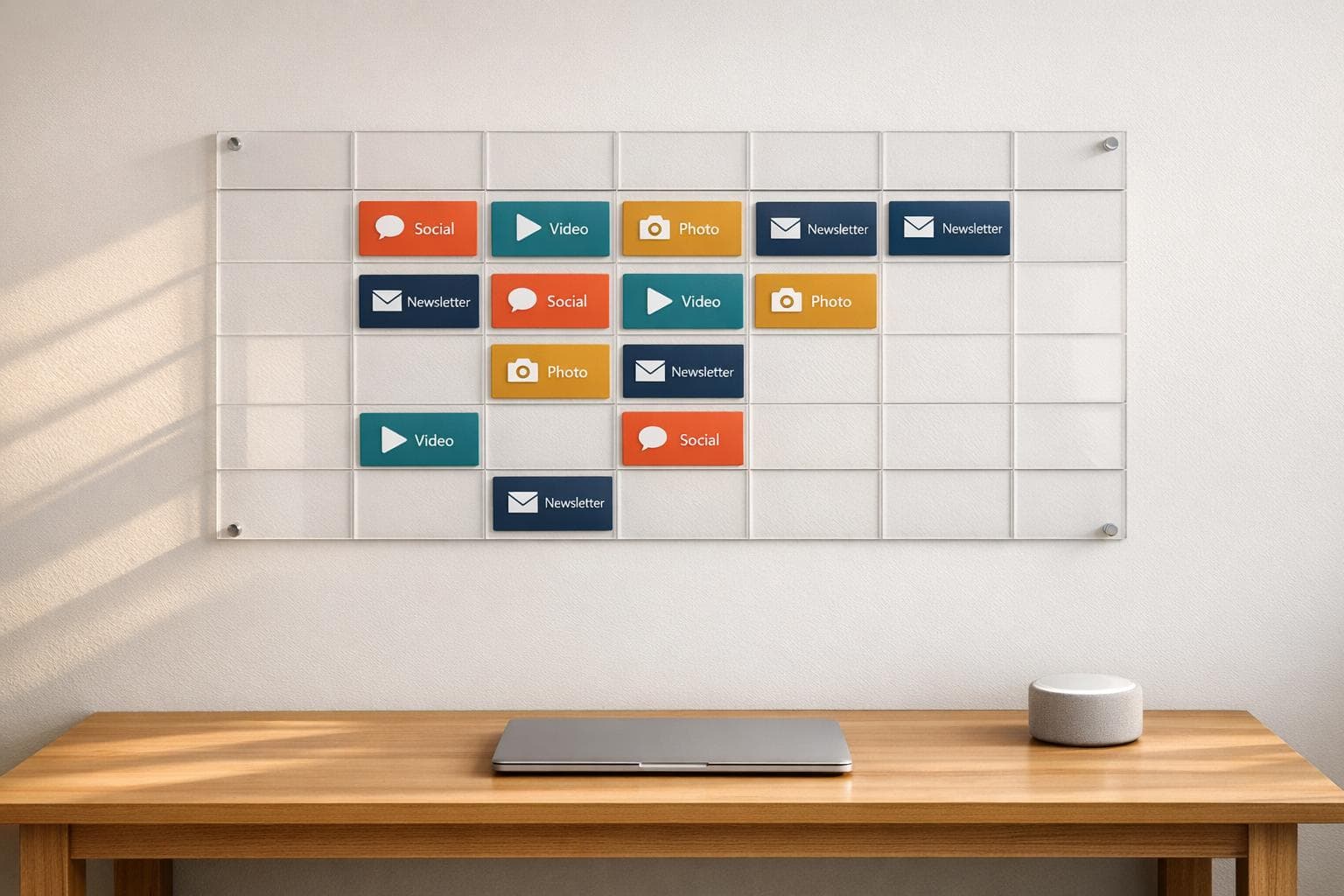
- Content Calendars: Plan posts visually to stay consistent and engage audiences. Brands posting 4–7 times weekly see triple the engagement.
- AI Benefits: Save 10–15 hours weekly, boost productivity by 83%, and improve engagement by 76%.
- Key Features:
- Automated caption and hashtag generation.
- Multi-platform integration (Instagram, TikTok, LinkedIn, YouTube, etc.).
- Real-time analytics for performance tracking.
- Posterly: A centralised tool for managing posts, generating visuals and videos, and optimising schedules.
AI tools like Posterly streamline workflows, allowing you to focus on planning and creativity while maintaining brand consistency.
::: @figure 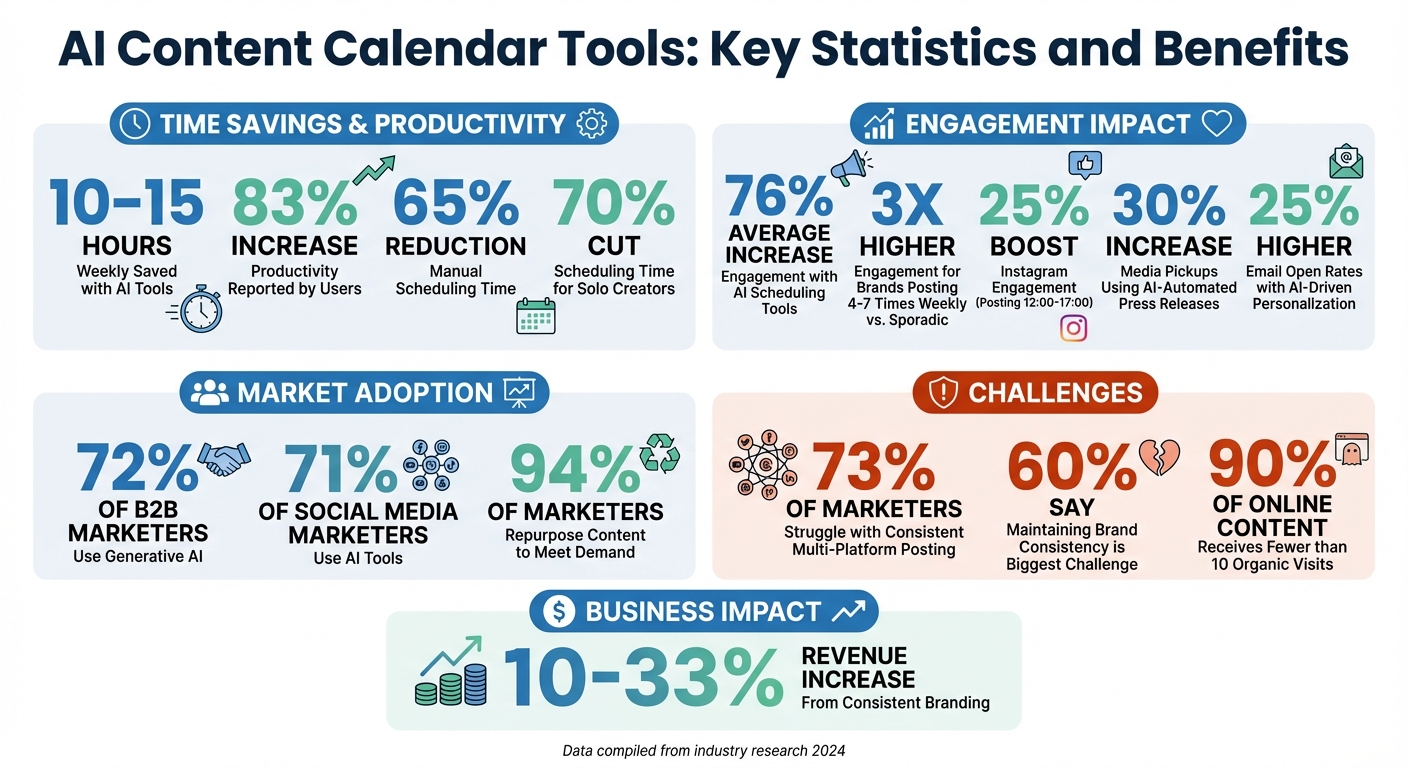 {AI Content Calendar Tools: Key Statistics and Benefits}
:::
{AI Content Calendar Tools: Key Statistics and Benefits}
:::
Let AI Create Your Entire 12-Month Content Calendar for 2025 (AI prompt included)
::: @iframe https://www.youtube.com/embed/AJ4hitPiUJw :::
Once your calendar is ready, you can schedule YouTube videos automatically to maintain a consistent posting rhythm.
What to Look for in AI Content Calendar Tools
When picking an AI content calendar tool, focus on options that simplify your workflow and boost productivity. The best tools combine content creation, scheduling automation, and performance tracking into one seamless system, helping you manage your content with ease.
AI Content Creation and Scheduling
Look for tools that leverage natural language processing to quickly generate captions, headlines, and hashtags that align with your brand's voice. A chat-based interface can make this process even more intuitive.
For example, Posterly uses Nano Banana Pro and Veo to turn simple text prompts into platform-ready visuals, removing the need for separate design tools. Its smart scheduling features analyse audience activity to post at optimal times, ensuring your content reaches the right people.
"The AI Writer tool is particularly remarkable, helping me overcome creative blocks and generate engaging content quickly." - JC Casagan [3]
Features like bulk CSV uploads and pre-scheduling validation can save teams significant time - up to 10 hours a week [3]. Additionally, users of AI scheduling tools have reported a 76% increase in engagement on average [3]. Beyond generating content, seamless integration across platforms is a must-have.
Multi-Platform Integration
A centralised dashboard can be a game-changer, allowing you to manage platforms like Instagram, TikTok, LinkedIn, and YouTube without constantly switching between tabs. Posterly supports over 10 platforms, enabling you to preview, schedule, and publish content efficiently.
Native integrations with platform-specific features - such as Instagram Reels, YouTube Shorts, and LinkedIn Articles - ensure your content is tailored to each platform's unique format. Tools with drag-and-drop functionality in an interactive calendar make it easy to reorganise posts and identify gaps in your schedule visually.
Beyond social media, some tools expand their utility to business profiles. For instance, Posterly can manage Google Reviews for Google Business Profile and generate posts featuring those reviews, adding more content opportunities. Developers and technical teams might appreciate GitHub integration, which transforms code commits into marketing content. These integrations create a unified system that simplifies your entire content workflow.
Analytics and Performance Tracking
Once your content is live, real-time analytics are essential for gauging success. The best tools track engagement metrics - such as reach, likes, comments, and shares - helping you refine your content strategy over time.
Advanced tools also provide status tracking for posts, allowing teams to monitor content from the draft stage through to approval and publication. This is especially useful for managing high volumes of content across multiple clients or brands. A/B testing features allow experimentation with different titles, thumbnails, and posting times, which is particularly valuable on platforms like YouTube where metadata heavily influences discoverability [6].
Posterly offers a 99.9% uptime SLA for its publishing services, ensuring reliability when it matters most [3]. Structured approval workflows further enhance the process, enabling managers to review and approve content before it goes live. Together, these features help maintain brand consistency while scaling your output. Performance tracking also informs your future content calendar, ensuring a strategy that continuously evolves and improves.
Planning Your Content Strategy with AI Tools
Before diving into AI-generated content, having a clear content strategy is essential. A solid plan ensures that AI tools produce content that aligns with your goals. Successful creators treat AI as a collaborative partner, not just a tool for random ideas. This means defining your brand identity, understanding your audience, and setting clear objectives before using any AI platform. Tools like Posterly can help integrate these elements seamlessly into your content calendar.
A structured strategy ensures your content supports your business goals. Research shows that 72% of B2B marketers already use generative AI, with 83% reporting increased productivity [1]. At the same time, with 90% of online content receiving fewer than 10 organic visits [1], strategic planning is more critical than ever. Let’s explore how to define core content pillars and optimise scheduling for an effective AI-driven content plan.
Define Your Content Pillars and Themes
Start by outlining 3–5 core content pillars that align with your business objectives. For example, a B2B SaaS company might focus on themes like Industry Expertise, Product Education, Customer Success Stories, Market Trends, and Company Culture [1]. These pillars should address your audience’s needs while reinforcing your brand’s position.
Document your brand voice attributes clearly to guide AI outputs and avoid generic results. Create an "avoid list" to steer AI away from overused jargon or promotional clichés.
"The most effective content teams combine AI efficiency with human insight, leveraging automation for ideation, research, and initial drafts while maintaining editorial control over strategy, voice, and quality." - Averi Team [1]
Provide AI tools with detailed audience personas, including job roles, challenges, and preferred communication styles. This level of detail helps generate content that resonates. For example, using prompts like "Write as a research analyst addressing mid-market CMOs" yields more relevant results than vague instructions.
To keep your content calendar organised, assign specific themes to different days. For instance, dedicate Mondays to Educational Tips, Wednesdays to Behind-the-Scenes content, and Fridays to Offers. This approach simplifies planning while ensuring a balanced content mix. Using AI for planning can reduce manual scheduling time by 65% [7].
Set Posting Schedules and Frequency
Consistency is more important than sheer volume. Brands that post regularly - between 4 and 7 times a week - experience three times higher engagement compared to sporadic posting [2]. However, 73% of marketers find maintaining this consistency across platforms challenging [2].
AI analytics can help identify when your audience is most active. For example, posting on Instagram between 12:00 and 17:00 can boost engagement by 25% [9]. However, audience behaviour varies, so it’s important to configure AI tools to align with your audience’s primary timezone rather than your own.
With your content pillars defined, align your posting schedule to maximise impact. Start with a manageable cadence of 3–5 posts per week and adjust based on performance. Posterly’s smart scheduling features can analyse audience patterns and automatically post at optimal times, taking the guesswork out of timing.
| Platform | Recommended Frequency | Peak Engagement Windows (General) |
|---|---|---|
| 3–5 posts/week + Daily Stories | 07:00–09:00, 12:00–13:00, 19:00–21:00 [2][4] | |
| 2–5 posts/week | 07:00–09:00, 12:00–13:00, 17:00–18:00 [2] | |
| TikTok | 1–2 Reels/week (minimum) | 06:00–09:00, 12:00–15:00, 19:00–23:00 [2][4] |
| YouTube | 1–2 videos/week | 14:00–16:00, 20:00–22:00 [2] |
Batch-create content at the start of the week, such as on Mondays, and leave room for real-time trends. Aim to fill 70–80% of your calendar with scheduled posts, leaving 20–30% open for spontaneous opportunities [2]. This approach balances consistency with flexibility.
Maintain Brand Voice and Visual Identity
Consistency in branding can boost revenue by 10–33% [1], but 60% of marketers say maintaining this consistency is their biggest challenge [8]. Advanced AI tools can help by analysing your high-performing content to create a brand voice profile for future use. This ensures your content remains aligned with your identity across platforms.
Develop reusable content templates for headlines, hooks, and body text that reflect your brand voice but allow for platform-specific tweaks [8]. For visuals, create a brand kit with your colours, logos, and design presets. Posterly’s Nano Banana Pro feature can generate platform-ready visuals from simple text prompts, ensuring alignment with your brand identity without switching between multiple design tools.
To maintain quality, implement approval workflows where human editors review AI-generated content before publication. This step ensures all content meets your brand standards and resonates with your audience. By combining AI’s efficiency with human oversight, you can create content that is both polished and impactful.
How to Build a Content Calendar with AI Tools
AI tools can transform your content strategy into an actionable and efficient calendar. Instead of spending hours on manual planning, you can streamline the process and create a dynamic workflow in no time. With 72% of B2B marketers already using generative AI [1], the real question is no longer if you should use these tools but how to use them effectively.
Set Content Goals and Parameters
Start by feeding your AI tool the core elements of your strategy. Input key details like your content pillars, audience personas, and brand voice. These act as the foundation for generating content that aligns with your goals.
For example, Posterly's AI Caption Assist can help you refine your brand voice and audience preferences. You can define tone characteristics - like "confident but approachable" - and even create an "avoid list" to keep the AI from using overused jargon or corporate clichés.
To ensure relevance, use specific prompts. Instead of a vague instruction like "write about productivity", try something like, "Write as a research analyst addressing mid-market CMOs struggling with team collaboration." This level of detail helps the AI create content that feels tailored to your audience. Once your parameters are set, move on to generating content ideas that reflect your brand’s voice.
Generate and Customise Content Ideas
Once your guidelines are in place, use AI to generate a month's worth of content ideas in one session. A weekly thematic approach can keep your content varied and engaging. For instance:
- Week 1: Focus on market analysis and thought leadership to establish authority.
- Week 2: Share product education through problem-solution narratives.
- Week 3: Build connections with behind-the-scenes content.
- Week 4: Highlight forward-thinking strategies and frameworks.
After generating ideas, review them against your brand guidelines. Tools like Posterly's Nano Banana Pro can turn text prompts into ready-to-use visuals, while Veo specialises in creating videos that align with your messaging. A single idea can be adapted across multiple formats - think LinkedIn articles, Instagram carousels, or TikTok videos. Tailoring content for each platform while maintaining consistency can boost revenue by 10–33% [1].
Once your ideas are customised, it’s time to organise and schedule them.
Schedule Posts Across Platforms
Use Posterly’s unified dashboard to schedule and manage your content across platforms like Instagram, TikTok, LinkedIn, and YouTube. The drag-and-drop interface makes it easy to adjust post timings based on AI-recommended engagement windows.
For bulk scheduling, you can prepare a CSV file with fields like caption, platform, due date, and media URL. Hosting your media on Posterly Cloud ensures reliable public URLs, allowing you to schedule up to 500 posts at once [3].
To stay organised, filter your calendar by status - such as Drafts, Scheduled, Needs Approval, or Failed/Errors. This level of oversight ensures nothing gets overlooked. Plus, it gives your team the chance to review AI-generated content before it goes live, balancing efficiency with quality control.
Making AI-Generated Content More Authentic
Quick AI-generated content won't cut it if it doesn't connect with your audience. A better approach? Combine "human direction + AI acceleration + human QA" [11]. Think of AI as your junior writer - speedy and efficient, but needing a guiding hand to make sure the final product reflects your brand's personality and values.
Once your content calendar is in place, every piece should genuinely resonate with your audience. With 71% of social media marketers now using AI tools [11], the real challenge isn't whether to use AI, but how to make the content feel real. Here's a stark reality: 90% of online content gets fewer than 10 organic visits [1]. That stat alone shows how quickly people dismiss content that feels robotic or disconnected.
Review and Edit AI-Generated Content
Start by building a Brand Voice + Claims Pack. This should include details about your audience, your positioning, verified facts, and adjectives that describe your tone (e.g., clear, witty, slightly sceptical) [11]. This pack acts as your go-to guide when fine-tuning AI-generated content.
Follow a 4-Step Editing Process:
- Proofread for clarity
- Cut out redundancies
- Adjust the tone to match your brand
- Add specific, relatable details [11]
Before hitting publish, use a Humanisation Checklist. Add a personal touch, such as a unique observation or insight, and eliminate generic phrases [11][12]. Being upfront about AI's role in creating content can actually enhance your credibility, positioning your brand as forward-thinking rather than deceptive [15].
To maintain quality, implement a 10-point scoring rubric. Evaluate posts on elements like hook strength, tone alignment, and factual accuracy. Only publish content that scores at least 16 out of 20 [11]. Additionally, include a "proof needed" column in your content calendar to ensure every statistic and claim is backed up [11].
And don't stop at editing - varying your content formats can make a huge difference in keeping things fresh and engaging.
Use Different Content Formats and Styles
Switching up your content formats is a powerful way to keep your audience engaged and highlight different aspects of your brand. Tools like Posterly's Nano Banana Pro can create stunning 4K images with precise text, while Veo excels at producing videos tailored to your messaging [13].
Another smart tactic? Break down a single pillar article into modular content blocks. Use AI to repurpose headers, quotes, and key points into bite-sized posts, infographics, or video snippets [14]. This allows you to maintain a consistent message while adapting it for various platforms. For example:
- LinkedIn thrives on professional and credible content, while Facebook requires optimized page updates.
- Instagram demands visually appealing posts with concise captions.
- TikTok calls for snappy scripts and attention-grabbing on-screen hooks [11][10].
"The goal isn't to replace human creativity - it's to amplify it with intelligent automation that handles the grunt work whilst preserving editorial control over strategy and quality." – Averi Team, Averi.ai [1]
Experimenting with content formats can also lead to measurable results. A U.S.-based PR firm used AI tools to automate press release creation, increasing media pickups by 30%. Similarly, a retail marketer leveraged audience segmentation to craft personalised email campaigns, boosting open rates by 25% [16]. These examples show how diverse content formats, rooted in a brand's authentic voice, can drive real engagement.
Timing also matters. Match your content to your audience's daily rhythms. Light, visual posts tend to perform better in the morning, while detailed, educational pieces gain traction later in the day [5]. Combining this timing strategy with varied formats ensures your AI-generated content feels intentional and thoughtfully crafted. Tools like Posterly can help integrate these steps directly into your workflow for a seamless process.
Repurposing Content Across Multiple Platforms
Repurposing content is a smart way to save time and effort while maintaining a steady flow of posts. Studies reveal that high-volume posting is the norm, with 94% of marketers repurposing their content to meet demand [18]. The real challenge lies in doing this effectively - ensuring quality and tailoring content to fit each platform.
Adapting Content for Different Platforms
Start with a strong base asset, like a detailed blog post, a webinar recording, or a vertical video. From there, AI tools can help extract essential elements - key points, supporting data, or bite-sized ideas - and reformat them for various platforms [18][19]. For instance, a single LinkedIn article could become an Instagram carousel, a TikTok video script, and a Twitter thread.
Tools like Posterly simplify this process by resizing images, checking video specs, and flagging errors (e.g., character limits) before publishing [17][19]. Its unified composer allows you to preview and adjust all platform-specific versions in one place. Considering that 73% of marketers cite consistent multi-platform posting as their biggest hurdle, this functionality is a game-changer [2].
Another effective approach is creating an "angle bank", where you generate 8–12 unique takes on a single idea - like "Common mistakes", "Myths debunked", or "Before-and-after transformations" [18]. This method aligns well with the scheduling strategies discussed earlier, giving you a variety of content to post without starting from scratch each time.
Optimising Posting Strategies for Each Platform
Consistency is key, but timing matters too. Use AI analytics to pinpoint the best posting windows - such as 07:00–09:00 for LinkedIn professionals or 19:00–23:00 for TikTok users [2]. Brands that post regularly (4–7 times weekly) often see engagement rates triple compared to sporadic posting [2].
Each platform has its own quirks. For LinkedIn, focus on professional, scannable content up to 3,000 characters. Instagram works best with an attention-grabbing opening line, 3–5 relevant hashtags, and visuals in 1:1 or 9:16 formats. TikTok requires a snappy hook within the first two seconds [20]. Posterly ensures your message fits each platform's style while maintaining your brand's voice [19].
Batching your content is another great time-saver. Draft 12–20 posts in one session and schedule them as "content packs" for the next one to two weeks [18][2]. This eliminates the need for daily posting while keeping your feed active. Be sure to schedule posts according to your audience's local timezone to maximise engagement during peak hours [2]. With Posterly supporting over 10 networks from a single dashboard, managing your entire content workflow is easier than ever.
Conclusion
Take control of your content calendar and free up your creative energy. With AI-powered tools like Posterly, tasks that used to eat up hours - like resizing images, rewriting captions, or juggling multiple platforms - become quick and seamless. Solo creator Marcus Johnson summed it up perfectly:
"As a solo creator managing 5 accounts, Posterly cut my scheduling time by 70%." [21]
The secret lies in unified management. Posterly lets you plan, create, and schedule content for Instagram, TikTok, LinkedIn, YouTube, and over 10 other platforms - all from a single dashboard. Features like AI Caption Assist, Nano Banana Pro for images, and Veo for video generation handle the repetitive work, while Brand Kits ensure your posts stay consistent with your unique voice and style.
Consistency is key to engagement, and automation makes it achievable. Whether you're batching posts for the next two weeks or using smart scheduling to hit peak posting times, AI workflows keep your channels alive and thriving. As Alex Chen shared:
"The caption generation alone saves me hours every week. A transformative boost to my workflow." [21]
These streamlined workflows support a strategy built around consistent engagement. Start with clear content pillars and a steady posting schedule, and let AI handle the execution. From crafting platform-specific captions to turning GitHub updates into marketing posts, Posterly adapts to your needs instead of forcing you to adjust to its system. Starting at just AED 25.70/month, it quickly pays for itself in time saved and improved engagement.
The future of content management isn't about doing more - it’s about doing it smarter. By embracing AI-powered tools and refining your brand’s message with thoughtful input, you can work more efficiently while growing your audience. This unified, AI-driven approach allows creators to focus on strategy, leaving the repetitive tasks to automation.
FAQs
::: faq
How do I set up my content pillars for AI?
Start by identifying the main themes or core topics that align with your brand or niche. These content pillars act as the backbone of your strategy, helping you maintain a clear and consistent message.
AI tools can be incredibly helpful in this process. Use them to brainstorm ideas, conduct research, and generate fresh content within each pillar. They can uncover trends, suggest keywords, and even create drafts, saving you time and effort.
Once your pillars are defined, organise your content with a calendar. Plan and schedule posts for each theme to ensure your messaging stays focused and cohesive across all platforms. This approach keeps your strategy aligned and makes managing multiple channels more efficient. :::
::: faq
How can I keep AI posts on-brand and authentic?
To keep AI-generated posts aligned with your brand’s voice, tone, and style, tools like Posterly's Brand Kit can be a game-changer. This tool helps ensure your content resonates with your unique identity. Pair this with clear content guidelines and an approval process to review posts before they go live.
For recurring content, features like AI Remix can help breathe new life into old ideas, avoiding monotony. However, human oversight remains crucial - especially when ensuring accuracy and cultural sensitivity for local audiences in the UAE. This combination of AI tools and human input can create content that feels both polished and relevant. :::
::: faq
What’s the best way to repurpose one idea across platforms?
To make the most of a single idea across multiple platforms, start with a flexible core concept - this could be a blog post, a video, or even a podcast episode. Then, reshape that concept into formats that suit specific platforms. For example, turn it into bite-sized tips for Twitter, a visual infographic for Instagram, or a short video clip for TikTok.
AI tools can be a game-changer here, helping you create customised versions of your content for each platform. To stay organised, consider using a content matrix. This tool helps you map out how one idea can be adapted for various channels. Pair this with automated scheduling tools to save time and maintain consistent, engaging content across your social media and beyond. :::
Related Articles
How to Create 30 Days of Social Media Content Using AI Images in posterly
A practical guide to generating a full month of original social media images with posterly's AI image tool, writing captions for each one, and scheduling everything in a single session.
Read moreHow to Find the Best Time to Post on Social Media Using posterly's AI Scheduler
Stop guessing when to post. This guide explains how posterly's AI Scheduler analyses your audience activity and automatically picks the best posting times so your content gets seen by more people.
Read moreHow to Manage Google Business Reviews on Autopilot With posterly
A step-by-step guide to responding to Google reviews with AI, automatically requesting new reviews from customers, auditing your profile for local SEO, and turning your best reviews into social media content.
Read moreHow to Manage Multiple Client Social Media Accounts With posterly Workspaces
A practical guide for agencies and teams on using posterly Workspaces to organise client accounts, assign roles, get content approved, and schedule posts across dozens of social profiles without things getting messy.
Read more