
Cross-Platform Scheduling: Best Practices
Cross-Platform Scheduling: Best Practices
Cross-Platform Scheduling: Best Practices
Managing social media across platforms can be overwhelming, but a smarter approach makes all the difference. With 5.17 billion social media users globally and each person active on about 7 platforms monthly, the challenge isn’t posting more - it’s posting better. Businesses with consistent strategies retain 89% of customers compared to 33% with fragmented efforts. Here’s how you can improve:
- Customise content for each platform instead of reusing the same post.
- Post at the right times for each platform to maximise engagement.
- Use smart scheduling tools to save time and avoid errors.
- Monitor key metrics like engagement rates and adjust based on performance.
- Centralise your workflow with a single dashboard to manage everything efficiently.
Effective scheduling not only saves time but also strengthens your brand’s presence. By focusing on platform-specific strategies and using tools like Posterly, you can simplify your process while improving results.
Common Scheduling Challenges
::: @figure 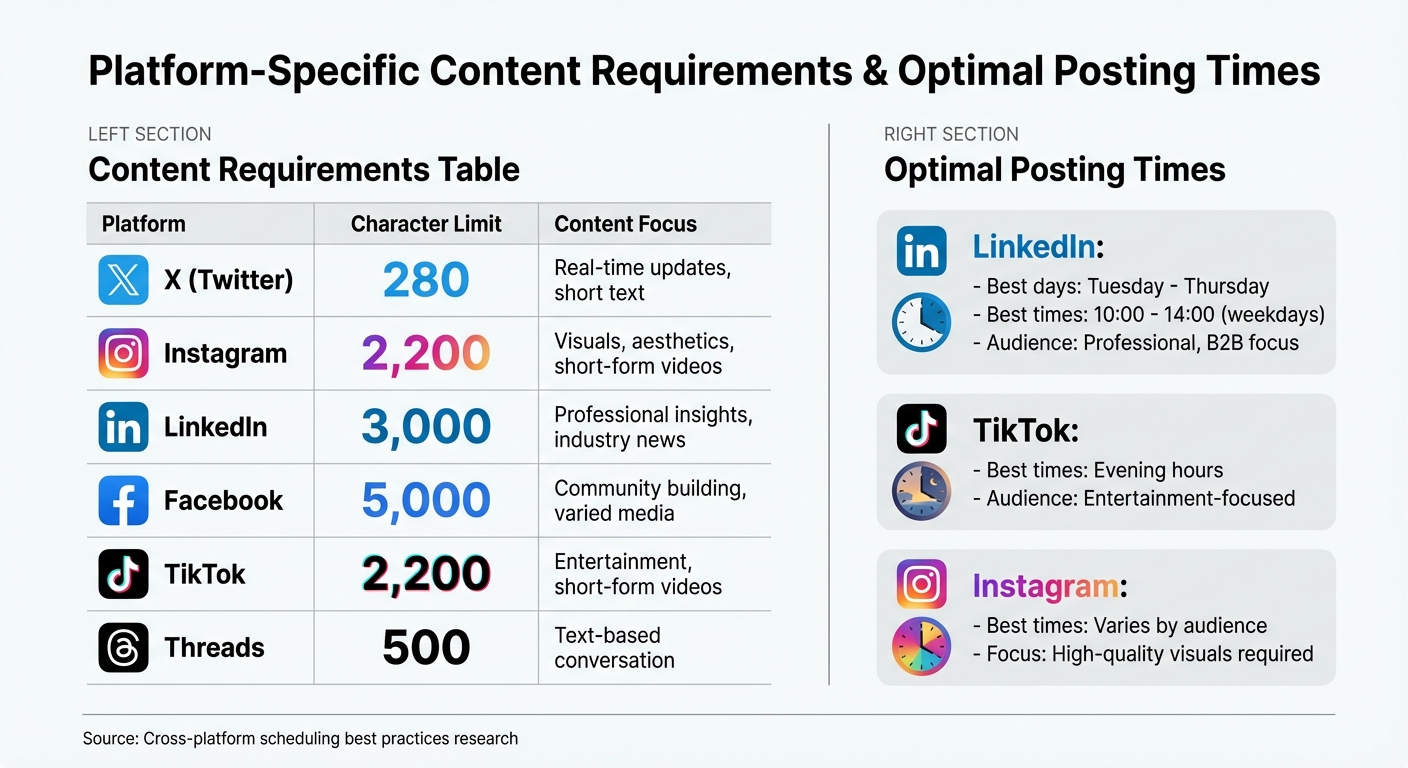 {Social Media Platform Content Requirements and Optimal Posting Times}
:::
{Social Media Platform Content Requirements and Optimal Posting Times}
:::
Managing content across multiple platforms isn’t always smooth sailing. It often creates challenges that can directly affect how your audience interacts with your brand. Let’s dive into some of the most frequent issues.
Inconsistent Posting Times
Posting at the wrong time can leave your content unnoticed. In fact, 82% of people lack a structured time-management system, which often leads to clashing schedules and irregular posting patterns [5]. When you’re manually juggling platforms like Instagram, LinkedIn, TikTok, and others, it’s easy to miss those crucial posting windows.
Every platform has its own sweet spot for engagement. For example, LinkedIn tends to perform best on weekdays - Tuesday through Thursday - between 10:00 and 14:00 [3]. TikTok, on the other hand, sees more activity in the evenings, while Instagram’s optimal times can vary depending on your audience.
If you’re working with a Dubai-based schedule, you might miss key engagement windows in other regions, leading to scheduling errors [4]. And it’s not just about timing; tailoring your content to fit each platform’s unique style is just as important.
Ignoring Platform-Specific Formats
Using the same content across all platforms might seem efficient, but it rarely works. Each platform has its own style and format requirements. For instance, Instagram thrives on high-quality visuals and short videos, LinkedIn focuses on professional updates and industry insights, and TikTok rewards entertaining, creative content [1].
Here’s a quick breakdown of platform-specific requirements:
| Platform | Character Limit | Content Focus |
|---|---|---|
| X (Twitter) | 280 | Real-time updates, short text |
| 2,200 | Visuals, aesthetics, short-form videos | |
| 3,000 | Professional insights, industry news | |
| 5,000 | Community building, varied media | |
| TikTok | 2,200 | Entertainment, short-form videos |
| Threads | 500 | Text-based conversation |
For example, Instagram carousels need specific image dimensions, TikTok videos benefit from subtitles for accessibility, and X limits posts to 280 characters. Overlooking these details can lead to awkward issues like cropped images or cut-off text, which can hurt how algorithms prioritise your content.
Duplicate Content Issues
Posting the same content across platforms might save time, but it can backfire. Identical posts can feel repetitive and spammy, leading to audience fatigue. This can result in users hiding your posts, unfollowing your account, or simply ignoring your content altogether.
Beyond engagement, duplicate posts often miss the mark when it comes to timing. For example, LinkedIn’s audience is most active during weekday mornings, while TikTok thrives in the evenings. Customising your posting schedule for each platform ensures your content gets the attention it deserves.
Another risk with pre-scheduled identical posts is the potential to appear tone-deaf during major news events or crises. A rigid content calendar can make your brand seem out of touch. Adding flexibility to your schedule allows for timely, relevant updates that resonate better with your audience. Avoiding duplicate content is key to maintaining a dynamic and effective cross-platform presence.
Best Practices for Cross-Platform Scheduling
Efficient cross-platform scheduling can simplify your workflow and enhance your content strategy.
Customise Content for Each Platform
When it comes to posting on multiple platforms, customisation is the secret ingredient. Instead of copying and pasting the same content everywhere, focus on tailoring your posts to fit the unique vibe of each platform. Start by identifying 3–5 core content themes - these could include educational posts, promotional updates, or community-focused content. Once you have your themes, adapt the tone, format, and style to match the culture of each platform. This way, your posts feel relevant and engaging, not out of place.
Pay special attention to the first 100–200 characters of your post. This is your "hook" - the part that grabs attention. For example, on LinkedIn, you might start with a thought-provoking question about industry trends, while on TikTok, an energetic or bold opening statement works wonders.
Tools like Posterly's AI Caption Assist make this process easier by letting you customise captions for each platform in one go. Plus, its drag-and-drop scheduler ensures your visuals are optimised for platform-specific requirements, like Instagram's square images or LinkedIn's landscape preferences.
Once your customised posts are ready, the next step is to make sure they go live at the right time.
Use Smart Scheduling Tools
Timing is everything when it comes to social media. Posting during peak activity hours not only increases visibility but can also boost engagement right away. This early engagement signals algorithms to push your content to more users, expanding your organic reach [1].
Smart scheduling tools are especially helpful here. They can automatically recycle evergreen content, ensuring your best-performing posts continue to deliver value without extra effort [5,20]. This approach not only saves time but also keeps your brand presence consistent, allowing you to focus on strategy instead of repetitive tasks [7].
Posterly’s smart scheduling features are designed with global audiences in mind. They’re timezone-aware, so you can plan posts to hit peak activity hours in different regions - all from a single session [1].
Manage Content from One Dashboard
Centralising your content management is a game-changer. Jumping between multiple apps is not only time-consuming but also increases the chance of mistakes. A unified dashboard lets you oversee your entire strategy at a glance, ensuring your messaging stays consistent across all platforms [4,21].
A centralised tool offers several benefits. For instance, you can batch-create content, set up approval workflows to avoid accidental posts, and even pause all scheduled content instantly in case of an emergency [9]. Additionally, features like consolidated engagement tools bring comments and DMs from all platforms into one place, enabling your team to respond up to 10× faster [8].
Posterly’s content calendar supports over 10 platforms, including Instagram, TikTok, LinkedIn, and YouTube - all from a single dashboard. You can monitor your posting schedule in real-time, avoid duplicate posts, and visualise your entire content plan. This streamlined approach eliminates manual coordination and ensures your brand stays consistent and professional.
Monitoring and Improving Scheduled Content
Start tracking how your posts perform as soon as they go live. This helps you figure out what works and what might need tweaking.
Track Engagement Metrics
Pay attention to the numbers that truly matter - metrics that show how your audience is engaging with your content. Forget vanity metrics; instead, focus on engagement rates and reach to see if your posts are making a real impact [11].
Different platforms measure success differently. For instance, on Instagram, saves show long-term value, while on TikTok and Reels, the completion rate is key [10][11]. For video content, it's useful to check where viewers stop watching so you can improve hooks and pacing for future posts [11]. Categorise your content into themes like educational, promotional, or entertainment to identify what drives the most interaction [11][12].
"Engagement metrics... are the fastest path to credibility as they combine emotional proof ('people care') with functional proof ('it's working')."
- Nidhi Parikh, Content Writer, Socialinsider [11]
Tools like Posterly’s integrated analytics simplify this process by centralising all your performance data. Instead of bouncing between apps, you can compare results across platforms in one place. This makes it easier to spot trends and adjust your strategy based on what's working.
While tracking metrics shapes your content strategy, automation ensures smooth execution.
Prevent Errors with Automation
Automation not only saves time but also reduces mistakes. Issues like duplicate posts, missed deadlines, or formatting errors can hurt your brand's reputation. Using approval workflow tools ensures posts are reviewed before going live, catching errors and avoiding scheduling conflicts [6][13].
Features such as post expiration settings automatically remove outdated promotions after a specific date, so your content stays relevant [2]. Visual planning grids let you preview how posts will look on your profile, helping maintain a consistent aesthetic tailored to each platform [2][6]. If a post fails to publish due to technical issues like API errors or account disconnections, automated alerts notify you immediately, allowing you to act quickly [6].
Posterly’s automation tools keep an eye on your content queues, preventing duplicates and ensuring everything goes live as planned. This reliability lets you focus on strategy and creativity, rather than worrying about manual errors. Ultimately, these tools help maintain a seamless and efficient cross-platform approach.
Conclusion
Managing cross-platform scheduling doesn’t have to be complicated. By creating content tailored to each platform, maintaining a consistent posting routine, and leveraging automation, you can save valuable time while strengthening your brand’s presence. Research indicates that brands with a steady posting schedule see engagement rates that are three times higher than those that post irregularly [14][1]. Consistency clearly pays off.
On top of that, scheduling tools can free up 10–15 hours every week [14], giving creators more time to focus on creativity and connecting with their audience.
FAQs
::: faq
How can I optimise content for different social media platforms?
To make sure your content performs effectively across different platforms, it's important to adapt it for each network while considering local preferences in the UAE.
- Optimise visuals for each platform: Ensure images and videos meet the specific size requirements of each platform. For example, use landscape formats for YouTube and square formats for Instagram.
- Tailor captions to the platform: Keep it professional and concise for LinkedIn, add emojis and hashtags for Instagram, and stick to short, snappy text for TikTok.
- Localise for UAE audiences: Use AED for prices (e.g., AED 1,250.00), metric units like kilometres and kilograms, Celsius for temperatures, and British spelling (e.g., optimise, customise). Dates should be formatted as 1 January 2026.
Tools like Posterly can simplify this process by allowing you to create a master draft and then customise it for each platform directly. Always preview your posts to make sure they fit the platform’s guidelines and schedule them at peak engagement times, such as 19:00 GST. This strategy ensures your content stays consistent while catering to the unique needs of your audience. :::
::: faq
What are the advantages of using smart scheduling tools for social media?
Smart scheduling tools bring a range of benefits that make managing social media across various platforms much easier. By letting you plan and queue posts weeks - or even months - in advance, these tools help save time and eliminate repetitive tasks. This frees up your team to focus on the creative and strategic aspects of your social media campaigns.
Another key advantage is their ability to publish posts during peak engagement times, ensuring your content reaches the widest possible audience when they're most active. With a single, unified dashboard, you can handle platforms like Instagram, TikTok, LinkedIn, and YouTube effortlessly. This not only keeps your branding consistent but also helps avoid common pitfalls like missed or duplicate posts.
What's more, smart scheduling tools offer data-driven insights, helping you fine-tune your posting schedules, content formats, and frequency. For users in the UAE, this means you can align your posts with local preferences - like scheduling content after 18:00 GST - and manage budgets effectively in AED. These tools don't just improve efficiency; they also enhance audience engagement and boost your brand's presence across multiple platforms. :::
::: faq
What are the best ways to track and improve engagement metrics across platforms?
To monitor engagement effectively, start by defining clear, measurable objectives. For instance, if your aim is to achieve AED 5,000 in Instagram sales by 31/12/2026, focus on metrics like likes, comments, shares, click-through rates, and overall reach. Tools like Posterly can simplify this process by consolidating data from platforms such as Instagram, TikTok, LinkedIn, and YouTube into a single dashboard. You can also customise features like date filters (dd/mm/yyyy) and currency formats (e.g., AED 1,250.00), making it easier to generate reports tailored for UAE stakeholders.
To boost engagement, start by analysing your top-performing posts to uncover patterns in content formats, posting times, and audience preferences. Posterly’s smart scheduling feature can suggest optimal posting times based on past engagement trends. Additionally, try A/B testing for elements like headlines, hashtags, and calls-to-action to see what resonates most. Use AI-driven insights to refine content that isn’t performing well. By consistently reviewing your results, tweaking your strategy, and maintaining a steady posting schedule, you can steadily increase engagement across all your platforms. :::
Related Articles
How to Create 30 Days of Social Media Content Using AI Images in posterly
A practical guide to generating a full month of original social media images with posterly's AI image tool, writing captions for each one, and scheduling everything in a single session.
Read moreHow to Find the Best Time to Post on Social Media Using posterly's AI Scheduler
Stop guessing when to post. This guide explains how posterly's AI Scheduler analyses your audience activity and automatically picks the best posting times so your content gets seen by more people.
Read moreHow to Manage Google Business Reviews on Autopilot With posterly
A step-by-step guide to responding to Google reviews with AI, automatically requesting new reviews from customers, auditing your profile for local SEO, and turning your best reviews into social media content.
Read moreHow to Manage Multiple Client Social Media Accounts With posterly Workspaces
A practical guide for agencies and teams on using posterly Workspaces to organise client accounts, assign roles, get content approved, and schedule posts across dozens of social profiles without things getting messy.
Read more