
Content Consistency vs. Platform Customization
Content Consistency vs. Platform Customization

Content Consistency vs. Platform Customization
Should you post the same content everywhere or tweak it for each platform? The answer lies in balancing consistency and customization. Consistency strengthens your brand's identity, making you recognizable and trustworthy. Customization, on the other hand, helps you connect with each platform's unique audience and algorithm preferences.
Key Takeaways:
- Consistency builds trust and recognition: Uniform branding across platforms can increase revenue by up to 33% and boost brand recognition by 80%.
- Customization drives engagement: Tailoring content to platform-specific formats and audience preferences significantly improves reach and interaction.
- One-size-fits-all doesn’t work: Each platform has different expectations - LinkedIn thrives on professional insights, Instagram on visuals, TikTok on "edutainment."
- Balance is essential: Maintain a consistent brand identity while adjusting tone, format, and style to fit each platform's requirements.
Quick Tips:
- Use a brand guide to ensure consistency in visuals, tone, and messaging.
- Repurpose content: Break long-form pieces into smaller, platform-friendly formats.
- Test and track performance metrics like engagement rates and audience sentiment to refine your approach.
- Leverage tools like Posterly to manage multiple platforms efficiently.
Balancing consistency and customization ensures your content stands out while resonating with diverse audiences across platforms.
::: @figure 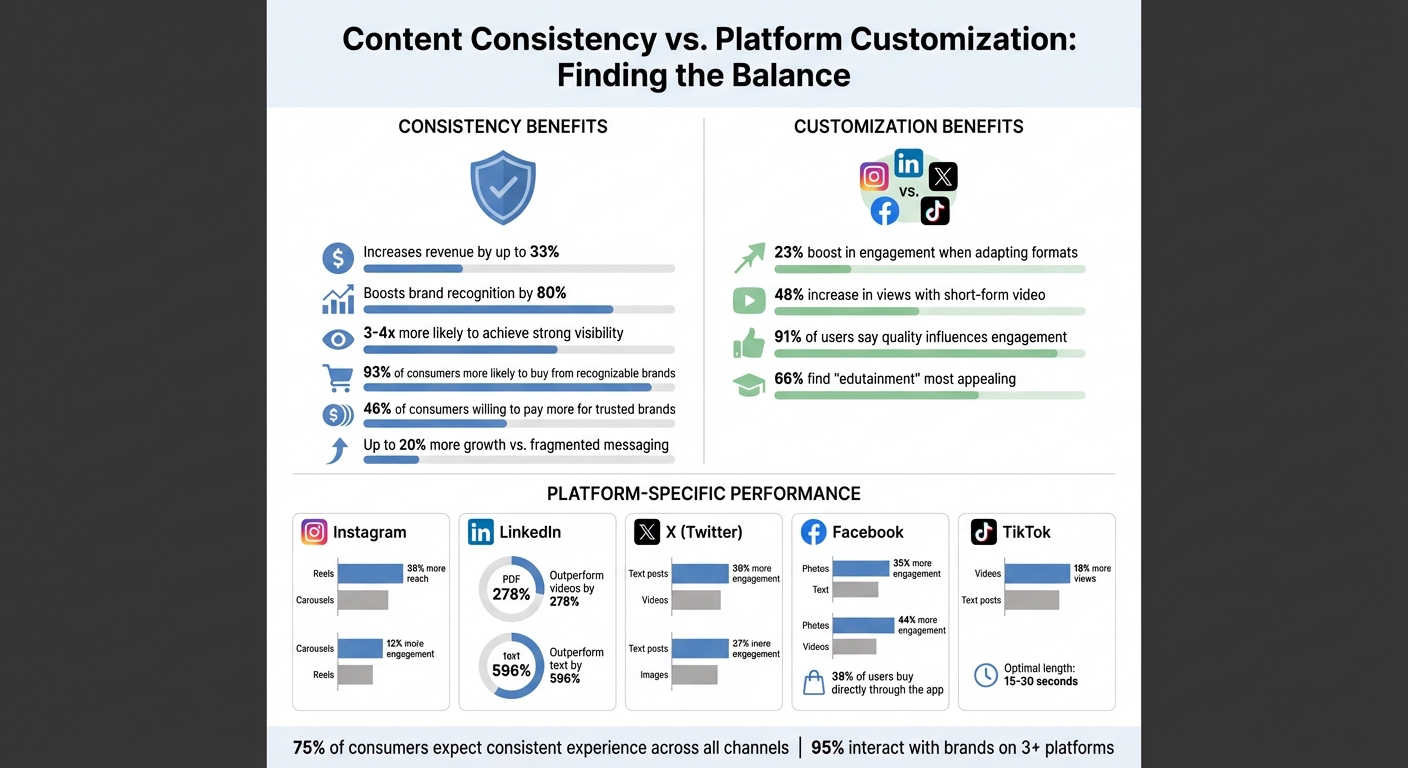 {Content Consistency vs Platform Customization: Key Statistics and Platform Performance}
:::
{Content Consistency vs Platform Customization: Key Statistics and Platform Performance}
:::
How to Finally Look Consistent on Every Platform (Without Spending Hours)
::: @iframe https://www.youtube.com/embed/u7lJiYnVGrE :::
Why Content Consistency Matters
Having a uniform brand identity makes you instantly recognisable. Think of iconic logos or colour schemes - they serve as a visual shorthand for your brand, creating an immediate connection with your audience[5].
The numbers back this up: consistent branding can increase revenue by up to 33%[6]. On top of that, maintaining a steady visual style boosts brand recognition by as much as 80%[6]. In a world where 75% of global consumers expect a seamless experience across all channels[5], and 95% interact with brands on three or more platforms during a single engagement[4], any inconsistency becomes glaringly obvious. This consistency not only strengthens recognition but also lays the groundwork for a deeper bond with your audience.
Building Brand Recognition
Consistency is like your brand’s signature - it’s what sets you apart. Using the same colours, fonts, and design elements across all platforms creates what experts call "immediate recall." Essentially, your brand becomes the safe, familiar choice in your audience’s mind[5].
The benefits are tangible: brands that maintain consistent messaging are three to four times more likely to achieve strong visibility[6]. Plus, 93% of consumers are more inclined to buy from brands they can easily recognise visually[10]. It’s not just about standing out; it’s about becoming the go-to option.
Creating Trust and Credibility
Consistency does more than make you recognisable - it builds trust. When your messaging stays on-brand, it signals professionalism and reliability. As SEO expert Rajeev R explains:
Trust stems from reliability, knowing exactly what to expect from a business at every interaction[7].
This trust can directly impact your bottom line. Nearly half (46%) of consumers are willing to pay more for products from brands they trust[10]. Companies with consistent branding often see up to 20% more growth compared to those with fragmented messaging[9]. When your LinkedIn posts align with your Instagram visuals and TikTok personality, you’re not just creating recognition - you’re establishing credibility that resonates.
Improving Long-Term Engagement
Consistency also nurtures engagement. Familiarity makes it easier for your audience to connect, encouraging them to return time and again. By reducing the mental effort needed to recognise and engage with your content, consistent branding keeps your audience coming back[6].
The University of Leeds research team sums it up perfectly:
The more consistent we are, the more likely it is that people will understand what makes us special. The way we express ourselves has to be joined up and consistent so that people admire, respect and, crucially, trust us[9].
This trust and understanding lead to sustained engagement. Whether someone stumbles upon your content on YouTube or LinkedIn, a cohesive brand identity turns casual viewers into loyal supporters.
Why Platform Customization Matters
While maintaining consistent content is essential for building a strong brand identity, tailoring your approach to suit each platform can significantly boost your reach and engagement.
Consistency strengthens your brand, but customisation is what truly connects with your audience. Each platform has its own set of rules, audience preferences, and content formats. What works on LinkedIn might flop on TikTok, and vice versa.
For example, Instagram Reels reach 39% more users than carousels, but carousels drive 12% more engagement once your audience is hooked[11]. On LinkedIn, PDF carousels outperform videos by 278% and text-only posts by a staggering 596%[11]. Meanwhile, on X (formerly Twitter), text posts generate 30% more engagement than videos and 37% more than images[11].
"Video, Video, Video, Video. Keep an eye on video", experts advise[11].
However, even this advice requires nuance. LinkedIn’s algorithm favours professional discussions, while TikTok rewards content with high completion rates[1][2].
Understanding Different Platform Audiences
Customising your content means understanding how audiences behave on each platform while staying true to your brand's identity.
People use platforms for different reasons. Facebook users focus on community and customer care, making it the leading platform for direct purchases, with 39% of users buying directly through the app[2]. On Instagram, discovery thrives through Reels, while LinkedIn users expect thought-provoking content. TikTok audiences, on the other hand, crave "edutainment" - a mix of entertainment and quick, informative snippets[2][14].
"Think about Facebook users - they LOVE to comment, tag friends, and share posts on their own feeds", social media experts note[15].
This behaviour contrasts sharply with LinkedIn, where professionals engage with content that fuels career growth or sparks industry discussions. Overlooking these differences can leave your content feeling out of place, no matter how consistent your branding is.
Adapting Content Formats
The format of your content can be just as important as the message itself. Each platform has specific features that perform better than others. On Facebook, photos see 35% more engagement than text posts and 44% more than videos[11]. TikTok videos outperform text posts by 18% in views[11]. On LinkedIn, document posts (like PDF carousels) dominate when it comes to professional engagement[11].
Short-form videos, in particular, are a game-changer, increasing views by 48% across platforms[13]. But video length expectations vary: Instagram Stories work best under 15 seconds, TikTok videos thrive in the 15–30 second range, and YouTube favours those over a minute long[2]. Brands that adapt their content formats for each platform see a 23% boost in engagement[13].
A smart way to do this is by repurposing content. Start with one long-form asset, like a YouTube video or blog post, and break it into three short-form pieces - think Instagram Reels, X threads, or LinkedIn posts. This approach maximises reach without adding extra production costs[13].
Increasing Engagement Through Customisation
Customisation goes beyond format - it’s about aligning with each platform's algorithm and speaking directly to its audience. Algorithms act as gatekeepers, deciding what appears in user feeds[16]. Facebook prioritises posts that encourage meaningful conversations. Instagram pushes Reels for discovery. TikTok focuses on completion rates, while LinkedIn elevates content that fuels professional discussions[1].
Ellie Macklin sums it up well:
"By customising your content to meet these unique algorithmic preferences, you're more likely to boost visibility and engagement. Ignoring these differences can result in lower reach, wasting your creative efforts."[16]
Research supports this: 91% of social users say production quality influences their engagement with brand content, and 66% find "edutainment" the most appealing form of branded content[14]. Even small tweaks - like using casual captions on Facebook and a more authoritative tone on LinkedIn - can make a big difference[12].
The best way to refine your approach is by testing. Run small-scale experiments on a new platform for 8 to 12 weeks, posting at least twice a week. This allows you to gauge what resonates with the audience before fully committing resources[13]. By testing and learning, you can adapt without stretching your team too thin.
How to Balance Consistency and Customisation
Striking the right balance between consistency and customisation is key to building a strong brand presence. Globally, 75% of consumers expect a brand to deliver a consistent experience across all channels[5]. Yet, every platform has its unique demands. The trick lies in creating a framework that maintains your brand identity while allowing room to adapt. This ensures your brand remains familiar and recognisable, even as your messaging adjusts to different audiences.
Think of it this way: your brand voice remains constant, but your tone shifts depending on the platform or audience. As Bonnie Porter from Buffer puts it:
You have the same voice all the time, but your tone changes.[19]
This distinction is vital. Your brand's core personality stays intact, but how you express it should evolve to suit the context.
Setting Up Brand Guidelines
A comprehensive brand book is the foundation for achieving consistency. It should detail your visual and verbal standards, including typography, colour palettes (with exact hex codes), logo usage rules, and your brand voice[18][8]. Standardising engagement protocols and response practices also ensures consistency across interactions[17][5]. This matters because 93% of consumers are more likely to purchase from brands they can visually identify[10]. Recognition begins with clear, well-documented standards.
Equally important is how you handle mistakes. Transparency in addressing errors can rebuild trust, with 89% of people believing a business can regain their trust if it openly communicates its resolution steps[5]. Consistent responses, guided by your brand book, reinforce your identity even in challenging situations.
Customising Within a Framework
Once your brand guidelines are established, customisation becomes more straightforward. You can tweak tone, format, and content length without losing your brand voice. Documenting platform-specific requirements - like image dimensions or hashtag limits (e.g., 3 for LinkedIn, 8 for Instagram) - helps ensure your content aligns with each platform's best practices[17].
Repurposing content is a smart way to maximise your efforts. Instead of creating entirely new material for every platform, adapt existing assets. For instance, transform a long YouTube video into Instagram Reels or split an infographic into a LinkedIn carousel. This approach extends your reach while keeping production costs manageable[2].
Using Tools to Manage Multiple Platforms
Managing consistency across platforms can be challenging, but advanced tools can make it easier. For example, Posterly supports over 10 platforms, including Instagram, TikTok, LinkedIn, and YouTube, allowing you to plan, publish, and monitor content from one dashboard.
Posterly offers AI-driven features like Caption Assist, which creates platform-specific captions that stay true to your brand voice. Nano Banana generates custom images, and Hey Posterly simplifies scheduling with natural language commands. For tech-oriented brands, Ship & Share turns GitHub commits into shareable marketing content, giving visibility to your development efforts.
Using a shared content calendar can streamline your planning process. Map out posts for the month, detailing the platform, type of post, and timing[8]. Posterly's drag-and-drop scheduling and real-time queue monitoring make this process effortless. Features like duplicate prevention help avoid accidental reposts.
To maintain consistency, conduct quarterly or bi-annual reviews of all your digital touchpoints. Check for discrepancies in logo placement, colour schemes, or tone[4][5]. With 95% of customers using three or more channels during a single interaction with a brand[4], ensuring a seamless experience across all platforms is critical for building trust. Tools like Posterly simplify adhering to your brand guidelines while optimising content for each platform.
Measuring Results and Adjusting Your Strategy
Evaluating your performance is essential for maintaining a balance between consistent content and adapting to the unique needs of each platform. By relying on clear metrics, you can move away from guesswork and make smarter, data-driven decisions.
Tracking Key Metrics
Metrics can be divided into two categories: consistency metrics and customisation metrics. Consistency metrics include publishing frequency, brand mentions, share of voice, and audience sentiment, while customisation metrics focus on engagement rates per post, the performance of specific content formats, video completion rates, and click-through rates[20][21].
For visibility, metrics like reach and impressions are crucial, while engagement is better captured through likes, comments, shares, and saves[21]. To ensure your content is reaching the right people, track audience demographics such as age, location, and gender[21][22]. Additionally, long-term follower growth and your overall brand presence can help you measure the cumulative impact of your strategy[21][3].
To simplify tracking, consider using a KPI dashboard. This can consolidate data from platforms like LinkedIn, TikTok, and Instagram, making it easier to compare performance across different channels[20].
These metrics provide a quantitative foundation for your strategy and pave the way for deeper, more nuanced insights.
Using Audience Feedback
While numbers tell you what's happening, audience feedback explains why[22]. Tools for social listening can help you monitor real-time mentions, keywords, and sentiment, offering a glimpse into how people perceive your content[22]. These insights can guide adjustments to your tone and topics, ensuring they align with platform expectations[24].
Engagement is a two-way street. Responding to comments and direct messages not only builds connections but also helps you gauge whether your brand voice is striking the right chord on each platform[22][25]. You can also survey your audience directly to understand their preferences, reducing the guesswork in tailoring your content[22][23]. As Instagram consultant Elise Darma puts it:
Customer research isn't just part of my strategy. It's the foundation of everything I do.[23]
Organising your posts into themes or campaigns can reveal which types of content - whether educational or humorous - resonate best on specific platforms[24]. Keep a close watch on brand sentiment, as sudden negative feedback might indicate you've veered too far from your brand's core identity[22].
By combining quantitative data with audience feedback, you can refine your approach and make informed adjustments.
Testing and Improving Over Time
Continuous testing is key to fine-tuning your strategy. Use A/B testing to experiment with one element at a time, such as headlines, visuals, or posting schedules, to identify what drives the best results[22][26]. Test various content formats - like GIFs versus static images or short videos versus carousels - to see what works best on each platform[22].
Allow at least 90 days for meaningful results, but review your top-performing posts monthly to spot trends and patterns[24][25]. This can help you identify the most effective formats and optimal posting times.
Tools like Posterly can be invaluable for real-time data tracking and queue monitoring. They allow you to quickly identify any anomalies and tweak your publishing schedule, ensuring your brand identity remains consistent while adapting to platform-specific engagement trends[21].
Conclusion
Finding the sweet spot between a consistent brand identity and platform-specific strategies is key. While your brand's core identity - its visuals, voice, and messaging - should stay constant across all channels, adapting to the unique expectations of each platform ensures your content resonates with its audience. This balance builds recognition and trust, two pillars of a strong brand presence[8].
To achieve this, stick to your brand guidelines as your foundation, but tweak your delivery to fit the format and user behaviour on each platform[1][2]. Repurposing your core ideas into different formats - like turning a blog post into a carousel for social media or a video for YouTube - can help you engage audiences effectively wherever they are[8][17].
Let data guide your efforts. Keep an eye on metrics that measure both consistency, such as publishing frequency and brand mentions, and customisation, like engagement rates and video completion percentages. Give yourself at least 90 days to gather meaningful insights, and don’t overlook audience feedback - it’s invaluable for fine-tuning your tone and topics[25]. As Mark Schaefer wisely puts it:
Consistency is more important than genius[3].
Tools like Posterly can make this balancing act easier by offering a centralised platform to manage multiple channels. They help you maintain your brand identity while tailoring content to fit the engagement style of each platform. Stay consistent, track your results, and adapt based on what your audience tells you - they’ll guide you toward success.
FAQs
::: faq
How can I maintain a consistent brand identity while customising content for different platforms?
To maintain a consistent brand identity across platforms like Instagram, TikTok, LinkedIn, and YouTube, start by creating a detailed brand style guide. This guide should outline key elements such as your logo usage, colour palette, typography, tone of voice, mission, and values. Use it as a blueprint for all content creation. Pair this with a content calendar to schedule posts ahead of time, ensuring you account for platform-specific needs like caption lengths or image dimensions.
Consistency in visuals is crucial. Stick to the same colour schemes and logo placements across platforms, but resize images to fit the specifications of each channel. While adapting your tone for different audiences - more relaxed for TikTok and more formal for LinkedIn - ensure your core brand voice remains intact.
To simplify the process, tools like Posterly can centralise your branding assets, automate design elements, and help you customise content for each platform. For UAE-specific localisation, consider regional preferences: display prices in AED (e.g., AED 1,250.00), use the day-month-year date format (29 Dec 2025), and adopt British spelling (e.g., colour, organise). Be mindful of cultural norms by choosing modest visuals and using respectful language. By combining a clear brand guide, thoughtful planning, and regional customisation, you can create a cohesive yet tailored presence across all platforms. :::
::: faq
How can I effectively customise content for different social media platforms?
To create content that resonates across different social media platforms, start by understanding your audience and their expectations on each channel. For instance, Instagram users in the UAE tend to favour high-quality visuals paired with concise, lifestyle-oriented captions. On the other hand, LinkedIn audiences appreciate professional and data-focused posts. Adjust your tone to match the platform’s vibe - keep it friendly and casual on Instagram, professional on LinkedIn, and sharp yet engaging on X. During Ramadan or other cultural occasions, weaving in Arabic phrases or themes can help you connect more effectively with local audiences.
Make sure your content format aligns with each platform’s specific requirements. Resize images to fit perfectly, keep videos within platform limits (like 60 seconds for Instagram Reels or up to 9 minutes for TikTok), and explore native features such as Instagram Stories, LinkedIn polls, or trending TikTok challenges. Timing is also key - posting during peak hours in the UAE, such as 19:00 AED on weekdays, can boost visibility. Additionally, A/B testing can help fine-tune captions, hashtags, and calls-to-action for better engagement.
Tools like Posterly make this process much easier. With its AI-powered features, you can upload a single piece of content and instantly generate versions tailored for each platform. This not only ensures your posts meet technical specifications but also keeps your brand message consistent while respecting local cultural nuances - all without wasting time. :::
::: faq
How can I evaluate the success of my customised content across different platforms?
To measure how well your tailored content is performing, keep an eye on platform-specific metrics like engagement, reach, click-through rates, and conversions. Match these numbers against your original goals or benchmarks to pinpoint areas where adjustments are needed.
For a broader perspective, consider using a unified analytics dashboard. This tool compiles performance data from all platforms into one place, making it easier to identify trends, fine-tune your strategy, and ensure your content connects with your audience on every channel. :::
Related Articles
How to Create 30 Days of Social Media Content Using AI Images in posterly
A practical guide to generating a full month of original social media images with posterly's AI image tool, writing captions for each one, and scheduling everything in a single session.
Read moreHow to Find the Best Time to Post on Social Media Using posterly's AI Scheduler
Stop guessing when to post. This guide explains how posterly's AI Scheduler analyses your audience activity and automatically picks the best posting times so your content gets seen by more people.
Read moreHow to Manage Google Business Reviews on Autopilot With posterly
A step-by-step guide to responding to Google reviews with AI, automatically requesting new reviews from customers, auditing your profile for local SEO, and turning your best reviews into social media content.
Read moreHow to Manage Multiple Client Social Media Accounts With posterly Workspaces
A practical guide for agencies and teams on using posterly Workspaces to organise client accounts, assign roles, get content approved, and schedule posts across dozens of social profiles without things getting messy.
Read more