
AI vs. Manual Content Distribution: Key Differences
AI vs. Manual Content Distribution: Key Differences

AI vs. Manual Content Distribution: Key Differences
Want to save time and boost efficiency in content distribution? This article breaks down the differences between AI-powered and manual content distribution, so you can decide which approach suits your needs. Here's what you need to know:
- AI-driven tools automate repetitive tasks like scheduling, resizing, and caption creation, saving up to 10+ hours weekly.
- Manual methods offer full control but are time-intensive, often taking 15+ hours per week for teams managing multiple platforms.
- AI is cost-effective, with tools like Posterly starting at AED 26/month, compared to the high costs of hiring staff or agencies.
- Manual workflows excel in tasks requiring personalisation and nuanced judgement but can lead to burnout when scaled.
- A hybrid approach blends AI's efficiency with human oversight, ensuring balance between speed and quality.
Quick Comparison:
| Feature | AI-Driven Distribution | Manual Distribution |
|---|---|---|
| Time Required | Minutes for bulk tasks | Hours per post |
| Cost | Low (AED 26–92/month) | High (labour-intensive) |
| Consistency | High | Variable |
| Scalability | Easy | Challenging |
| Control | Moderate | High |
AI tools like Posterly simplify multi-platform management, offering features like smart scheduling, caption assistance, and bulk uploads. For tasks requiring precision and emotional connection, manual efforts remain valuable. The best results often come from combining both methods.
::: @figure 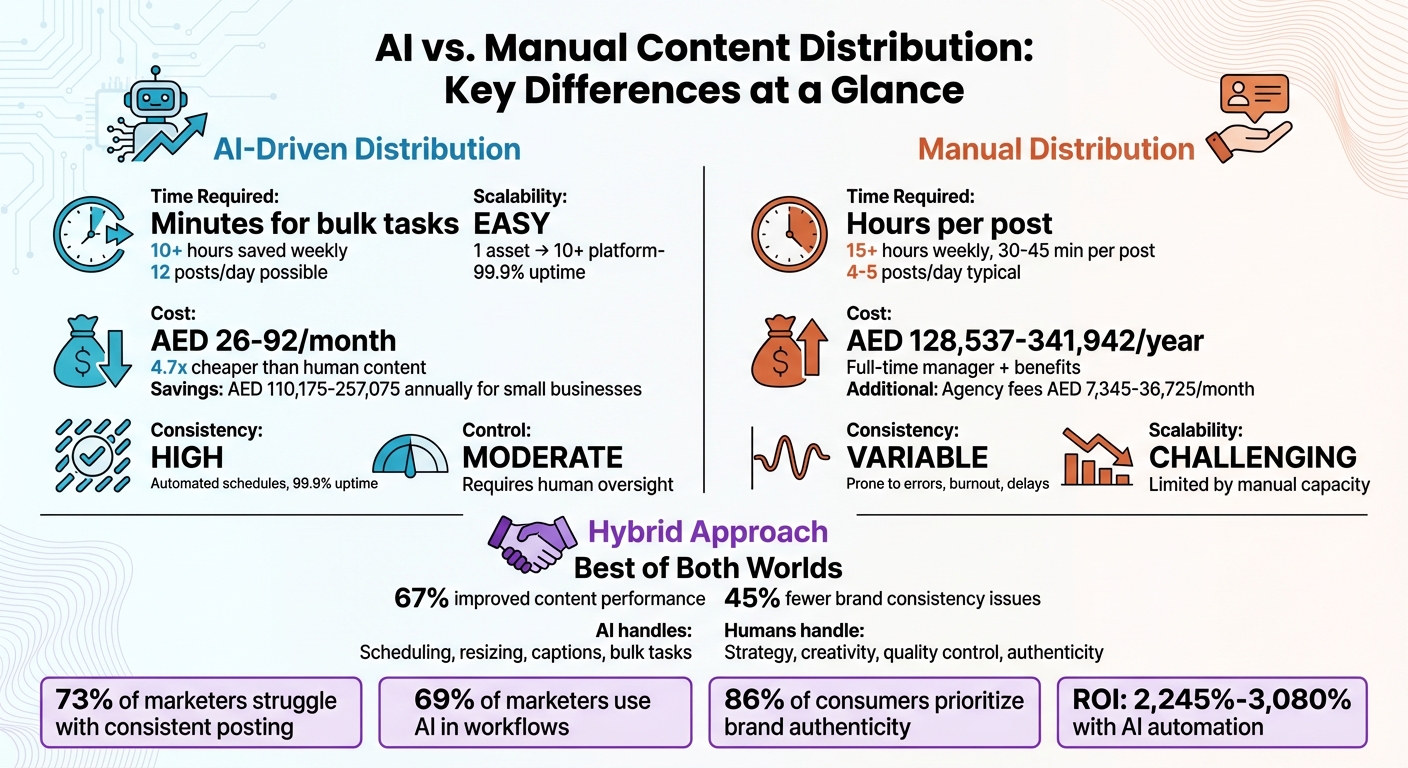 {AI vs Manual Content Distribution: Time, Cost, and Efficiency Comparison}
:::
{AI vs Manual Content Distribution: Time, Cost, and Efficiency Comparison}
:::
How to Automate Your Content Creation with AI (Save Hours!)
::: @iframe https://www.youtube.com/embed/tyUtBUurR34 :::
Main Differences Between AI and Manual Content Distribution
The difference between AI-driven and manual content distribution lies in how tasks are handled. One automates repetitive processes, while the other relies entirely on human effort. This choice impacts how quickly content reaches your audience and how much time your team spends on distribution. Let’s break down what sets these two approaches apart.
What is AI-Driven Content Distribution?
AI-driven content distribution leverages automation to streamline workflows. For example, tools like Posterly allow you to manage multiple accounts from a single dashboard, improving efficiency and scalability. These systems analyse audience behaviour to determine the best posting times, adapt content automatically, and transform one long-form piece into platform-specific formats.
Imagine taking a single blog post and turning it into a LinkedIn carousel, an X thread, and Instagram captions - all formatted correctly for each platform. This process eliminates the need to resize graphics or rewrite text manually for different channels. With Posterly, you can even generate platform-optimised content directly within the tool. Its smart scheduling feature ensures posts go live when your audience is most active, saving both time and effort.
What is Manual Content Distribution?
Manual distribution, on the other hand, requires you to handle every task yourself. This means logging into each platform one by one, uploading content, writing captions, scheduling posts, and adjusting text to meet each channel's specific requirements. Performance tracking also happens separately across different dashboards.
While this method gives you full control over every detail, it can be extremely time-consuming. Teams often spend hours switching between tabs, copying and pasting, and resizing images for various platforms. Managing five or six channels manually can quickly become overwhelming, leading to irregular posting schedules and team fatigue [1].
Speed and Time Savings
AI: Automation and Fast Execution
AI tools are game-changers when it comes to saving time. Tasks that used to take hours can now be completed in seconds. For example, you can batch-create and schedule posts weeks in advance. Tools like Posterly take it a step further with features like smart scheduling, which analyses audience engagement patterns and automatically posts content at the best times - even across different time zones [2].
The time saved is no small matter. Agencies using AI-powered distribution tools report cutting over 10 hours from their weekly workload [5]. Marketers, who used to manage just 4–5 posts daily, are now producing up to 12 posts a day with automation [2]. Posterly’s bulk upload feature is another standout - it allows you to schedule hundreds of posts in minutes using a single CSV file [6]. No more tedious copy-pasting into multiple dashboards.
"Great tool that saves hours every day." - Kam Tehrani [5]
AI also takes the guesswork out of the equation. Instead of manually figuring out the best posting times or resizing images for each platform, tools like Posterly handle it for you. Their automatic media optimisation and data-driven scheduling lighten the load. Plus, Posterly’s AI Writer steps in to generate captions, hooks, and hashtags tailored to each platform [7][8]. This not only helps you maintain speed but also keeps creative blocks at bay. It’s a stark contrast to the slower, more error-prone manual approaches.
Manual: Slow and Time-Consuming Processes
On the other hand, manual distribution is a slog. Every task - from setting reminders to opening multiple tabs and uploading files - has to be handled individually [9][10]. For many marketers, this process is incredibly frustrating. In fact, 73% of marketers say that consistently posting across platforms is their biggest challenge [10].
The time drain is real. A single post can take 30–45 minutes to prepare and publish manually. Compare that to just 10–15 minutes when using a unified platform [9]. Teams posting five or more times a week across various platforms can end up spending 10–15 hours weekly on these repetitive tasks [10]. And it’s not just the time - it’s the complexity. Each platform has its own requirements: square carousels for Instagram, vertical videos for TikTok, long-form text for LinkedIn. Keeping up with these nuances can turn into a bottleneck [1][9].
"If you're still handling distribution manually, you're wasting a ton of time on stuff that doesn't move the needle. Posting here, tweaking the copy there, resizing graphics - it all adds up." - Ross Simmonds, Founder and CEO, Foundation Marketing [1]
Manual workflows are also prone to human error. Meetings, multitasking, and other interruptions can lead to delays, copy-paste mistakes, or even missed deadlines [10]. By the third week of this grind, many teams start to feel the burnout. Posts get delayed, and consistency slips [9].
The contrast between AI-driven efficiency and manual labour couldn’t be clearer. One keeps you ahead of the game, while the other keeps you stuck in the weeds.
Resource Costs and Efficiency
AI: Lower Costs Through Automation
AI-generated content is a game-changer when it comes to cost efficiency. It costs 4.7 times less than human-written content - just AED 481 compared to AED 2,244 [11]. On average, companies spend AED 690 per month on AI tools, with 64% keeping their monthly AI content expenses below AED 1,835 [11].
For social media management, AI platforms are much more affordable for small businesses, typically costing between AED 364 and AED 914 per month. Compare that to traditional agencies, which charge anywhere from AED 7,345 to AED 36,725 monthly [12]. This means small businesses using AI automation can save between AED 110,175 and AED 257,075 annually [12]. AI platforms manage tasks at just 5%–10% of the cost of human labour [12].
"AI platforms are affordable because they rely on computing power. Agencies and employees are expensive because they rely on human hours." – Tim Eisenhauer, Apaya [12]
A great example of this cost efficiency is Kokotree, a B2B SaaS company. In December 2025, they switched from a traditional social media agency costing AED 22,035 per month to an AI-powered platform priced at AED 914 per month. Their Marketing Director automated 25 to 60 posts monthly across Instagram, LinkedIn, Facebook, and X. Manual effort was reduced to just 3 hours per month for review and strategy, saving the company AED 253,254 annually [14].
AI marketing automation typically costs under AED 7,345 per month. In contrast, hiring a single marketing professional costs between AED 18,362 and AED 29,380 monthly, excluding benefits [13]. For example, a mid-level social media manager can cost about AED 341,942 per year, factoring in a base salary of AED 238,725, 30% in benefits, and additional software tools [14]. AI automation also saves between 156 and 158 hours of manual labour per month, delivering an impressive ROI of 2,245% to 3,080% compared to a full-time human manager [14].
While AI significantly reduces costs and streamlines operations, manual distribution often leads to higher expenses due to labour and overhead.
Manual: Higher Labour Costs
Manual processes, on the other hand, come with a hefty price tag. A full-time social media manager costs between AED 128,537 and AED 238,725 annually, and this figure often climbs to AED 238,725–AED 275,512 when benefits and overhead are included [12]. Additional costs, such as recruitment fees, equipment, office space, and payroll taxes, further inflate the budget. Moreover, new hires typically require 2–3 months to adapt to your brand voice before producing meaningful output [12].
Scaling manual efforts means hiring more staff, which multiplies costs. Agencies also charge premium "rush" fees for urgent posts and double rates for holiday work [12]. On top of that, high-value executives often spend their time on low-priority tasks like fine-tuning graphics or writing captions - time that could be better spent securing partnerships or developing products [12].
"AI content is primarily a cost-cutting measure, allowing companies to publish more content with the same budget - instead of unlocking radically new or different content strategies." – Ryan Law, Director of Content Marketing at Ahrefs [11]
These comparisons highlight how AI tools allow businesses to scale their social media presence without the financial burden of manual processes. By automating repetitive tasks, companies can focus their resources on high-impact strategies while keeping operational costs in check.
Content Consistency and Scalability
AI: Maintaining Consistency at Scale
AI tools make it easier to manage accounts by centralising processes, automating tasks, and reducing human error. This helps maintain a consistent brand voice across multiple platforms [2][8].
With AI, a single long-form piece of content can be quickly transformed into various platform-specific formats. It ensures the core message stays the same while adapting to each platform's unique requirements. Additionally, AI-powered systems maintain an "always-on" schedule, avoiding the posting gaps that often happen with manual management due to meetings, workload, or burnout [2][8].
AI tools also handle platform-specific adjustments like tone, hashtags, and image sizes automatically. This eliminates the need for manual resizing or rewriting, ensuring your brand maintains its voice across platforms. Even lean teams can manage high-volume publishing - 12 or more posts daily - without the need for extra manpower or high labour costs [2].
"The brands and teams that succeed are not the ones creating twice as much. They are the ones making what they have already created go twice as far." – Ross Simmonds, Founder, Distribution.ai [1]
For instance, Posterly users have reported a 7% average increase in engagement while saving over 10 hours per week - especially useful for agencies. Its bulk scheduling feature allows creators to plan and distribute content across platforms efficiently, keeping a steady posting rhythm without constant manual effort [8].
Manual: Challenges with Consistency and Scale
While AI simplifies scaling and consistency, manual methods come with several challenges:
Manually distributing content often leads to irregular posting schedules and difficulty adapting content for different platforms. This can result in missed deadlines and uneven quality [1][2].
The demand for consistent content across blogs, social media, and video channels makes manual workflows challenging to sustain without significantly increasing labour costs. Manual processes also heighten the risk of errors, like copy-paste mistakes, and contribute to team burnout. Automating tasks like social media posting can save companies over six hours per week [2].
Comparison Table
Here’s a quick look at how AI-driven and manual content distribution stack up:
| Feature | AI-Driven Distribution | Manual Distribution |
|---|---|---|
| Processing Speed | Minutes for bulk processing [4] | Days for manual creation and scheduling [1] |
| Cost | Lower (subscription-based automation) [7] | Higher (labour-intensive) [1] |
| Consistency | High (automated schedules and brand voice) [1][2] | Variable (prone to errors and burnout) [2] |
| Scalability | Highly scalable (one asset becomes 10+ posts) [4] | Limited (manual capacity constraints) [2] |
| Platform Adaptation | Automatic (formats, hashtags tailored) [1][7] | Manual (requires individual adjustments) [1] |
This comparison highlights how AI-powered tools enable creators to distribute content more consistently and at a larger scale, making automation an increasingly attractive option for content teams.
sbb-itb-f7b3a33
Creativity and Quality Control
AI: Combining Automation with Human Oversight
AI serves as a powerful tool for boosting efficiency, complementing rather than replacing creative work. It handles repetitive tasks like reformatting content, resizing images, and scheduling posts, freeing up humans to focus on strategy and creative direction. This "human-in-the-loop" approach combines AI's speed with human judgment for a balanced workflow.
Modern AI tools, such as "AI Ghostwriters", are designed to replicate a creator's tone, ensuring brand consistency. For instance, Posterly's AI Caption Assist generates captions tailored to specific platforms while aligning with your brand's voice. However, the final step - quality control - remains a human responsibility, ensuring the content retains its warmth and authenticity.
"AI isn't about removing the human - it's about amplifying their output." – Vipul Aggarwal, BetterCommerce [16]
A practical example comes from a power tools distributor that adopted BetterCommerce's AI-enabled Smart CPQ engine in 2024. Within just 90 days, they improved creative quality control by replacing manual tasks with AI-generated suggestions, which were then reviewed by sales representatives. This hybrid approach helped reduce content production costs by 40% to 60% [15][16]. Human editors still play a vital role in verifying facts, ensuring accuracy, and fine-tuning tone to suit the target audience.
While AI accelerates production and enhances efficiency, manual methods remain unmatched in offering detailed creative control.
Manual: Direct Control Over Creativity and Quality
Manual workflows, while slower and more labour-intensive, allow for unparalleled creative depth and precision. Every aspect of the process, from initial concept to final execution, is directly shaped by human intuition and expertise. This hands-on approach often captures emotional subtleties and context that AI might overlook.
Manual methods shine in projects requiring a high level of personalisation, cultural sensitivity, or specialised knowledge. Creators can refine content as they go, ensuring every detail aligns with their vision. However, this process is not without challenges - it demands more time, incurs higher labour costs, and can sometimes lead to inconsistencies.
"Reviewing the content before it goes live, adding context when needed, and making small adjustments help your communication stay genuine." – Ross Simmonds, Founder, Distribution.ai [1]
Despite its strengths, relying solely on manual workflows can strain resources, especially when trying to meet the demand for consistent and frequent content. This is particularly relevant in a landscape where 86% of consumers prioritise authenticity when choosing brands [18].
Ultimately, the key lies in finding the right balance between AI-driven efficiency and the nuanced control of manual processes. This blend ensures content distribution that is both scalable and high-quality.
Posterly's AI-Powered Distribution Benefits
Single Dashboard for Multi-Platform Management
Posterly simplifies the often overwhelming task of managing multiple social media accounts by offering a single dashboard that handles everything from uploading to customising content. It automatically resizes images, rewrites captions, and schedules posts for over 10 platforms, including Instagram, TikTok, LinkedIn, YouTube, Facebook, Threads, and X. The dashboard's user-friendly features include calendar, list, and table views, drag-and-drop functionality, real-time queue monitoring, automatic retries, and duplicate prevention. These tools ensure your posts go live as planned, with minimal effort.
"As a solo creator managing 5 accounts, Posterly cut my scheduling time by 70%. The multi-platform publishing is seamless." - Marcus Johnson [20]
This streamlined approach makes managing content across platforms faster and more efficient.
AI-Assisted Content Creation and Scheduling
Posterly takes automation to the next level with its suite of AI tools designed to save time and reduce manual effort. Features like Caption Assist generate platform-specific captions, while Nano Banana creates and refines images, including automatic background removal. For scheduling, Hey Posterly uses natural language commands, making it as simple as typing your instructions.
Other tools like Image Auto-Fix and Video Validation ensure your media meets platform-specific requirements - covering aspect ratios, file sizes, and durations - so you don’t have to worry about failed uploads. For bulk tasks, users can upload and validate up to 500 posts at once via CSV, a process that would otherwise take hours.
"The caption generation alone saves me hours every week. Game changer for my content workflow." - Alex Chen [20]
Additional features include Ship & Share, which converts GitHub code commits into marketing content, and tools for managing Google Business reviews - all integrated into the same dashboard.
Affordable Plans for Every Creator
Posterly offers pricing plans that cater to different needs, making it accessible for creators at any stage:
- Starter: AED 26/month (US$7) – Includes 5 social accounts, 30 AI Caption Assists, and 10 Nano Banana generations.
- Pro: AED 55/month (US$15) – Covers 12 social accounts, unlimited AI Caption Assists, and 30 Nano Banana generations.
- Power User: AED 92/month (US$25) – Supports 30 social accounts, unlimited AI credits for most features, and priority support.
Every plan comes with unlimited scheduled posts, a drag-and-drop calendar, and multi-platform publishing. For those who want to try it out, a 7-day trial is available for just AED 3.67 (US$1). Agencies and teams using Posterly report saving over 10 hours per week compared to manual workflows, along with an average engagement increase of 36% [19]. Plus, with a 99.9% uptime SLA, you can trust Posterly to deliver your content reliably across all platforms.
When to Use AI, Manual, or Hybrid Approaches
Deciding between AI, manual, or hybrid content distribution methods depends on your goals, resources, and the type of content you're working with. AI excels at handling high-volume tasks and scaling quickly, while manual approaches are better suited for more nuanced, human-centred projects. Often, the best results come from blending the two. Here's a closer look at when to use each approach.
Choose AI for Speed and Scale
If you're managing multiple social media accounts - let's say 5 or more - and each needs content tailored to specific algorithms, AI tools like Posterly can be a game-changer [2]. AI thrives in high-volume scenarios, where tasks like resizing images or adapting captions for character limits can eat up hours. By automating these repetitive processes, AI frees up valuable time for strategic work [2]. It's all about identifying those time-draining tasks and letting AI take over the heavy lifting, such as repurposing long-form content into platform-specific snippets [1][2].
Choose Manual for Specialised or Hands-On Projects
When it comes to high-stakes storytelling or building meaningful connections with your audience, manual methods are the way to go. For example, in September 2025, Khe Hy, founder of the RadReads newsletter, gained 900 new subscribers in just one day after appearing on a podcast hosted by Nathan Barry, the founder of Kit [21]. This kind of success highlights the power of manual, targeted efforts. Similarly, manual approaches are essential for addressing sensitive customer concerns or navigating feedback that requires empathy - areas where AI often falls short [22]. Tasks like developing strategies, conducting deep audience research, and maintaining a consistent brand voice are best left to human intuition [22].
Hybrid Approaches for Balanced Workflows
A hybrid model offers the best of both worlds. AI can handle repetitive tasks like drafting posts, repurposing content, and scheduling, while humans focus on refining tone, ensuring accuracy, and aligning with the brand's identity [22][3]. Companies that blend AI with human oversight report 67% improved content performance and 45% fewer issues with brand consistency [17]. For example, let AI manage routine FAQs or automate posting schedules, but rely on your team for creative direction and resolving complex issues [22].
"AI gives you leverage, but it cannot replace strategy" – Ross Simmonds, founder of Distribution.ai [1].
The key to a successful hybrid approach is to assign AI the repetitive, data-heavy tasks while reserving human effort for creative and strategic decisions [17][1]. Below is a summary of the strengths and challenges of each method:
| Approach | Best For | Key Benefit | Main Risk |
|---|---|---|---|
| AI-Driven | High-volume scaling, repurposing | Saves significant time (6+ hours/week) | Risks tone mismatch or overly generic content |
| Manual | Specialised projects, community engagement | Offers authenticity and control | Can lead to higher labour costs and burnout |
| Hybrid | Balanced workflows for small teams | Combines efficiency with quality control | Requires clear review processes |
Conclusion
Deciding between AI and manual content distribution boils down to understanding how to use each method to its advantage. AI shines when it comes to automating time-consuming tasks, freeing up over 6 hours every week for marketers[2]. It allows teams to increase their output significantly, scaling from 4–5 posts to as many as 12 daily, all without the risk of burnout[2]. With 69% of marketers already incorporating AI into their workflows[3], the trend towards automation is undeniable.
However, while AI simplifies routine tasks, human judgement remains irreplaceable for strategic decisions. AI works best when it complements human oversight, especially in areas like creative storytelling, authentic branding, and high-stakes decision-making. As Kelly Moser from Login Lockdown explains:
"Scaling content works best when AI stays in a supporting role. Human judgement sets direction, tone, and intent. AI supports production, not decision-making."[3]
For creators and teams juggling multiple platforms like Instagram, TikTok, LinkedIn, and YouTube, Posterly offers a practical solution. Its single dashboard combines AI-powered content creation, smart scheduling, and multi-platform management. This ensures you can maintain consistency and scale your efforts, all while keeping the human touch intact. With plans starting at just AED 25.70/month, it’s a cost-effective option for both individual creators and growing teams.
FAQs
::: faq
How can AI-driven content distribution save time compared to manual methods?
AI-powered tools for content distribution streamline workflows and cut down on tedious tasks. Rather than spending hours manually creating, scheduling, and posting content for every platform, these tools handle everything in a fraction of the time. They can produce, refine, and distribute content across multiple channels in just minutes.
By taking care of tasks like uploads, formatting, and timing, AI tools free up creators and teams to focus on bigger-picture strategies and creative work. This shift not only speeds up execution but also ensures campaigns are launched swiftly and on a larger scale, driving both efficiency and results. :::
::: faq
What are the cost advantages of using AI tools like Posterly for content distribution?
AI tools like Posterly offer a smart way to cut costs by simplifying how content is created and shared. Tasks like drafting, scheduling, and publishing can be automated, freeing up time and reducing labour expenses. This allows teams to dedicate more energy to strategic planning and creative work.
With Posterly, managing extensive content calendars becomes much more manageable. It lets you publish on multiple platforms at once, minimising the need for large teams. This approach not only ensures consistent, high-quality content but also helps businesses in the UAE and elsewhere keep their operational budgets in check. :::
::: faq
When should you use a mix of AI and manual methods for content distribution?
A combination of AI and human effort strikes the perfect balance when you want to pair the speed and scalability of AI with the creativity and nuanced understanding that humans bring. This method works especially well when you need to produce and share content quickly without sacrificing quality or authenticity.
AI is great for handling repetitive tasks like scheduling posts, repurposing content, and distributing it across multiple platforms. Meanwhile, human involvement ensures the content stays true to your brand’s voice and connects meaningfully with your audience. This mix becomes especially important in fast-moving environments where personalised and culturally appropriate messaging is crucial. By blending AI’s capabilities with human insights, you can deliver consistent, high-quality content across all channels. :::
Related Articles
How to Create 30 Days of Social Media Content Using AI Images in posterly
A practical guide to generating a full month of original social media images with posterly's AI image tool, writing captions for each one, and scheduling everything in a single session.
Read moreHow to Find the Best Time to Post on Social Media Using posterly's AI Scheduler
Stop guessing when to post. This guide explains how posterly's AI Scheduler analyses your audience activity and automatically picks the best posting times so your content gets seen by more people.
Read moreHow to Manage Google Business Reviews on Autopilot With posterly
A step-by-step guide to responding to Google reviews with AI, automatically requesting new reviews from customers, auditing your profile for local SEO, and turning your best reviews into social media content.
Read moreHow to Manage Multiple Client Social Media Accounts With posterly Workspaces
A practical guide for agencies and teams on using posterly Workspaces to organise client accounts, assign roles, get content approved, and schedule posts across dozens of social profiles without things getting messy.
Read more