
How AI Improves SaaS Email ROI
How AI Improves SaaS Email ROI
How AI Improves SaaS Email ROI
AI is reshaping email marketing for SaaS businesses, especially in the UAE, where personalisation and efficiency are critical. With AI, companies can achieve higher open rates, increased revenue, and better engagement by tailoring emails to individual behaviours and preferences. For example, global SaaS campaigns have seen up to a 227% ROI increase and 50% higher open rates using AI-driven strategies.
Key takeaways:
- AI automates tasks like segmentation, email triggers, and timing for maximum impact.
- It boosts efficiency, reduces costs, and enhances customer retention.
- UAE-specific features include localised content (e.g., AED pricing, Arabic text), cultural sensitivity during Ramadan, and optimised timing for the local workweek.
::: @figure 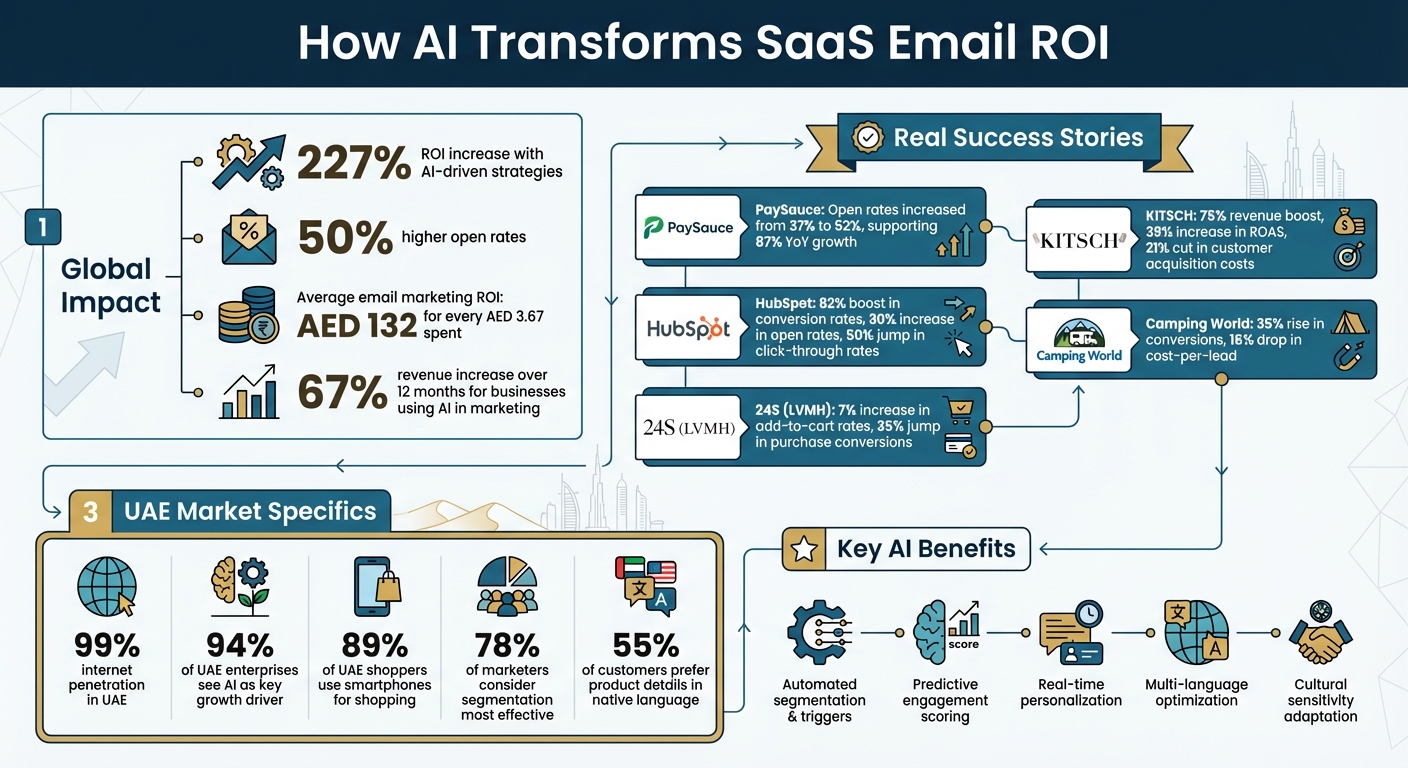 {AI-Driven SaaS Email Marketing ROI Statistics and Key Metrics}
:::
{AI-Driven SaaS Email Marketing ROI Statistics and Key Metrics}
:::
Understanding SaaS Email ROI in the UAE
What Is ROI and How to Measure It
Email ROI is calculated using the formula: (Gained – Spent) / Spent [13][15]. For SaaS businesses, this goes beyond simple revenue numbers. It factors in efficiency (like time and cost savings), growth (such as trial-to-paid conversions and renewals), and risk management (avoided churn and compliance costs). However, the UAE often falls behind the global average [1]. This is usually because businesses focus on just one aspect of ROI while overlooking others.
"ROI doesn't appear by chance; it comes from discipline: choosing vertical use cases tied to P&L, embedding ROI baselines early, and managing costs across their full horizon."
- Chirag Bhardwaj, VP - Technology, Appinventiv [1]
Before starting any AI-powered email campaign, it's essential to establish your baseline metrics in AED, such as renewal rates or trial conversion values. Without this, your analysis might end up as just a story rather than actionable insights [1].
Once you have your baseline, the next step is mapping revenue events across the entire customer journey.
Mapping Revenue Events in SaaS Email
In SaaS, revenue often comes from specific milestones triggered by email campaigns. These include actions like trial sign-ups, demo requests, trial-to-paid conversions, subscription renewals, plan upgrades, and feature adoption [16].
Take PaySauce, a payroll software company, as an example. In 2024, they implemented Salesforce Marketing Cloud to segment their audience and automate newsletters. By aligning their emails with specific user journeys, they boosted open rates from 37% to 52%, which supported an impressive 87% year-on-year growth [11].
When sales cycles stretch over weeks or months, attribution becomes a key factor. Different models help assign value to email campaigns:
- Linear attribution: Gives equal credit to all touchpoints, like welcome emails and nurture sequences.
- Time decay attribution: Assigns more weight to emails sent closer to the conversion event.
- Last-click attribution: Credits only the final email before a subscription.
For a clearer long-term picture, calculate ROI using Customer Lifetime Value (CLV) instead of just initial transactions. For instance, if a customer pays AED 500 monthly for 24 months, the campaign drives AED 12,000 in total revenue.
Once revenue events are mapped, the next step is tracking costs to calculate ROI accurately.
Calculating Costs for Accurate ROI
Overlooking costs can inflate ROI figures and lead to poor investment decisions. Your core expenses generally include the subscription for your Email Service Provider (ESP), labour costs, and technology tools [13][16][18].
In the UAE, where labour costs are higher, precise cost tracking is especially important. For an average SaaS company, monthly costs might look like this: AED 1,500 for the ESP, AED 5,000 for 25 hours of a specialist's time (at AED 200 per hour), and AED 400 for AI and testing tools. Altogether, that's AED 6,900 in monthly expenses [17]. Labour costs in the UAE are particularly significant, as only 0.4% of the global AI talent pool is based here, increasing acquisition costs [1][14].
A good example of cost management comes from 24S, a digital luxury retailer under LVMH. In 2024, they adopted Braze's AI Item Recommendations to personalise abandoned cart alerts. Led by Senior CRM Project Manager Carla Rota, the initiative resulted in a 7% increase in add-to-cart rates and a 35% jump in purchase conversions [17].
"By consolidating our tech stack and migrating to Braze, we were able to cut technology costs, reduce integration time, and limit technical complexity while delivering highly personalised experiences."
- Carla Rota, Senior CRM Project Manager, 24S [17]
When calculating ROI, remember to exclude organic sales growth to isolate the campaign's true impact [19]. If your campaign generates leads that convert later, factor in the lead value. For instance, with a AED 500 monthly subscription and a 2% historical conversion rate, each lead is worth AED 10 [18]. This level of precision turns ROI from a vanity metric into a strategic tool for shaping your AI email campaigns.
sbb-itb-f7b3a33
How to Start Using AI in Email Marketing (The Right Way)
::: @iframe https://www.youtube.com/embed/hOXZ2a7PxOw :::
Preparing Your SaaS Email Strategy for AI
To make the most of AI in your email strategy, start with the basics: clean, well-organised data. Without this, even the most advanced AI tools will struggle to deliver meaningful results.
Auditing and Mapping Email Journeys
First, ensure your email infrastructure is in order. Verify SPF, DKIM, and DMARC for all sending domains so your AI-optimised emails land in inboxes instead of spam folders [20]. Next, audit your existing email workflows - whether it’s onboarding, engagement, renewal, or win-back campaigns. Take note of acquisition sources, historical complaints, and bounce rates to identify any segments that could interfere with AI learning.
It’s also a good idea to implement a sunset policy for inactive users (typically 90–120 days without engagement) and standardise your tracking mechanisms, such as UTM parameters and event names, to ensure your data remains consistent [20][21].
Centralising Data for AI Optimisation
Once your email workflows are mapped and cleaned, focus on centralising your data. Identify all systems where customer data is stored, such as your CRM or analytics platforms [21]. Tools like a Customer Data Platform (CDP) or data warehouses (e.g., Snowflake or BigQuery) can consolidate behavioural signals, demographic details, and purchase history into unified customer profiles [21][2].
For real-time data integration, connect these systems through APIs. A great example of this in action comes from HubSpot's demand generation team in late 2024/early 2025. They used GPT-4 to analyse user behaviour and website data, matching users with relevant educational courses based on intent signals. The results? An 82% boost in conversion rates, a 30% increase in open rates, and a 50% jump in click-through rates [10].
To replicate such success, you’ll need to clean your data thoroughly - removing duplicates and outdated records. The quality of your data directly impacts the accuracy of AI insights and, ultimately, your ROI [7][21].
Segmenting Audiences for ROI Growth
With your data centralised and cleaned, fine-tune your strategy by segmenting your audiences. Move beyond static lists to dynamic segments that update in real time based on live customer signals [5]. In fact, 78% of marketers consider segmentation one of the most effective email marketing strategies [22].
AI can help by assigning predictive scores for metrics like churn risk, purchase likelihood, and lead quality. These scores can then trigger automated workflows, ensuring timely and relevant communication [10].
For instance, map key product actions - such as trial activations, feature usage, or visits to pricing pages - to lifecycle stages like Lead, MQL (Marketing Qualified Lead), and SQL (Sales Qualified Lead). You might also create a segment for "New Engaged Subscribers" based on activity within the last 14 days.
Finally, use global suppression lists and frequency caps to avoid over-messaging, which can lead to higher unsubscribe rates and lower ROI. Before deploying AI, normalise your contact properties (e.g., standardising variations like "HubSpot" and "HUBSPOT") and replace free-text fields with dropdown menus to ensure clean, consistent data for the algorithm to analyse [10].
Using AI to Optimise SaaS Email Performance
Once your data systems are in place, AI can be a game-changer for refining content, choosing the best send times, and personalising emails to suit individual recipients.
AI for Subject Line and Content Optimisation
AI can predict which subject lines will perform well before you even hit send. By analysing vast amounts of data, these tools score different variations based on their potential open rates and then refine them continuously based on how recipients actually respond [3].
"AI is your assistant who remembers every subject line that's ever worked for your audience and applies those insights instantly."
- Justina Thompson, HubSpot [3]
To get the most out of this, connect your AI tool to your CRM. This lets it access crucial data like lifecycle stages, behavioural cues (e.g., visits to your pricing page), and intent signals. Use dynamic tokens to personalise emails at scale - think first names, company names, or even specific product usage stats [3][8]. For mobile optimisation, keep subject lines under 7 words and 45 characters, and ensure each A/B test variant is sent to at least 1,000 contacts for reliable results [3].
Build a library of modular content - pre-approved sections like intros, feature highlights, and CTAs - that AI can mix and match based on the recipient's profile [10]. To avoid spam filters, set up a disallowed list for phrases like "Guaranteed results" or overuse of punctuation, which can harm your brand's credibility [10][4].
| Lifecycle Stage | AI Content Goal | Metric to Watch |
|---|---|---|
| Awareness | Subject line/Preview text | Open Rate |
| Consideration | Value framing and length | Click-Through Rate |
| Decision | CTA clarity and placement | Conversion Rate |
| Retention | Dynamic content and timing | Reply/Renewal Rate |
Once your content is optimised, it’s time to focus on using AI for smarter email triggers.
Automating Behaviour-Based Email Triggers
Static email schedules often fall short in the SaaS world. AI-powered triggers can respond to real-time signals - like completed onboarding steps, changes in feature usage, or periods of inactivity - ensuring messages arrive at the perfect moment [5][2].
AI can analyse engagement trends to determine the best send times for each recipient [5][8]. Using dynamic segmentation, your email lists can update automatically based on customer behaviour [5][7]. AI also predicts the next best action for each user, whether it’s an invite to a product demo, a tutorial, or a renewal reminder [7].
Start with high-impact scenarios like onboarding emails for new trials, abandoned cart reminders, or re-engagement campaigns for inactive users [6][7]. Use anomaly detection to catch issues early, such as a sudden spike in unsubscribes or a drop in engagement [8]. To avoid overwhelming your audience, set frequency caps - even though AI can churn out content quickly [4].
While AI can automate much of the process, avoid relying on "one-click send" for sensitive content like pricing or compliance-related emails. Always include a human review for such cases [10].
Personalising Content for UAE Audiences
With a population representing over 200 nationalities, the UAE requires more than basic personalisation [23][24]. AI can incorporate local touches like AED pricing, neighbourhood names (e.g., Jumeirah, Downtown Dubai), and landmarks to make messages more relatable [26].
Tools that detect a user's language preference from their first interaction save time and improve the experience [24]. AI can adapt to both Modern Standard Arabic and regional dialects, tailoring messages to individual preferences [23][24]. Real-time sentiment analysis in Arabic and English helps adjust the tone of your emails to match customer moods [25].
Cultural sensitivity is crucial. In the GCC, family-focused messaging, modest imagery, and respect for religious values resonate strongly [24]. During Ramadan, for example, AI can adjust email delivery to align with peak engagement times, like just before Iftar or late at night [26]. For occasions like Eid Al-Fitr or UAE National Day, tweak themes and timings accordingly.
Since 89% of UAE shoppers use smartphones for their shopping journeys [24], ensure your AI-driven emails are mobile-friendly. Also, highlight local payment options like mada, Benefit, or KNET in checkout reminders [24].
"Gulf consumers don't just want personalised experiences, they demand culturally intelligent ones."
- Aneesh Sreedharan, CEO of 2Hats Logic Solutions [24]
Once your emails are personalised, the next step is integrating them seamlessly with other channels.
Integrating Email with Social Content via Posterly
AI’s benefits don’t have to stop at email. By integrating email campaigns with social media content, you can streamline your processes and maintain consistency. Posterly allows you to repurpose AI-generated social media content directly into email campaigns, ensuring a unified message across platforms like Instagram, LinkedIn, and WhatsApp - all popular in the UAE [23].
Posterly’s AI Caption Assist can generate social media copy that aligns with your brand, which can then be adapted for email subject lines, preview text, or body content. Its Nano Banana feature even creates visuals that work across both channels, keeping your brand’s look consistent. By managing everything through Posterly’s dashboard, you save time and ensure your messaging remains cohesive, whether it’s in someone’s inbox or on their Instagram feed.
This approach is especially relevant in the UAE, where 94% of enterprises see AI as a key driver for growth [23]. By linking your social and email strategies, you can meet customers wherever they are, all while reducing workload and maintaining a strong brand voice.
Measuring and Refining AI-Driven Email ROI
After laying the groundwork with strategy and optimisation, it’s time to dive into how to measure and fine-tune the returns on investment (ROI) from AI-powered email campaigns. Once AI takes the reins of your email marketing, it’s crucial to track its performance using a handful of revenue-focused metrics. Stick to three to five key indicators, such as conversion rate, revenue per email, and ROI percentage, to avoid getting lost in excessive data noise [28].
Setting Up an ROI Dashboard
Integrating your email platform with a CRM is essential for tracking email interactions and revenue in AED [28][12]. For SaaS businesses in the UAE, your dashboard should monitor revenue in AED, conversion rates across lifecycle stages, and cost per lead. Automating data updates is a must to save time and reduce manual errors [28].
Traditional last-click attribution often underestimates email’s contribution by 30–40% [27]. Instead, AI-based attribution models, like Markov chains or Shapley values, provide a more accurate picture of email’s role throughout the customer journey [27][28]. For instance, KITSCH, a €70 million brand, used AI attribution to better understand email’s nurturing impact, achieving a 75% revenue boost, a 39% increase in ROAS, and a 21% cut in customer acquisition costs [27].
To keep your campaigns on track, review your dashboard every 24–48 hours for immediate insights, conduct deeper trend analyses weekly, and perform strategic ROI evaluations monthly [28]. For UAE-specific campaigns, tailor your dashboard to local work schedules - like the Sunday-to-Thursday workweek - and consider Friday prayer times to ensure AI send-time optimisation aligns with regional behaviour.
With these dashboards in place, you can easily compare pre- and post-AI metrics to identify real improvements.
Comparing Metrics Before and After AI Implementation
Switching from traditional to AI-powered email marketing opens up opportunities to track more advanced metrics. Before AI, you might have focused on basic engagement stats like open rates and click-through rates. AI, however, brings tools like predictive engagement scores, churn risk analysis, and revenue attribution per email [17][2].
In January 2025, HubSpot’s marketing team, led by CMO Kipp Bodnar and VP Emmy Jonassen, adopted an AI system to predict individual lead preferences. By analysing factors like business URLs and content downloads, they matched leads with tailored content, resulting in an 82% boost in conversion rates, a 30% rise in open rates, and a 50% increase in click-through rates [9].
"The real 'magic' isn't in the email itself but in how well the AI could predict what the user actually needed."
- Kipp Bodnar [9]
When comparing metrics, it’s important to isolate variables. For example, if you’re testing AI-optimised send times, keep all other factors constant to measure true improvements [17]. Run tests for at least seven days to account for daily subscriber behaviour [17]. Additionally, segment your audience using AI into high, medium, and low engagement groups. Focus premium content delivery on high scorers to maximise ROI while maintaining email deliverability [17].
Here’s a snapshot of how key metrics evolve with AI:
| Metric Category | Traditional (Before AI) | AI-Driven (After AI) |
|---|---|---|
| Engagement | Open Rate, Click-Through Rate | Predictive Engagement Score, Send-Time Optimisation Uplift |
| Revenue | Total Sales Revenue | Revenue Attribution per Email, Customer Lifetime Value (CLV) |
| Audience | Static Segments (Demographics) | Dynamic Segments (Likely to buy/churn) |
| Content | A/B Test Winner (Manual) | Content Intelligence Score, Real-time Personalisation Uplift |
| Cost | Manual Labour Hours | Automation Efficiency, Cost per Lead (CPL) Reduction |
Continuous Testing and AI Optimisation
AI-driven email campaigns thrive on consistent testing and optimisation. Focus on isolating one variable at a time - such as subject lines, calls-to-action (CTAs), or layouts - to pinpoint its specific impact [2][29].
For more intricate campaigns, use multivariate testing to assess several elements, like tone, structure, and personalisation, all at once [29][7]. Many AI tools can automatically push the best-performing variation to the rest of your audience after testing [3][29]. To ensure reliable results, aim for each variant to reach at least 1,000 contacts [3][17].
Follow a structured testing process: start with 20 AI-generated variations, test them on 10% of your segment for two days, validate the top performers on an additional 20% for another two days, and then roll out the winning version to the remaining 70% [3][17]. Keep a record of "failed patterns" to prevent the AI from repeating ineffective strategies [3].
In 2025, Camping World, under the guidance of Senior Marketing Director Brad Greene, used Twilio Segment’s predictive analytics to unify customer profiles. By improving data collection and leveraging predictive scores, they achieved a 35% rise in conversions and a 16% drop in cost-per-lead [17]. Regular testing and fine-tuning, based on real-world data, are essential to staying ahead in the ever-changing UAE SaaS landscape.
Localising SaaS Email Campaigns for the UAE Market
Once your AI-powered email campaigns are up and running, the next step is tailoring them to suit the preferences of your UAE audience. Localisation goes beyond simple translation - it's about honouring cultural expectations, adapting to local routines, and presenting information in a way that feels familiar. With over 99% internet penetration in the UAE and email marketing delivering an average ROI of AED 132 for every AED 3.67 spent, fine-tuning your approach to this market can lead to impressive results [30]. These strategies build on earlier discussions about data segmentation and AI tools, ensuring your emails truly connect with UAE recipients.
Adapting Formats and Units
When communicating with UAE audiences, make sure your emails reflect local norms. Dates should follow the DD/MM/YYYY format, and prices must be shown in AED - for example, "AED 365/month" instead of "$99/month" [31]. Also, use UTF-8 character encoding to ensure proper rendering of Arabic text and special symbols across various email platforms [31].
AI tools can simplify this process by automatically pulling location-specific data, such as currency and date formats, directly from subscriber profiles. Dynamic content blocks can further customise emails, allowing you to showcase different offers or prices based on the recipient's location within the UAE [32]. According to the Localization Industry Standards Association (LISA), investments in localisation can yield AED 92 for every AED 3.67 spent [31].
Timing and Observing Local Customs
The UAE’s work week typically runs from Sunday to Thursday, with Friday set aside for prayer and rest in many sectors [31]. AI-powered tools can help you optimise email send times, with peak engagement windows identified as early morning (07:00–08:30), lunchtime (12:30–14:00), and late evening after 21:00 [30]. Be mindful to avoid sending emails during Friday prayer times or key religious periods like Ramadan.
Segmenting your audience based on cultural holidays allows you to deliver timely and meaningful content. For example, crafting campaigns around Ramadan or Eid can strengthen your connection with subscribers by addressing their specific needs and emotions during these times. Regularly updating your UAE subscriber database will also help maintain high delivery rates [30].
Multilingual and Tone Considerations
With 55% of customers preferring product details in their native language, testing bilingual campaigns in both English and Arabic can enhance engagement [31]. Arabic, being a right-to-left (RTL) language, may require some layout adjustments compared to English. Opt for one-column email designs to accommodate the extra space Arabic translations often require, as they generally use more characters than English [31].
AI can help you experiment with different tones to find the one that resonates best with UAE business professionals. Let subscribers choose their preferred language through a preference centre, and use dynamic content to automatically deliver the appropriate version. Keep subject lines under 50 characters in both languages to ensure they display fully on mobile devices [31]. Additionally, steer clear of overly aggressive phrases like "Free" or "Discount", as these are often flagged as spam by UAE email providers [30].
Conclusion
AI has redefined SaaS email marketing, turning what was once a time-consuming trial-and-error process into a streamlined and scalable approach. By automating tasks like segmentation and A/B testing, it allows teams to shift their focus to strategy and creativity while continuously learning from each campaign to enhance results. This efficiency drives every phase of your marketing efforts, from planning to execution. In fact, businesses leveraging AI in marketing and sales have reported a 67% increase in revenue over 12 months, while AI-powered personalisation can improve customer satisfaction by 15–20% [7].
Experts in the field echo this transformation. Jesse Sumrak from Twilio SendGrid highlights:
"AI doesn't replace marketers. Instead, it works alongside them, handling data analysis and optimization so marketers can focus on creative strategy, messaging, and building customer relationships." [8]
For SaaS teams in the UAE, the potential is immense. AI can be tailored to optimise send times for the UAE’s Sunday-to-Thursday work week and to create bilingual campaigns that connect with local audiences effectively.
To maximise AI’s impact, it’s essential to consolidate your data. Ensure your CRM serves as the central repository for engagement history and deal stages. Start small by focusing on one high-impact funnel, such as trial-to-paid conversion, and measure the results before expanding AI’s role across your entire lifecycle [10][33].
Additionally, tools like Posterly can help manage email and social media content effortlessly. By using AI-driven content creation and scheduling across platforms, you can maintain a cohesive message throughout your campaigns. This alignment not only prevents fragmented customer experiences but also strengthens your overall return on investment [4].
FAQs
::: faq
How can AI help SaaS businesses improve email open rates?
AI helps SaaS businesses improve email open rates by making subject lines more personalised, ensuring they connect with each recipient on a deeper level. It also determines the optimal time to send emails based on individual subscriber behaviour, boosting the chances of engagement. On top of that, AI facilitates dynamic audience segmentation, enabling businesses to craft content tailored to specific groups, which leads to better open rates and overall campaign success. With these tools, SaaS companies can refine their email strategies and see a higher return on investment. :::
::: faq
How can SaaS email campaigns be effectively localised for the UAE?
To tailor SaaS email campaigns for the UAE, it’s essential to do more than just translate your content. Instead, adapt it to reflect Emirati culture and preferences. While Arabic is widely spoken, keep in mind the variations in dialect and the subtleties of local customs. This should influence everything from the tone of your message to the imagery you use and the way you phrase your calls-to-action. Aligning your content with these local sensibilities can significantly boost engagement.
Another crucial factor is compliance with regional regulations. Be mindful of UAE-specific rules, such as data privacy laws and anti-spam guidelines. Formatting is equally important - use the UAE’s standard formats for dates (DD/MM/YYYY), times (24-hour clock), numbers (1,000.00), and currency (AED) to ensure clarity and avoid misunderstandings.
To make these adjustments more efficient, consider using AI-driven personalisation. This technology helps you fine-tune your campaigns, tailoring messages to individual preferences while delivering a strong return on investment. :::
::: faq
How can businesses measure the ROI of AI-powered email marketing campaigns effectively?
To gauge the return on investment (ROI) of AI-powered email marketing, start by linking revenue directly to specific email actions - like opens, clicks, and conversions. AI tools go beyond basic metrics such as last-click revenue (e.g., د.إ127,000), offering a more detailed view of the customer journey. This enables businesses to better understand the actual impact of their campaigns and calculate ROI with greater precision.
Some key metrics to focus on include:
- Improvements in open rates
- Growth in click-through rates
- Conversion rates for each email
- Revenue generated per email
- Cost reductions achieved through automation, such as advanced segmentation and optimised send times
AI also brings operational advantages, such as saving up to 70% of the time spent drafting emails and improving lead scoring accuracy. By consistently running A/B tests and analysing data, businesses can fine-tune their strategies and achieve tangible, measurable outcomes. :::
Related Articles
How to Create 30 Days of Social Media Content Using AI Images in posterly
A practical guide to generating a full month of original social media images with posterly's AI image tool, writing captions for each one, and scheduling everything in a single session.
Read moreHow to Find the Best Time to Post on Social Media Using posterly's AI Scheduler
Stop guessing when to post. This guide explains how posterly's AI Scheduler analyses your audience activity and automatically picks the best posting times so your content gets seen by more people.
Read moreHow to Manage Google Business Reviews on Autopilot With posterly
A step-by-step guide to responding to Google reviews with AI, automatically requesting new reviews from customers, auditing your profile for local SEO, and turning your best reviews into social media content.
Read moreHow to Manage Multiple Client Social Media Accounts With posterly Workspaces
A practical guide for agencies and teams on using posterly Workspaces to organise client accounts, assign roles, get content approved, and schedule posts across dozens of social profiles without things getting messy.
Read more