
AI Audience Segmentation for Social Media Platforms
AI Audience Segmentation for Social Media Platforms

AI Audience Segmentation for Social Media Platforms
AI audience segmentation is transforming how businesses target users on social media. By analysing behavioural, demographic, and psychographic data, AI tools help marketers create precise audience groups that update in real-time. This approach improves ad spend efficiency, increases personalisation, and boosts ROI.
Key insights:
- 88% of marketers are expected to use AI tools by 2026, achieving 41% revenue growth and cutting acquisition costs by 32%.
- AI adapts to user behaviour dynamically, ensuring campaigns remain relevant.
- Platforms like Instagram, Facebook, and LinkedIn use AI differently, tailoring strategies to their unique audiences.
- Predictive modelling and real-time updates allow brands to focus on high-value prospects.
AI-driven segmentation is especially useful in competitive markets like the UAE, where optimising ad budgets is critical. By leveraging tools like Posterly, businesses can streamline content creation, scheduling, and performance tracking.
Deploy Tomorrow: AI Marketing Usecases - AI Campaign Ideation & Audience Segmentation
::: @iframe https://www.youtube.com/embed/QWDTczusopQ :::
How AI Audience Segmentation Works
AI audience segmentation takes raw social data and turns it into actionable insights. By gathering data, applying machine learning to uncover patterns, and updating segments in real time, it gives marketers a clearer view of how social media activity translates into precise audience targeting.
Data Collection and Analysis
AI systems start by gathering multiple data layers to build detailed user profiles. Demographic data lays the groundwork, capturing essential details like age, gender, income level, education, job title, and location across the UAE. Behavioural data tracks real-time actions such as browsing habits, purchase frequency, and social media interactions like likes, shares, comments, and clicks [1][2][8]. Meanwhile, psychographic data digs deeper, analysing factors like values, beliefs, lifestyles, personality traits, and even consumer frustrations [4][8].
Intent signals, such as how recently or frequently a user has engaged, help predict future behaviours like purchase likelihood or churn risk [4]. Metrics unique to each platform - such as engagement rates, video completions, and preferred communication channels - add even more precision [2][8][9]. By combining a brand’s internal data (e.g., CRM records, loyalty programmes) with external insights from partners and marketplaces, AI paints a complete picture of the customer [1][3].
For example, in 2025, automotive retailer CARiD used Blueshift's AI tools to shift from generic campaigns. The result? A 70% increase in email open rates, a 35% rise in clicks, and a staggering 148% jump in email revenue [2].
Machine Learning Algorithms
Machine learning (ML) dives into social media data - likes, shares, and comments - to find patterns that would be impossible for humans to detect [5]. Instead of just focusing on a "social graph" (who you follow), modern algorithms explore an "interest graph" (what you care about), predicting what content users are likely to engage with next [11].
ML models use signals like watch time, swipe-through rates on carousels, and comment quality to group users into segments [11]. Advanced systems can even detect over 25 emotions - like joy, frustration, or excitement - based on user interactions, further refining these audience segments [6]. They also analyse behavioural trends to distinguish genuine users from bots [6].
Take Halara, for instance. By using Symphony Recommended Creatives on TikTok, the brand achieved a 70% drop in cost per acquisition by fine-tuning both targeting and creative elements [6]. Similarly, LendingTree used Blueshift's predictive segmentation to focus on high-value audiences, boosting customer engagement by 48% [2].
These insights flow directly into AI's dynamic segmentation process, making it smarter with every interaction.
Real-Time Updates and Dynamic Segments
Dynamic segmentation takes customer data analysis to the next level by continuously updating audience profiles as new data rolls in [1]. Unlike static labels, this approach captures real-time shifts in customer motivations, which can change weekly - or even daily [4].
Feedback loops play a key role here. By constantly integrating data from purchases, website activity, and social media interactions, AI ensures that marketing strategies stay ahead of the curve. This eliminates the need for manual data updates and allows brands to act immediately [1][2][4]. Dynamic scoring systems rank customers based on their likelihood to make a purchase, churn, or engage, enabling swift interventions when needed [2].
Spotify offers a great example. Between July 2015 and June 2020, its "Discover Weekly" feature used a dynamic segmentation loop to analyse micro-feedback like skips, repeats, and saves. This constant refinement led users to stream over 2.3 billion hours of personalised content [4].
"Every company has data, but if you can't action off that data instantly, then it doesn't do you any good."
– Joyce Poole, Sr. Director, Marketing CRM, LendingTree [2]
AI Segmentation for Instagram, Facebook, and LinkedIn
::: @figure 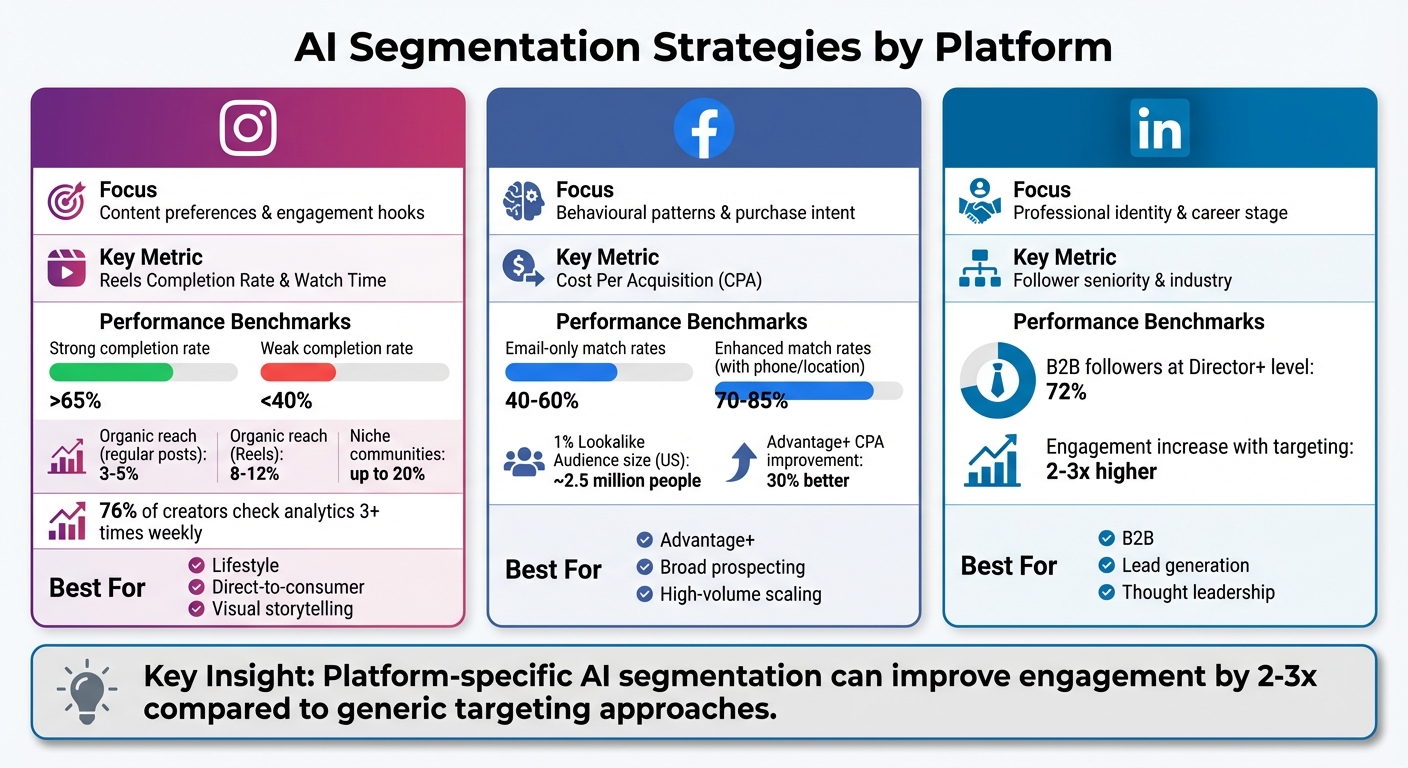 {AI Audience Segmentation Strategies Across Instagram, Facebook, and LinkedIn}
:::
{AI Audience Segmentation Strategies Across Instagram, Facebook, and LinkedIn}
:::
Each social platform employs a unique AI-driven strategy tailored to its user base. Instagram focuses on visual content, Facebook zeroes in on behavioural patterns tied to purchasing, and LinkedIn targets professional attributes. By understanding these nuances, marketers can refine their campaigns to suit each platform's strengths.
AI Segmentation for Instagram
Instagram's AI thrives on analysing visual engagement. It tracks metrics like Reels completion rates, watch time, and the number of times content is forwarded via direct messages - key indicators of audience interest [12]. The platform also offers tools to suggest optimal posting times and content styles based on these trends [12].
For instance, a Reels completion rate above 65% signals strong content appeal, while rates below 40% suggest the need for better hooks [12]. By 2026, average organic reach for regular posts was between 3–5%, while Reels reached 8–12%, with niche communities sometimes exceeding 20% [12]. Furthermore, 76% of creators now check their analytics at least three times a week, with those actively using insights earning 34% more from partnerships [12].
This data-driven approach highlights Instagram's unique emphasis on visual metrics to engage users effectively.
AI Segmentation for Facebook
Facebook's AI excels in identifying purchase intent and driving conversions. Tools like Lookalike Audiences and Advantage+ Audience use data such as purchase history, device habits, and online behaviour to find potential customers who resemble a brand's most valuable audience [13][14].
For example, email-only customer lists typically yield match rates of 40–60% for AI modelling. However, adding details like phone numbers, names, and locations can boost match rates to 70–85% [13]. To maximise effectiveness, brands should focus on high-value groups like "Purchasers" or the top 20% of spenders when creating Lookalike Audiences [13][14]. In the United States, a 1% Lookalike Audience translates to roughly 2.5 million people [13].
The introduction of Advantage+ Audience in 2026 has revolutionised targeting. This AI system adjusts audience parameters in real-time, testing ads across various segments and reallocating budgets to maximise conversions at the lowest cost [14].
"A Lookalike Audience is only as good as its source. Building lookalikes from a broad, unsegmented list of 'all customers' will produce mediocre results." – AdStellar [7]
Facebook's precision in behavioural targeting makes it a powerful tool for cost-efficient campaign scaling.
AI Segmentation for LinkedIn
LinkedIn's AI focuses on professional demographics, making it ideal for B2B marketing. It analyses attributes like job roles, seniority, industry, and company size to help brands reach decision-makers [15][16]. Interestingly, in some B2B sectors, 72% of LinkedIn followers hold Director-level roles or higher [15].
This professional lens makes LinkedIn a go-to platform for thought leadership and lead generation. Its AI tools even offer suggestions for content tone and style, adapting to demographic shifts within a brand's audience [15]. Brands that align their strategies with these insights often see 2–3x higher engagement compared to broader, less targeted approaches [16].
| Platform | Focus | Metric | Best For |
|---|---|---|---|
| Content preferences & engagement hooks [12] | Reels Completion Rate & Watch Time [12] | Lifestyle, direct-to-consumer, and visual storytelling [16] | |
| Behavioural patterns & purchase intent [13] | Cost Per Acquisition (CPA) [13] | Broad prospecting and high-volume scaling [14] | |
| Professional identity & career stage [15] | Follower seniority & industry [16] | B2B, lead generation, and thought leadership [16] |
These tailored AI approaches demonstrate how platform-specific segmentation can elevate social media marketing. Posterly's unified dashboard streamlines this process, offering tools like AI-assisted caption creation and smart scheduling for Instagram to help marketers optimise campaigns across Instagram, Facebook, and LinkedIn efficiently.
Benefits of AI-Driven Audience Segmentation
AI-powered audience segmentation offers tangible advantages that can significantly improve campaign outcomes. Organisations using AI in their marketing efforts report an average 41% boost in revenue and a 32% drop in customer acquisition costs[6]. With a return of AED 13.60 for every AED 3.70 invested, the financial benefits are clear[6]. These tools enable more precise targeting and enhanced personalisation.
Precision Targeting and Personalisation
Beyond financial returns, AI sharpens messaging by diving deeper than simple demographics. It analyses behavioural trends, psychographics, and real-time intent signals[7][19]. This allows machine learning algorithms to uncover niche personas and micro-segments that manual methods often miss[17][19]. Consider this: 79% of social media managers now rely on AI daily[17], and 71% say AI-created content outperforms traditional content[6].
AI takes personalisation to the next level. Dynamic ad content adapts based on individual interactions - like showing a case study to someone who watched a video but didn’t engage further[17]. AI agents can even detect over 40 different emotions, enabling brands to tailor messaging to match emotional states[18]. Predictive modelling further refines this process, forecasting which content will resonate with specific audiences with up to 85% accuracy[18].
"AI works best as a multiplier, not a replacement. Teams get better results when AI handles first drafts, analysis, and optimization, while humans provide strategy, voice, and final review." – Hootsuite[17]
Better ROI and Campaign Efficiency
AI’s ability to process real-time data and deliver actionable insights dramatically improves campaign efficiency. By automating repetitive tasks, teams can focus on strategy instead of execution. For example, execution time can drop from 20 hours to under 5 hours per week[17].
Meta's Advantage+ Shopping Campaigns, which use AI segmentation, achieve 30% better Cost Per Acquisition (CPA) performance[6]. Meanwhile, Sprout Social users have reported a 268% ROI over three years thanks to AI-driven efficiencies[6]. AI also scales A/B testing, running hundreds of micro-tests simultaneously and reallocating budgets in real time. Influencer vetting powered by AI can boost campaign ROI by 25% on average[18].
A practical example comes from Ashwin Thapliyal, Head of Marketing at Exemplifi. In the last quarter of 2025, his team used AI-driven segmentation for a B2B logistics client. This approach reduced content planning time by 50% and increased lead generation by 20%, all while crafting highly targeted LinkedIn campaigns[17].
"AI-driven audience segmentation reduced our content planning time by 50% last quarter." – Ashwin Thapliyal, Head of Marketing, Exemplifi[17]
Scalability and Real-Time Updates
AI can process massive amounts of social media data - likes, shares, comments, and sentiment - at speeds no human team could match[5]. It ensures audience segments stay up-to-date automatically, eliminating the need for manual adjustments[7]. This proactive approach helps marketers anticipate customer needs before they even arise[5].
AI-driven scheduling based on user activity can improve engagement rates by 25% to 40%[18]. Additionally, AI can reformat core content into platform-specific versions for LinkedIn, Instagram, and TikTok with ease or schedule Pinterest pins with AI-optimised descriptions[17][18]. Well-targeted social media ads powered by AI can reduce cost-per-acquisition by 50% or more, compared to broader targeting approaches[20][21].
Platforms like Posterly make scalability even easier. With tools like Nano Banana Pro for image creation and Veo for video production, Posterly offers a unified dashboard for AI-assisted content creation. Its smart scheduling and multi-platform management capabilities allow marketers to run optimised campaigns across Instagram, Facebook, LinkedIn, and more - all without adding manual workload. These tools make implementing AI-driven segmentation strategies not just effective but also seamless.
How to Implement AI Audience Segmentation
Breaking down AI-driven audience segmentation into three steps - data collection, segment definition, and performance optimisation - can help marketers create dynamic, effective audience groups. Interestingly, marketers with a documented social media strategy are 414% more likely to report success compared to those without one [10]. This structured approach builds on existing data insights to refine your targeting efforts.
Step 1: Collect and Organise Audience Data
The first step is to centralise your audience data. Start by auditing all your active, dormant, and duplicate social media accounts. This ensures that your data isn't scattered across platforms, which could otherwise confuse AI models later on [10].
Use analytics tools like Instagram Insights, LinkedIn Analytics, and Meta Business Suite to gather demographic and behavioural data. Supplement this with Google Analytics and CRM data to fill in any gaps [15][21]. If you notice mismatched demographic data, adjust your targeting accordingly.
Install tracking pixels, such as Meta Pixel or Conversions API, to capture detailed behavioural interactions [7]. Additionally, integrate first-party data - like email subscriber lists and transaction histories - into a Customer Data Platform (CDP). This gives AI a broader understanding of your customers' value [7].
Organise your data into layers:
- Demographics: Basics like age, gender, and location.
- Psychographics: Insights into customer motivations and values.
- Behavioural: The actions they take, such as clicks or purchases.
- Firmographics (for B2B): Company-specific traits like size or industry [10][7].
For transactional data, use RFM (Recency, Frequency, Monetary value) modelling to identify high-value customers (e.g., "Champions") versus those who are at risk of disengaging [7]. Regularly export and analyse performance data to track shifts in your audience and fine-tune your AI models [15].
Well-defined audience targeting can boost conversion rates by up to 50% compared to broad targeting [21]. Before diving into segmentation, make sure your data is clean, consistent, and aligned with your branding [10].
Step 2: Use AI Tools to Define Audience Segments
Once your data is in order, AI tools can take over to create and test various audience segments. These tools can analyse factors like age, interests, and behaviours to identify the most promising profiles [7]. Machine learning models help you pinpoint patterns linked to high lifetime value, so you can focus your budget on the most impactful audiences [7].
Platforms like Posterly offer AI-driven features to streamline this process. For example, AI Caption Assist and Nano Banana Pro can generate tailored messaging for different segments - such as Gen Z users on TikTok versus professionals on LinkedIn [15][10]. Posterly’s unified dashboard simplifies managing multiple platforms and audience groups.
Combine demographic, behavioural, intent, and transactional data to create highly specific segments that update in real-time [7]. Use lookalike audience tools to find new prospects who share traits with your best customers [7]. With AI adoption among social media marketers growing by 180% year over year as of 2026 [10], it's clear that AI handles the heavy lifting while marketers focus on strategy.
Start with broader segments, like age or location, and refine them as performance data rolls in. Once your segments are set, switch gears to monitoring and improving them.
Step 3: Monitor and Optimise Segmentation Performance
Segmentation isn’t a "set it and forget it" process. Continuously compare your assumptions with performance data [7][15]. Follow an optimisation cycle: Create → Publish → Measure (after 48–72 hours) → Learn → Adjust → Repeat [9].
Update behavioural segments weekly to reflect current user actions, while RFM segments typically need monthly recalibration [7]. Review ad performance regularly to cut spending on underperforming segments and reallocate resources to those delivering results [7]. Weekly metric reviews, monthly strategy adjustments, and quarterly deep dives can help you stay ahead of trends [15][10].
Analyse your top five posts each month to spot patterns in format, timing, or caption style [9]. Posterly’s analytics tools can track a post’s lifecycle, helping you identify peak engagement hours for better scheduling [9]. On most platforms, an engagement rate above 3% is strong, with TikTok leading at 3.70% on average [10].
"Posting without measuring is like throwing darts blindfolded. Analytics tell you what's resonating, when your audience is paying attention, and where to invest more effort." – Posterly [9]
Combine demographic insights with behavioural and psychographic data to ensure your assumptions align with actual purchases [7]. Social listening tools can also provide real-time insights into audience concerns and language trends that numbers alone might miss [21]. When managed strategically, social media campaigns can deliver an average ROI of AED 19.10 for every AED 3.70 spent [10]. This ongoing refinement is where AI’s real-time capabilities shine, making dynamic segmentation a game-changer.
Advanced AI Segmentation Features
AI segmentation takes targeting far beyond basic demographic filters. With tools like predictive modelling, lookalike audience creation, and automated dynamic updates, marketers can achieve a level of precision that static methods simply can’t match. These advanced techniques focus not just on identifying "who" your audience is but predicting "what they will do" based on patterns in their past behaviour [7].
Predictive Modelling and Behaviour Forecasting
Predictive modelling uses historical data - like purchase history, engagement trends, and online habits - to anticipate future actions [7]. By identifying patterns tied to high lifetime value (LTV), AI allows you to prioritise your budget on audiences with the greatest potential [7].
Modern platforms leverage machine learning trained on billions of interactions to predict outcomes, replacing outdated static rules [11]. For instance, consistent posting can improve reach by 40%-60%, as it helps algorithms develop more accurate prediction models [11].
To get started, focus on high-quality "seed" data. For example, instead of using all website visitors, target repeat purchasers for better results [7][22]. Combine predictive data with geographic or firmographic filters to fine-tune your targeting [7][23].
In May 2025, a fashion e-commerce brand on Shopify achieved impressive results by creating a Lookalike Audience from their top 5% of customers. This strategy led to a 35% increase in click-through rate (CTR), a 26% decrease in cost-per-acquisition (CPA), and a 3.8x increase in return on ad spend (ROAS) [22].
These predictive insights also enhance lookalike audience strategies, sharpening target profiles for even greater impact.
Lookalike Audience Creation
Lookalike audiences help you reach new prospects who share characteristics with your best customers. By analysing a "seed" audience, AI identifies lookalike groups on a 1%-10% scale. A 1% group offers the closest match, often delivering conversion rates up to 2.5x higher [24][13][23].
For example, Meta requires at least 100 people in a source audience to create a lookalike, though a group of 1,000 to 5,000 profiles is recommended for better pattern recognition [13].
A B2B lead generation project by HawkSEM showed the power of this approach. By modelling lookalike audiences based on high-LTV leads and pairing them with exclusion audiences, the campaign achieved a 32% lower cost-per-lead (CPL) and generated 4.5x more qualified leads [22].
When launching campaigns, start with a 1% lookalike size for precision. Expand to 2–5% for additional scale once the initial audience proves successful [23][13]. Always exclude the original source audience and existing customers from your lookalike campaigns to avoid wasted ad spend [23][13].
| Lookalike Size | Similarity Level | Best Use Case |
|---|---|---|
| 1% | Highest | Conversion campaigns, limited budgets |
| 2–3% | High | Scaling successful 1% campaigns |
| 4–5% | Moderate | Awareness and broader prospecting |
| 6–10% | Low | Maximum reach and brand awareness |
Once set up, these lookalike profiles stay accurate over time thanks to automated updates.
Automated Dynamic Updates
Automated dynamic updates keep audience segments accurate by adding or removing users in real-time based on their latest actions, such as purchases, browsing activity, or ad interactions [7]. This ensures your campaigns stay relevant, avoiding wasted spend on outdated intent. For example, someone who purchased a product last week is automatically moved from a "prospect" to a "customer" segment [7].
AI tools also sync first-party data, such as CRM or e-commerce transactions, with advertising platforms to maintain updated RFM (Recency, Frequency, Monetary) segments [7]. On Meta, lookalike audiences are refreshed every 3 days if they are part of an active ad group [25]. Well-targeted social ads can cut cost-per-acquisition (CPA) by 50% or more compared to broad targeting [20].
To make the most of these updates, use automated triggers to engage users immediately after high-intent actions, like visiting a pricing page [7]. Platforms like Posterly simplify this process by offering AI-driven tools such as AI Caption Assist and Nano Banana Pro for image generation. These features allow you to personalise messages for different segments while maintaining consistency across channels. Posterly’s unified dashboard makes it easy to manage dynamic segments and respond to real-time changes in audience behaviour.
Measuring AI Segmentation Success
AI-driven segmentation works best when you track the right metrics. While the social analytics market is projected to surpass US$43 billion by 2030 [27], only 23% of marketers currently document data-driven strategies [29]. Monitoring these metrics doesn’t just show how your segments perform - it helps you refine your entire AI-powered social media approach.
Key Metrics for Tracking Segment Performance
To measure success, focus on four key areas:
- Awareness: Metrics like reach and impressions.
- Engagement: Signals such as likes, shares, and saves.
- Conversion: Click-through rates (CTR), conversion rates, and ROI.
- Loyalty: Indicators like brand mentions and sentiment [27].
Avoid getting distracted by vanity metrics like follower counts. Instead, prioritise intent-driven metrics like saves, shares, and conversions, which reflect genuine interest.
"A large follower number means nothing if those followers don't engage, click, or buy." – PostPlanify [27]
Tailor your KPIs to each platform. For example:
- On LinkedIn, track lead form completions and cost per lead (CPL).
- On Instagram, monitor product tag clicks and “Add to Cart” actions.
- On Facebook, focus on initiated messages and appointment form fills [28].
For non-sales-focused segments, calculate the monetary value of leads by multiplying the Customer Lifetime Value (CLV) by your lead-to-customer conversion rate [28]. This approach is particularly relevant in the UAE, where 60% of marketers now evaluate social media success based on generated sales [28].
Also, follow the 48-hour rule: wait at least 48–72 hours before reporting data to allow platform APIs to stabilise [27]. Use UTM parameters on all shared links to track which audience segments drive website conversions [28].
Analysing Campaign Results by Segment
Analyse platform-specific demographics separately. For example, LinkedIn caters to professionals, while TikTok appeals to Gen Z [15][27]. Review top-performing posts monthly to identify trends in format (e.g., videos vs. carousels), topics, and posting times [9][29]. If your fastest-growing audience doesn’t match your target demographic, decide whether to pivot your content strategy or explore the new segment’s commercial potential [15].
AI-powered sentiment analysis adds another layer of insight by interpreting audience emotions. This has already led to a 35% increase in tracking engagement from influencers and user-generated content [27]. Pay attention to engagement velocity - the number of interactions within the first hour of posting - as it often determines whether algorithms push your content to a broader audience [29]. Posting during peak hours can also boost reach by 20–30% [15].
| Business Goal | Primary Metrics to Track | Segment Analysis Focus |
|---|---|---|
| Brand Awareness | Reach, Impressions, Growth Rate | Are we reaching new unique users within the target demographic? |
| Website Traffic | CTR, Clicks, CPC | Which segment finds the call-to-action most compelling? |
| Lead Generation | Conversion Rate, Form Fills | Which segment provides the highest quality leads at the lowest cost? |
| Customer Loyalty | Brand Mentions, Sentiment | How does the "feeling" behind mentions differ between segments? |
| Sales & Revenue | Social ROI, Sales Referrals | Which segment has the highest Customer Lifetime Value (CLV)? |
These metrics provide a foundation for ongoing improvements to your segmentation strategy.
Optimisation Strategies Based on Analytics
The insights you gather should guide continuous adjustments to maximise campaign impact. Follow a simple cycle: Create, Publish, Measure (after 48–72 hours), Learn, Adjust, and Repeat [9]. Use the "Keep, Improve, Stop" framework to categorise your efforts:
- Keep: Scale up what’s working.
- Improve: Adjust tactics with potential but weak CTAs.
- Stop: Eliminate low-ROI efforts to free up resources [30].
When a content style performs well for a segment, create 3–5 additional posts in that format the following week to build on the momentum [29]. Set SMART goals, like “Increase the SaaS Founder segment’s CTR by 15% in 90 days” [30]. To prioritise efficiently, use an impact–effort matrix, focusing first on “Quick Wins” like rewriting CTAs before tackling more complex projects [30].
Audience segments evolve with seasonal changes, market trends, and shifting consumer preferences. Consistently re-evaluate to stay relevant [26]. Accounts posting 4–7 times weekly grow 2.5× faster than those posting 1–2 times [29]. Tools like Posterly’s unified dashboard make it easier to track metrics across platforms like Instagram, Facebook, and LinkedIn. With features like AI Caption Assist and smart scheduling, you can quickly replicate successful content formats for different segments while maintaining consistency.
Conclusion
Summary of AI Segmentation Benefits
AI-powered segmentation is reshaping social media marketing by analysing user behaviour, sentiment, and real-time engagement data to create adaptable audience groups that update automatically [5]. This approach allows marketers to achieve a level of precision in targeting that manual methods simply can't match.
As discussed earlier, AI tools are delivering measurable results. For instance, Meta's Advantage+ improves cost-per-acquisition by 30%, while TikTok's Symphony AI boosts purchase intent by 37% [6]. These advancements demonstrate how AI optimises marketing budgets across platforms like Instagram, Facebook, and LinkedIn.
Beyond just statistics, AI-driven predictive modelling shifts marketing strategies from reactive to proactive. Marketers can now anticipate customer needs, personalise messages at scale, and fine-tune campaigns in real time based on performance data [5]. With adoption rates climbing steadily, it's clear that AI is becoming an essential tool in the marketer's toolkit [6].
Armed with these insights, marketers can take actionable steps to integrate AI into their strategies effectively.
Next Steps for Marketers
Integrating dynamic segmentation into your strategy can transform how you approach social media marketing. Start small - use AI for tasks like generating content ideas, writing captions, or analysing basic audience data. Gradually expand AI's role while maintaining human oversight to ensure quality and creativity [6]. As Jeff MacDonald, Social Strategy Director at Mekanism, puts it:
"I don't think social media managers should be concerned about AI taking their jobs. All AI is going to do - if you know how to use the tools right - is help you accelerate your work and decrease how long typical tasks take" [6].
This highlights AI's role as a tool to enhance, not replace, human creativity and strategy.
To streamline the integration process, platforms like Posterly offer a unified solution. They combine AI-powered tools for content creation with scheduling features for platforms like Instagram, Facebook, and LinkedIn. Tools such as AI Caption Assist, Nano Banana Pro for image creation, and Google Veo for video production allow marketers to craft platform-specific content from a single dashboard. Begin by connecting your social accounts, defining audience segments based on the strategies discussed, and closely tracking performance. With 71% of social media marketers reporting that AI-generated content outperforms traditional content [6], adopting these tools quickly and effectively could be the game-changer your strategy needs.
FAQs
::: faq
What data do I need to start AI audience segmentation?
To start with AI-based audience segmentation, collect detailed information about your audience. This includes demographics like age, gender, location, language, income, and education, as well as behavioural data such as interests, purchase habits, device preferences, and engagement patterns. Use social media analytics to dive deeper, creating comprehensive personas and pinpointing high-value audience segments. This approach helps refine targeting and boosts the success of your campaigns. :::
::: faq
How do I adapt AI segments for Instagram vs Facebook vs LinkedIn?
Adapting AI content for platforms like Instagram, Facebook, and LinkedIn means tailoring your approach to fit each platform's specific audience and style.
-
Instagram: Prioritise eye-catching visuals and short videos that resonate with a younger, image-driven audience. Think bold colours, trendy aesthetics, and concise captions that grab attention quickly.
-
Facebook: Use the platform's robust demographic and behavioural insights to create personalised content. Cater to a broad mix of age groups and interests, and aim for posts that spark engagement, such as polls, relatable stories, or community-focused updates.
-
LinkedIn: Focus on professional users by sharing content that adds value in a business context. This could include industry trends, career advice, or stories of professional achievements that align with B2B goals. :::
::: faq
How can I measure if my AI segments are improving ROI?
To determine if your AI-driven audience segments are boosting ROI, focus on tracking key metrics like engagement rates, reach versus impressions, and top-performing content. By analysing these metrics over time, you can evaluate whether your targeted segments are achieving higher engagement and delivering improved outcomes. Make it a habit to review your data regularly and fine-tune your segmentation strategies to keep your social media campaigns performing at their best. :::
Related Articles
Best Hashtag Practices for 2026 Social Media
Best Hashtag Practices for 2026 Social Media
Read moreHow AI Enhances Real-Time Social Media Monitoring
How AI Enhances Real-Time Social Media Monitoring
Read moreHow AI Predicts Social Media Engagement
How AI Predicts Social Media Engagement
Read moreWhat's New on posterly — March 2026
Everything we shipped in March 2026: Instagram Analytics, two new platforms, Link in Bio, Design Studio upgrades, AI Video presets, Workspaces, and more.
Read more