
AI-Assisted Brainstorming for Social Media
AI-Assisted Brainstorming for Social Media

AI-Assisted Brainstorming for Social Media
AI is transforming how social media content is created. Instead of spending hours brainstorming, you can now generate dozens of tailored ideas in seconds. By analysing trends, audience behaviour, and platform-specific requirements, AI helps marketers overcome creative blocks and streamline content production.
Key highlights:
- 78% of marketers use AI for brainstorming, while 42% rely on it for captions.
- AI tools analyse trending topics, predict content longevity, and suggest platform-specific formats.
- Structured prompts improve AI output, turning vague ideas into actionable content plans.
- AI reduces time spent on repetitive tasks, enabling teams to focus on refining and scheduling Instagram posts.
The best results come from combining AI's speed with human oversight, ensuring content aligns with brand voice and audience expectations. It's not about replacing creativity but enhancing productivity while staying relevant in a fast-paced digital landscape.
::: @figure 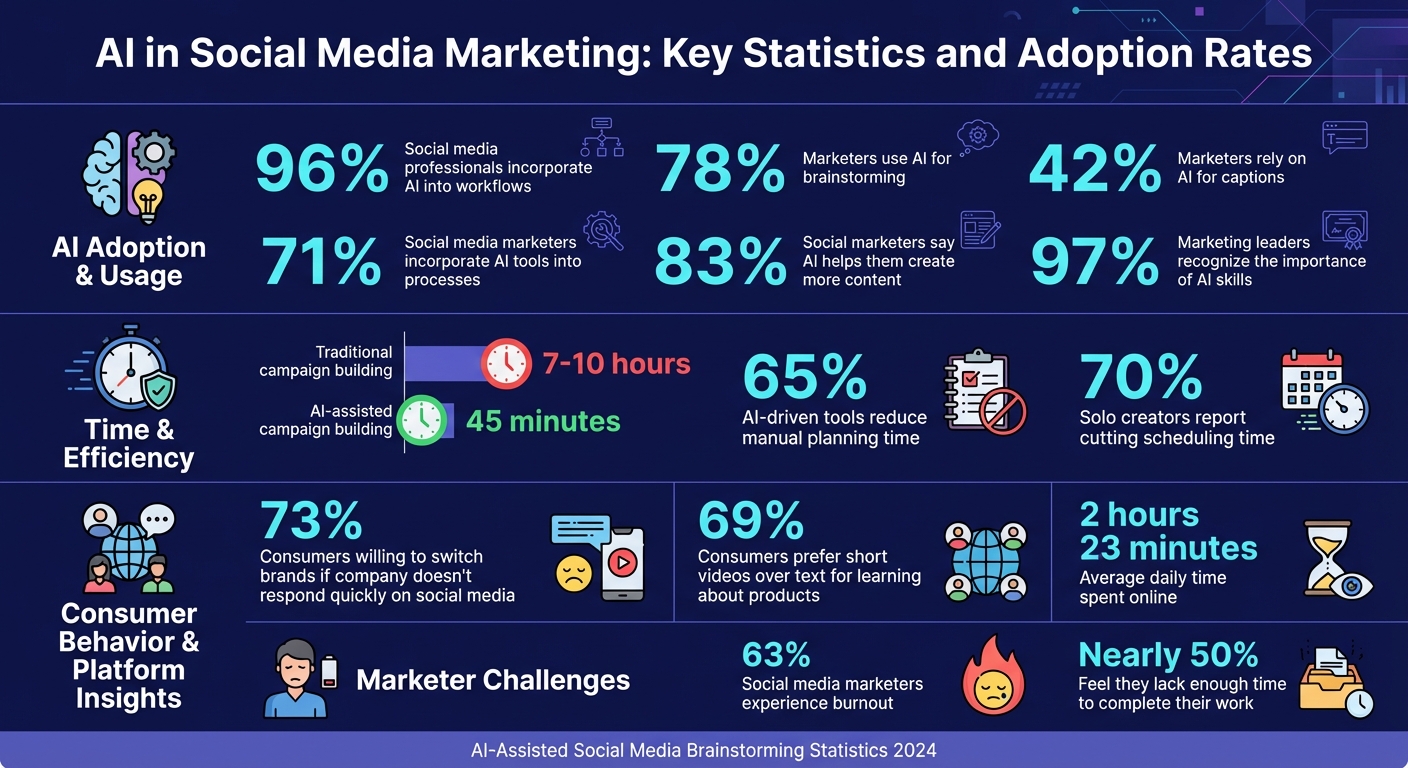 {AI in Social Media Marketing: Key Statistics and Adoption Rates}
:::
{AI in Social Media Marketing: Key Statistics and Adoption Rates}
:::
30-Minute AI Tool Challenge: Design a Social Media Campaign Using Only AI (Uncut)
::: @iframe https://www.youtube.com/embed/KKyq-tz9Rkg :::
Once you've designed your campaign, you can schedule tweets with AI assistance to maintain a consistent posting rhythm.
How AI Generates Ideas for Social Media
AI taps into machine learning, natural language processing (NLP), and computer vision to analyse millions of posts, comments, images, and videos across various platforms. By detecting sentiment and spotting patterns, it surfaces content ideas that align with what audiences are currently discussing and engaging with.
By simultaneously analysing text, visuals, and engagement metrics, AI groups similar conversations through semantic clustering, revealing audience behaviours that might otherwise go unnoticed. This method uncovers insights that help brands stay ahead of the curve.
AI also tracks "content velocity", or how fast a topic spreads online. When a surge in posts referencing a specific theme is detected, it often signals the rise of a new trend. Tools can pinpoint microtrends that may dominate for just a few days. For instance, 73% of consumers are willing to switch brands if a company doesn't respond quickly on social media [8].
Beyond trend detection, AI evaluates how long a topic might stay relevant. By assigning probability scores, it predicts whether an idea is a fleeting fad or a long-term opportunity. Additionally, by analysing how ideas spread across different platforms, teams can focus on concepts that show potential for lasting impact.
Using AI Prompts for Ideation
AI prompts are specific instructions that guide tools to generate platform-relevant content. These prompts can transform a single idea into various formats, whether it's a professional LinkedIn post, a punchy update for X (formerly Twitter), or an eye-catching Instagram caption.
The key to effective prompts lies in their structure. They should include details like audience demographics, tone (e.g., witty, formal, conversational), and platform-specific requirements such as character limits or hooks. For instance, instead of a vague request like, "Write a post about productivity", you could say, "Create a LinkedIn post under 150 words for marketing managers aged 30–45, using a professional yet approachable tone, about how AI streamlines content planning."
"Writing AI prompts for social media is an art and a science. Human reasoning and creativity are required to formulate the right query." - Sprout Social [9]
A well-structured prompt can make a huge difference. Requesting multiple variations - typically three to five - allows you to cherry-pick the best elements from each, a technique often called "Frankensteining." Refining these outputs through iterative prompts ensures the final content matches your brand's voice. To maintain consistency, you can create a Brand Voice Pack, a document outlining your audience, messaging guidelines, and non-negotiable elements for every prompt. With 97% of marketing leaders recognising the importance of AI skills [9], mastering prompt writing is now a critical part of content strategy.
Analysing Trends and Insights with AI
AI tracks emerging trends by monitoring signals like content velocity, creator momentum, and cross-platform spread. Instead of relying on intuition or manual observation, it uses predictive modelling to forecast which topics are likely to gain traction.
Take Mercedes-Benz Poland, for example. They launched a campaign called "The moody colours of Poland", where AI analysed social media posts tagged with emotion-focused keywords like #joy and #sadness. Based on the public's mood, the brand adjusted the lighting of its headquarters and digital billboards daily [8]. Similarly, Chipotle used AI-driven sentiment analysis during the COVID-19 pandemic to understand customer behaviour. This insight led to the #ChipotleTogether campaign, which focused on safety and free delivery messaging [8].
AI also excels at audience segmentation by examining interaction patterns, demographics, and psychographics. This allows brands to create highly targeted, niche content rather than generic, one-size-fits-all posts. As Gemma Persello, Senior Social Media Strategist at Magnetic Creative, puts it:
"For me, it's really about finding the outliers, what's performing above average and what's below average, and then spotting patterns to understand why." [7]
Additionally, AI can analyse historical data to identify top-performing posts and suggest ways to repurpose them for current campaigns. This ensures you’re building on past successes while saving time and effort.
Creating Platform-Specific Content Concepts
Each social media platform has its own tone, format, and algorithmic preferences. AI adapts content ideas to fit these nuances, ensuring posts feel native rather than just repurposed.
For example:
- LinkedIn content often focuses on professional insights, long-form posts, and carousel formats.
- Instagram thrives on visually appealing content, skimmable captions, and emojis, especially for Reels or Stories.
- X (formerly Twitter) favours short, punchy text, while TikTok demands engaging scripts with curiosity-driven hooks.
AI tools recognise these platform-specific requirements. For instance, they know TikTok favours 9:16 vertical videos, while YouTube prefers a 16:9 horizontal format [10]. This is crucial because platforms tend to reward content that aligns with their native visual styles.
Some tools, like Posterly, take this further by integrating advanced features like Nano Banana Pro for image creation and Veo for video generation. These tools create visuals optimised for each platform’s unique style and aspect ratio.
AI can also suggest content pillars - such as educational posts, testimonials, or behind-the-scenes glimpses - and categorise historical posts to identify gaps in strategy. The shift towards creating content tailored specifically for each platform marks a move away from simple cropping. With 69% of consumers preferring short videos over text for learning about products [10], adapting your content to fit platform preferences is key to boosting visibility and engagement.
Turning Ideas into Campaigns with AI
Transforming raw ideas into structured campaigns can be a daunting task, but AI simplifies the process by creating frameworks that align with your brand's goals and audience preferences.
The most effective method combines human creativity, AI-powered acceleration, and human quality assurance. This approach automates campaign building while ensuring the final output stays on-brand. A task that might traditionally take 7–10 hours can now be completed in just 45 minutes with this workflow [3][2]. This efficiency bridges the gap between brainstorming and execution, turning creative insights into actionable plans.
Building Campaign Frameworks with AI
AI tools excel at recommending campaign structures tailored to your objectives. For example, if you're launching a product, AI might suggest using the PAS (Problem-Agitation-Solution) framework. For thought leadership, it could propose formats like educational series or myth-busting content [3][1].
To ensure consistency, start by creating a Brand Voice Pack. This document should include key details like audience demographics, tone guidelines, and core messaging points. It acts as a guide, ensuring that every AI-generated post reflects your brand's identity and stays accurate.
Another key element is establishing Content Pillars - typically 3–5 themes that connect your audience's interests with your expertise. For instance, a fitness brand might focus on topics such as nutrition tips, workout routines, recovery advice, client success stories, and motivational content. AI uses these pillars to filter ideas and maintain strategic focus across campaigns [3][2].
Platforms like StoryChief Canvas make it easy to visually map out multi-channel campaigns. You can view posts, blogs, and emails side-by-side, identify messaging gaps, and ensure consistency across all touchpoints [11]. By simply providing details like the topic, quantity, and target audience, AI can generate an entire month’s worth of content ideas - complete with captions, hashtags, and visual suggestions - in just minutes [11][5].
"AI social media works best as a system: strategy → ideas → drafts → edits → proof → schedule." - PostQuickAI [3]
A practical example: AI can transform one core idea into a week-long content series. For instance:
- Day 1: Myth-busting post
- Day 2: Step-by-step guide
- Day 3: Case study
- Day 4: Checklist
- Day 5: Founder’s perspective
This approach keeps your content engaging while maintaining a cohesive campaign narrative [3].
Repurposing Ideas Across Multiple Platforms
AI doesn’t just help create campaigns - it also adapts them for different platforms. Each platform has its own tone and format, and AI ensures your message fits seamlessly. For instance, a professional insight crafted for LinkedIn can be reimagined as a snappy TikTok script or a casual Instagram caption [3][2].
This ability to tailor content for specific platforms is gaining traction. Take a webinar on productivity - it can be repurposed into:
- A LinkedIn article
- Instagram carousel slides
- Short TikTok clips highlighting key moments
- A thread for X (formerly Twitter)
AI dramatically reduces the time needed for these tasks. What once took hours - like identifying webinar highlights and writing platform-specific captions - can now be done in minutes with AI’s automated adjustments [2].
Tools like Posterly make this process even smoother. Supporting over 10 platforms, Posterly integrates with Nano Banana Pro for image creation and Veo for video generation. Whether you need a vertical 9:16 video for Instagram Reels or a horizontal 16:9 format for YouTube, AI handles the formatting automatically.
Recent data highlights AI's growing role in social media:
- 83% of social marketers say AI helps them create more content.
- 78% use AI for brainstorming ideas [2].
With AI-driven tools reducing manual planning time by 65% [11], teams can focus more on strategy and creativity instead of repetitive formatting tasks. By repackaging ideas efficiently, brands can maintain a consistent narrative across all platforms.
Combining Human Creativity with AI in Brainstorming
When paired with structured campaign frameworks, human insight adds a crucial layer to AI-generated ideas. A practical approach is the 80/20 model: AI takes care of 80% of repetitive tasks - like spotting trends, drafting initial ideas, or suggesting content angles - while humans refine the final 20% to ensure the strategy and voice align perfectly [2]. This collaboration merges AI's efficiency with human creativity, creating a smooth flow from brainstorming to producing engaging, on-brand content. Without this human touch, AI-generated material can feel flat, lacking the depth, personality, and sensitivity to connect with audiences on a meaningful level.
Interestingly, 71% of social media marketers now incorporate AI tools into their processes [3]. However, the most effective teams treat AI as a "junior writer", not the final decision-maker.
Balancing Automation with Creative Judgment
While AI is unmatched in speed, it’s the human touch that gives content its lasting impact. As Sheida Mirjahani from Flowjin aptly puts it:
"Think of your AI tool as a fast assistant. It produces a valuable first draft, but it lacks your unique perspective or brand voice" [2].
To ensure AI-generated content hits the mark, follow a four-step editing process:
- Proofread for clarity.
- Cut out unnecessary fluff.
- Adjust the tone to reflect your brand.
- Add specific examples and verified facts.
This method ensures that content remains polished while benefiting from AI’s time-saving capabilities.
Human oversight is also essential for ensuring ethical and accurate content. The FTC has introduced regulations banning fake AI-generated reviews and endorsements [3], making fact-checking a non-negotiable step. AI can sometimes pull outdated or incorrect data, so verifying every name, statistic, or claim is critical [2] [3].
By combining AI’s efficiency with thoughtful editing, you can maintain high-quality content that aligns with your brand’s values and identity.
Maintaining Brand Consistency with AI
To keep your messaging consistent, create a Brand Voice + Claims Pack. This document should outline your target audience, tone, and key brand guidelines [3]. Include details like audience demographics, descriptive brand traits (e.g., "witty but professional"), and a "taboo list" of words or overused industry phrases to avoid [3].
Tools like Posterly can automate brand guideline enforcement, ensuring logos, colours, fonts, and messaging stay consistent across platforms. Whether you’re designing graphics with Nano Banana Pro or producing videos with Veo, Posterly ensures your visual identity remains intact on Instagram, TikTok, LinkedIn, YouTube, and more.
For quality control, consider scoring drafts based on criteria like hook strength, voice alignment, accuracy, specificity, platform fit, and clarity. Only publish content that scores at least 16/20 [3]. This scoring system transforms subjective judgement into measurable standards, ensuring every post meets your brand’s quality expectations before it goes live.
Best Practices for Using AI in Brainstorming
Using AI effectively for brainstorming is all about technique. With 97% of marketing leaders recognising the importance of AI literacy for marketers [9], understanding how to leverage these tools has become a critical skill. The difference between generic results and actionable ideas often boils down to three key elements: how you prompt, how your team collaborates, and how you use AI to save time.
Writing Effective AI Prompts
The success of AI-generated ideas hinges on the quality of your prompts. As Phill Agnew, Senior Product Marketer at Buffer, explains:
"Nail the input and you're way closer to the perfect output" [12].
Providing clear and specific context can turn vague suggestions into practical content ideas.
Start by assigning a persona in your prompt. For example, instead of saying, "write a post", try "Act as a senior social media strategist for a Dubai-based lifestyle brand." This helps the AI align its tone and vocabulary with your needs [1]. Then, add constraints such as character limits, formatting styles (like bullet points or Twitter threads), and words to avoid. AI performs far better when given clear boundaries rather than open-ended instructions [1][3].
For more complex tasks, break them into smaller, focused prompts. For example, separate requests for ideas, captions, and hashtags to keep things organised [9]. Additionally, always request multiple variations so your team has options to refine and test [1].
To maintain consistency, create a concise Brand Voice + Claims Pack. This document should include details like your target audience, preferred tone, taboo topics, and essential facts. For UAE-focused brands, be sure to include culturally sensitive guidelines and specify whether you want a tone that’s "reassuring and formal" or "friendly yet professional." This ensures AI stays on-brand and avoids generating content that could feel out of place.
Once your prompts are refined, integrate them into your team’s workflow to maximise collaboration and productivity.
Improving Team Collaboration with AI Features
Beyond crafting effective prompts, embedding AI tools directly into your team’s workflow can enhance collaboration. Platforms like Posterly offer an all-in-one dashboard where teams can brainstorm, draft, approve, and schedule content without switching between tools. Supporting platforms like Instagram, TikTok, LinkedIn, YouTube, and more, Posterly helps teams manage AI-assisted ideation alongside real-time tasks like monitoring queues and avoiding duplicate posts - all in one place.
Structured brainstorming methods, facilitated by AI, can also boost creativity. Techniques like the 6-3-5 method (where six people generate three ideas each, passed around five times) or the Delphi Method (anonymous idea submission and scoring) reduce groupthink and bias [6]. AI can then analyse these ideas, identify trends, and suggest combinations your team might overlook.
With 63% of social media marketers experiencing burnout and nearly half feeling they lack enough time to complete their work [9], collaborative AI features are becoming essential. Tools like Posterly’s AI Caption Assist, Nano Banana Pro for image creation, and Veo for video production allow teams to move quickly from concept to finished content. For high-volume teams, Posterly’s Power User plan offers unlimited AI Caption Assist and generous image generation limits, making it easier to manage multiple brands or packed content calendars.
Using AI to Save Time and Resources
AI shines when it comes to handling repetitive tasks like generating post ideas, creating content outlines, or extracting key points from lengthy materials like webinars or product documentation [9]. This frees up your team to focus on strategy, audience engagement, and performance analysis while reclaiming hours each week.
Instead of spending time on daily AI prompts, consider a weekly brainstorming session. Generate 30 content ideas aligned with your brand’s pillars, then refine and schedule them throughout the week [3]. This approach reduces decision fatigue and ensures you always have content ready to go. Posterly’s drag-and-drop scheduling tool makes it easy to organise these ideas across your calendar.
With 42% of marketers already using AI to generate social media captions [1], early adopters are reporting significant time savings. As one industry analysis points out:
"AI social media isn't just 'nice to have' anymore. It's becoming the difference between posting sporadically vs running a repeatable system" [3].
For UAE-based teams, Posterly’s region-specific features ensure AI-generated ideas are informed by local news and relevant cultural references [5]. With tools like Google Business Profile integration and the ability to turn Google Reviews into social content, you’re not just saving time - you’re creating a smarter, more tailored content strategy that connects with your audience.
Conclusion
AI-assisted brainstorming has become a cornerstone of modern social media strategies. With 96% of social media professionals already incorporating AI into their workflows [4], it’s clear that this technology has moved beyond experimentation. It’s now the key to maintaining a consistent and effective presence across platforms, transforming sporadic posting into a well-oiled, repeatable system [3].
By taking over repetitive tasks - like generating ideas or customising content for specific audiences - AI lets you focus on what matters most: creativity. It helps break through creative blocks, offers data-driven insights into audience preferences, and ensures a consistent brand voice across all posts. For teams juggling multiple accounts, AI shifts the focus from basic idea generation to refining content, enabling smoother collaboration and more efficient campaign execution [14].
Tools like Posterly bring these benefits together, offering smart scheduling, AI-driven content creation, and seamless multi-platform management. Whether you’re using AI Caption Assist for on-brand copy, Nano Banana Pro for eye-catching visuals, or Veo for video production, you’re not just scheduling posts - you’re building an entire content creation system. Solo creators report cutting scheduling time by 70%, while larger teams can map out a full month’s content in a single session [13].
Still, technology alone isn’t enough. Strategic human oversight remains crucial. As Metricool wisely puts it:
"AI is a powerful brainstorming partner, but it works best when paired with human creativity. Think of it as a collaborator, not a replacement" [4].
AI is best seen as an ally - quick, reliable, and efficient - while human creativity adds the nuance and strategic thinking needed to produce content that resonates. For UAE-based brands, this balance is especially vital, ensuring content aligns with local sensibilities and cultural nuances.
With 5.04 billion active users spending an average of 2 hours and 23 minutes online daily [3], the opportunity to connect with your audience is immense. By combining the speed and efficiency of AI with human insight, your brand can craft content that’s not only scalable but also genuine. AI-assisted brainstorming helps you meet this challenge head-on, delivering fresh ideas, consistent posts, and content that truly engages.
FAQs
::: faq
Which AI tasks should I automate, and which need human review?
AI can handle tasks like coming up with content ideas, drafting posts, scheduling, and even performing basic analytics. These functions help simplify brainstorming and free up valuable time.
That said, human involvement remains crucial for areas that demand a personal touch, such as maintaining authenticity, respecting cultural nuances, and aligning content with the brand’s identity. This includes final edits, reviewing AI-generated material, and ensuring it adheres to UAE-specific guidelines. Combining automation with human oversight creates social media content that is both high-quality and culturally appropriate. :::
::: faq
How can I write prompts that reflect my brand voice on each platform?
To shape prompts that truly reflect your brand's voice, it's essential to give clear and detailed instructions about your tone, style, and messaging. Define whether your voice leans towards being professional, casual, playful, or authoritative, and back it up with examples or key phrases that embody your identity. When you craft tailored prompts, it ensures the AI produces consistent and engaging content that connects with your audience across all platforms. :::
::: faq
How can I spot trends early without chasing short-lived fads?
To spot trends that will stick around, it's better to look at long-term patterns rather than chasing short-lived fads. AI tools are particularly helpful here - they sift through massive amounts of social media data to uncover early signs of emerging interests. These insights can help you determine whether a trend has the potential to endure. By blending AI-driven analysis with careful, strategic monitoring, you can focus on meaningful changes in audience behaviour and steer clear of investing in trends that are just temporary bursts of popularity. :::
Related Articles
How to Create 30 Days of Social Media Content Using AI Images in posterly
A practical guide to generating a full month of original social media images with posterly's AI image tool, writing captions for each one, and scheduling everything in a single session.
Read moreHow to Find the Best Time to Post on Social Media Using posterly's AI Scheduler
Stop guessing when to post. This guide explains how posterly's AI Scheduler analyses your audience activity and automatically picks the best posting times so your content gets seen by more people.
Read moreHow to Manage Google Business Reviews on Autopilot With posterly
A step-by-step guide to responding to Google reviews with AI, automatically requesting new reviews from customers, auditing your profile for local SEO, and turning your best reviews into social media content.
Read moreHow to Manage Multiple Client Social Media Accounts With posterly Workspaces
A practical guide for agencies and teams on using posterly Workspaces to organise client accounts, assign roles, get content approved, and schedule posts across dozens of social profiles without things getting messy.
Read more